

Argent is in Field.
 Yorke Arms. Argent on a saltire azure a bezant. Source.
 Knyvet Arms. Argent, a bend sable a bordure engrailed of the last. Source.
 Acheson Arms. Argent, a double-headed eagle displayed sable, beaked and membered or, on a chief vert, two mullets or. Source.
 Lawson of Brough Hall Arms. Argent a chevron sable three martlets sable. Source.
 Avenell Arms. Argent, a fess between five annulets gules. Modified from source.
 Lennox Arms. Argent, a saltire between four roses gules. Source.
 Badlesmere Arms. Argent, a fess between two gemelles gules. Source.
 Littleton Arms. Argent, a chevron between three escallops sable. Source.
 Beresford Arms. Argent, crusilly fitchée sable, three fleurs-de-lis within a bordure engrailed of the second. Source.
Jean de Waurin's Chronicle of England Volume 6 Books 3-6: The Wars of the Roses
Jean de Waurin was a French Chronicler, from the Artois region, who was born around 1400, and died around 1474. Waurin’s Chronicle of England, Volume 6, covering the period 1450 to 1471, from which we have selected and translated Chapters relating to the Wars of the Roses, provides a vivid, original, contemporary description of key events some of which he witnessed first-hand, some of which he was told by the key people involved with whom Waurin had a personal relationship.
Available at Amazon in eBook and Paperback format.
 Lucas Arms. Argent, a fess between six annulets gules.
 Lumley Arms. Argent a fess gules between three parrots vert, collared of the second. Source.
 Boleyn Arms. Argent, a chevron gules between three bull's heads afrontée. Source.
 Roger Lupton Arms. Argent, on a chevron between three wolf's heads and necks erased sable three lilies of the field on a chief gules between two escallops a Tau cross or. Arms granted to Roger Lupton by King Henry VII. The Tau cross was a symbol of Saint Anthony of Egypt and thus probably referred to his mastership of St Anthony's Hospital. The escallops were possibly bells, another symbol of Saint Anthony, of which two were often shown suspended from the cross member of a Tau cross. The wolves were canting references to his surname from the Latin Lupus, "a wolf", and Sable, three lilies argent, is the base part of the arms of Eton College [Map].
 Bourchier Arms. Argent, argent a cross engrailed gules between four water bougets sable. Source.
 Luxemburg Arms. Argent a lion rampant gules, armed and langued or. Source.
 Braye Arms. Argent, a chevron between three eagle's legs erased sable. Source.
 Lygon Arms. Argent, two lions passant double queued gules.
Henrici Quinti, Angliæ Regis, Gesta, is a first-hand account of the Agincourt Campaign, and subsequent events to his death in 1422. The author of the first part was a Chaplain in King Henry's retinue who was present from King Henry's departure at Southampton in 1415, at the siege of Harfleur, the battle of Agincourt, and the celebrations on King Henry's return to London. The second part, by another writer, relates the events that took place including the negotiations at Troye, Henry's marriage and his death in 1422.
Available at Amazon in eBook and Paperback format.
 Lyttleton Arms. Argent, a chevron between three escallops sable. Source.
 Burnell Arms. Argent, a lion rampant sable, a bordure azure. Source.
 Mansel Arms. Argent, a chevron between three maunches. Source.
 Carey Arms. Argent, a bend sable, three roses of the first. Source.
 Maxwell Arms. Argent, a two headed eagle displayed sable beaked and membered gules on an inescutcheon argent a saltire sable charged with a hedgehog or. Source.
 Chaucer Modern Arms. Argent, a chief gules overall a lion rampant double queued or.
 Mildmay Arms. Argent, three lions rampant azure. Source.
 Montagu Arms. Argent, three fusils conjoined in fess gules. Source.
 Cockayne Arms. Argent, three cocks gules with legs, beaks, etc. sable. Source.
 Mordaunt Arms. Argent, a chevron between three estoiles sable. Source.

Adam Murimuth's Continuation and Robert of Avesbury’s 'The Wonderful Deeds of King Edward III'
This volume brings together two of the most important contemporary chronicles for the reign of Edward III and the opening phases of the Hundred Years’ War. Written in Latin by English clerical observers, these texts provide a vivid and authoritative window into the political, diplomatic, and military history of fourteenth-century England and its continental ambitions. Adam Murimuth Continuatio's Chronicarum continues an earlier chronicle into the mid-fourteenth century, offering concise but valuable notices on royal policy, foreign relations, and ecclesiastical affairs. Its annalistic structure makes it especially useful for establishing chronology and tracing the development of events year by year. Complementing it, Robert of Avesbury’s De gestis mirabilibus regis Edwardi tertii is a rich documentary chronicle preserving letters, treaties, and official records alongside narrative passages. It is an indispensable source for understanding Edward III’s claim to the French crown, the conduct of war, and the mechanisms of medieval diplomacy. Together, these works offer scholars, students, and enthusiasts a reliable and unembellished account of a transformative period in English and European history. Essential for anyone interested in medieval chronicles, the Hundred Years’ War, or the reign of Edward III.
Available at Amazon in eBook and Paperback format.
 Cookes Arms. Argent, two chevronels between six martlets 3, 2 and 1 gules. Source.
 Multon Arms. Argent, three bars. Source.
Craven Arms. Argent, a fesse between six cross crosslets fitchée gules. Source.
 Newport Arms. Argent, a chevron gules between three leopard's faces sable. Source.
 Culpepper Arms. Argent, a bend engrailed gules. Source.
 Onslow Arms. Argent, a fess gules, between six Cornish Choughs proper. Source.
 Davers Arms. Argent, a bend gules three martlets or. Source.
 Decker Arms. Argent, a demi-buck gules between his forelegs an arrow erected in pale or. Source.
 Paston Arms. Argent six fleurs de lis three two and one azure a chief indented or. Source.
 Despencer Arms. Quarterly 1&4: Argent, 2&3: Gules, a fret or, over all a bend sable. Source.
Jean de Waurin's Chronicle of England Volume 6 Books 3-6: The Wars of the Roses
Jean de Waurin was a French Chronicler, from the Artois region, who was born around 1400, and died around 1474. Waurin’s Chronicle of England, Volume 6, covering the period 1450 to 1471, from which we have selected and translated Chapters relating to the Wars of the Roses, provides a vivid, original, contemporary description of key events some of which he witnessed first-hand, some of which he was told by the key people involved with whom Waurin had a personal relationship.
Available at Amazon in eBook and Paperback format.
 Perceval Arms. Argent, a chief indented gules three crosses pattee of the field. Source.
 Dillon Arms. Argent, a lion passant gules. Source.
 Pierrepoint Arms. Argent, semée of cinquefoils gules, a lion rampant sable. Source.
 Drake of Ash Arms. Argent, a wyvern wings displayed and tail nowed gules. Source.
 Pollard Arms. Argent, a chevron sable between three escallops gules.
 Egerton Arms. Argent, a lion rampant gules between three pheons sable. Source.
 Portugal Arms. Argent, in Cross azure each charged with ten plates. Source.
 Feilding Arms. Argent, on a fess azure three lozenges or. Source.
 Portugal 1385 Arms. Argent, in Cross azure each charged with five plates in saltire charged with ten golden triple-towered castles and four fleur de lys in cross vert, Source.
 Finch Arms. Argent, a chevron between three griffins passant sable. Source.

Westminster Chronicle of King Richard II, 1381-1394
The Westminster Chronicle is one of the most vivid and important narrative sources for the reign of Richard II. Written by an anonymous chronicler closely connected with Westminster Abbey, it covers the years 1381 to 1394, from the Peasants’ Revolt to the political tensions, court ceremonies, diplomatic negotiations, royal progresses, and public crises of Richard’s later reign. Rich in detail the chronicle records major events such as the conflicts between the King and Lords Appellant, King and the City of London, negotiations with France and Scotland, the death and funeral of Queen Anne of Bohemia, the illness of Charles VI of France, and the changing fortunes of leading nobles including John of Gaunt, Thomas of Gloucester, Robert de Vere, and the Earl of Arundel. The Chronicle offers readers a remarkable window into late fourteenth-century England, combining political observation, courtly spectacle, urban drama, ecclesiastical affairs, and moral judgement. It is an essential source for anyone interested in medieval monarchy, London, Westminster, and the troubled reign of Richard II.
Available at Amazon in eBook and Paperback format.
 Pulteney Arms. Argent, a fess dancetté gules in chief three leopard's faces sable. Source.
 Furnival Arms. Argent, a bend gules six martlets gules. Source.
 Radclyffe Arms. Argent, a bend engrailed sable. Source.
 Gresham Arms. Argent, a chevron ermine between three mullets pierced sable.
 Russell Arms. Argent, lion rampant gules.
 Harrington Arms. Argent, fret sable.
 Saluzzo Arms. Argent, a chief azure. Source.
 Hay Arms. Argent three inescutcheons gules. Source.
 Savage Arms. Argent, six lions rampant sable. Source.
 Joicey Arms. Argent three lozenges Sable within two bendlets invected gules between two miners' picks in bend proper. Source.

This is a translation of the 'Memoires of Jacques du Clercq', published in 1823 in two volumes, edited by Frederic, Baron de Reissenberg. In his introduction Reissenberg writes: 'Jacques du Clercq tells us that he was born in 1424, and that he was a licentiate in law and a counsellor to Philip the Good, Duke of Burgundy, in the castellany of Douai, Lille, and Orchies. It appears that he established his residence at Arras. In 1446, he married the daughter of Baldwin de la Lacherie, a gentleman who lived in Lille. We read in the fifth book of his Memoirs that his father, also named Jacques du Clercq, had married a lady of the Le Camelin family, from Compiègne. His ancestors, always attached to the counts of Flanders, had constantly served them, whether in their councils or in their armies.' The Memoires cover a period of nineteen years beginning in in 1448, ending in in 1467. It appears that the author had intended to extend the Memoirs beyond that date; no doubt illness or death prevented him from carrying out this plan. As Reissenberg writes the 'merit of this work lies in the simplicity of its narrative, in its tone of good faith, and in a certain air of frankness which naturally wins the reader’s confidence.' Du Clercq ranges from events of national and international importance, including events of the Wars of the Roses in England, to simple, everyday local events such as marriages, robberies, murders, trials and deaths, including that of his own father in Book 5; one of his last entries.
Available at Amazon in eBook and Paperback format.
 Savile Arms. Argent, a bend sable three owls of the same. Source.
 Leslie Arms. Argent, on a bend azure three buckles or. Source.
 Babington Arms. Argent, ten torteau in chief a label three points azure. Source.
 Slanning Arms. Argent, two pales engrailed gules over all on a bend azure three griffin's heads or.
 Bertie Arms. Argent, three battering rams, barwise in pale proper, armed and garnished azure. Source.
 Southwell Arms. Argent, three cinquefoils gules each charged with six annulets or. Source.
 Booth Arms. Argent, three boar's heads erect sable. Source.
 León Arms. Argent, a lion rampant purpure.
 Brosse Arms. Argent, three garbs or. Source.

Annals of the six Kings of England by Nicholas Trivet
Translation of the Annals of the Six Kings of England by that traces the rise and rule of the Angevin aka Plantagenet dynasty from the mid-12th to early 14th century. Written by the Dominican scholar Nicholas Trivet, the work offers a vivid account of English history from the reign of King Stephen through to the death of King Edward I, blending political narrative with moral reflection. Covering the reigns of six monarchs—from Stephen to Edward I—the chronicle explores royal authority, rebellion, war, and the shifting balance between crown, church, and nobility. Trivet provides detailed insight into defining moments such as baronial conflicts, Anglo-French rivalry, and the consolidation of royal power under Edward I, whose reign he describes with particular immediacy. The Annals combines careful year-by-year reporting with thoughtful interpretation, presenting history not merely as a sequence of events but as a moral and political lesson. Ideal for readers interested in medieval history, kingship, and the origins of the English state, this chronicle remains a valuable and accessible window into the turbulent world of the Plantagenet kings.
Available at Amazon in eBook and Paperback format.
 Spencer Arms. Quarterly 1&4: Argent, 2&3: Gules, a fret or, over all a bend sable.
 Byron Arms. Argent, bendlets enhanced gules. Source.
 Spring of Lavenham Arms. Argent, a chevron engrailed between three mascles gules. Source.
 Clement Arms. Argent, two bendlets wavy sable on a chief gules three leopard's faces or a bordure compony or and azure. Source.
 St John Arms. Argent, a chief gules two estoiles or. Source.
 Conyngham Arms. Argent, a shake-fork between three mullets, sable. Source.
 St John Mildmay Arms. Argent, three lions rampant azure. Source.
 Cranfield Arms. Argent, in pale three fleur de lys argent. Source.
 St Lo Arms. Argent, a bend sable. Source.
 Dawnay Arms. Argent on a bend cotised sable three annulets of the field. Source.
 Stanley Arms. Argent, a bend azure three buck's heads caboshed or. Source.
Henrici Quinti, Angliæ Regis, Gesta, is a first-hand account of the Agincourt Campaign, and subsequent events to his death in 1422. The author of the first part was a Chaplain in King Henry's retinue who was present from King Henry's departure at Southampton in 1415, at the siege of Harfleur, the battle of Agincourt, and the celebrations on King Henry's return to London. The second part, by another writer, relates the events that took place including the negotiations at Troye, Henry's marriage and his death in 1422.
Available at Amazon in eBook and Paperback format.
 Devereux Arms. Argent, a fess gules three torteaux in chief. Source.
 Stapleton Arms. Argent, a lion rampant sable. Source.
 Dundas Arms. Argent, a lion rampant gules. Source.
 Strange Arms. Argent, two lions passant in pale gules. Source.
 Fermor Arms. Argent, a fess sable between three lion's heads erased gules. Source.
 Tailboys Arms. Argent, a saltire gules in chief gules three escallops argent. Source.
 Tempest Arms. Argent, a bend engrailed between six martlets sable. Source.
 Temple Arms. Argent two bars sable each charged with three martlets or.
Jean de Waurin's Chronicle of England Volume 6 Books 3-6: The Wars of the Roses
Jean de Waurin was a French Chronicler, from the Artois region, who was born around 1400, and died around 1474. Waurin’s Chronicle of England, Volume 6, covering the period 1450 to 1471, from which we have selected and translated Chapters relating to the Wars of the Roses, provides a vivid, original, contemporary description of key events some of which he witnessed first-hand, some of which he was told by the key people involved with whom Waurin had a personal relationship.
Available at Amazon in eBook and Paperback format.
 Jerningham Arms. Argent, three buckles lozengy gules. Source.
 Tennant Arms. Argent, two crescents in fess sable on a chief gules a boar's head couped of the first. Source.
 Ashley Arms. Argent three bulls passant sable, armed and unguled or.
 Tiptoft Arms. Argent, a saltire engrailed gules.
 Blackett Arms. Argent a chevron sable three escallops argent between three mullets sable. Source.
 Tollemache Arms. Argent, a fret sable.
 Brudenell Arms. Argent, a chevron gules between three morion caps azure pointed to the sinister. Source.
 Tosny Arms. Argent, a maunch. Source.
 Clinton Arms. Argent, six cross crosslets fitchée sable three two and one on a chief azure two mullets or pierced gules. Source.
 Trefusis Arms. Argent, a chevron between three spindles sable. Source.

The True Chronicles of Jean le Bel Volume 1 Chapters 1-60 1307-1342
The True Chronicles of Jean le Bel offer one of the most vivid and immediate accounts of 14th-century Europe, written by a knight who lived through the events he describes, and experienced some of them first hand. Covering the early decades of the Hundred Years’ War, this remarkable chronicle follows the campaigns of Edward III of England, the politics of France and the Low Countries, and the shifting alliances that shaped medieval warfare. Unlike later historians, Jean le Bel writes with a strong sense of eyewitness authenticity, drawing on personal experience and the testimony of fellow soldiers. His narrative captures not only battles and sieges, but also the realities of military life, diplomacy, and the ideals of chivalry that governed noble society. A key source for Jean Froissart, Le Bel’s chronicle stands on its own as a compelling and insightful work, at once historical record and literary achievement. This translation builds on the 1905 edition published in French by Jules Viard, adding extensive translations from other sources Rymer's Fœdera, the Chronicles of Adam Murimuth, William Nangis, Walter of Guisborough, a Bourgeois of Valenciennes, Geoffrey le Baker of Swinbroke and Richard Lescot to enrich the original text and Viard's notes.
Available at Amazon in eBook and Paperback format.
 Dashwood Arms. Argent, a fess gules.
 Trelawney Arms. Argent, a chevron sable.
NO IMAGE. Argent, on a chief azure three mullets of the first.
 Vernon Arms. Argent, fretty sable. Source.
 Fitzgerald Arms. Argent, a #saltire gules. Source.
 Villiers Arms. Argent, on a cross gules five escallops. Source.
 Hastings Arms. Argent, a maunch gules. Source.
 Wallop Arms. Argent a bend wavy sable. Source
 Belasyse Arms. Argent a chevron gules between three fleur de lys azure. Source.
 Watson Arms. Argent, on a chevron engrailed azure between three martlets sable as many crescents or. Source.
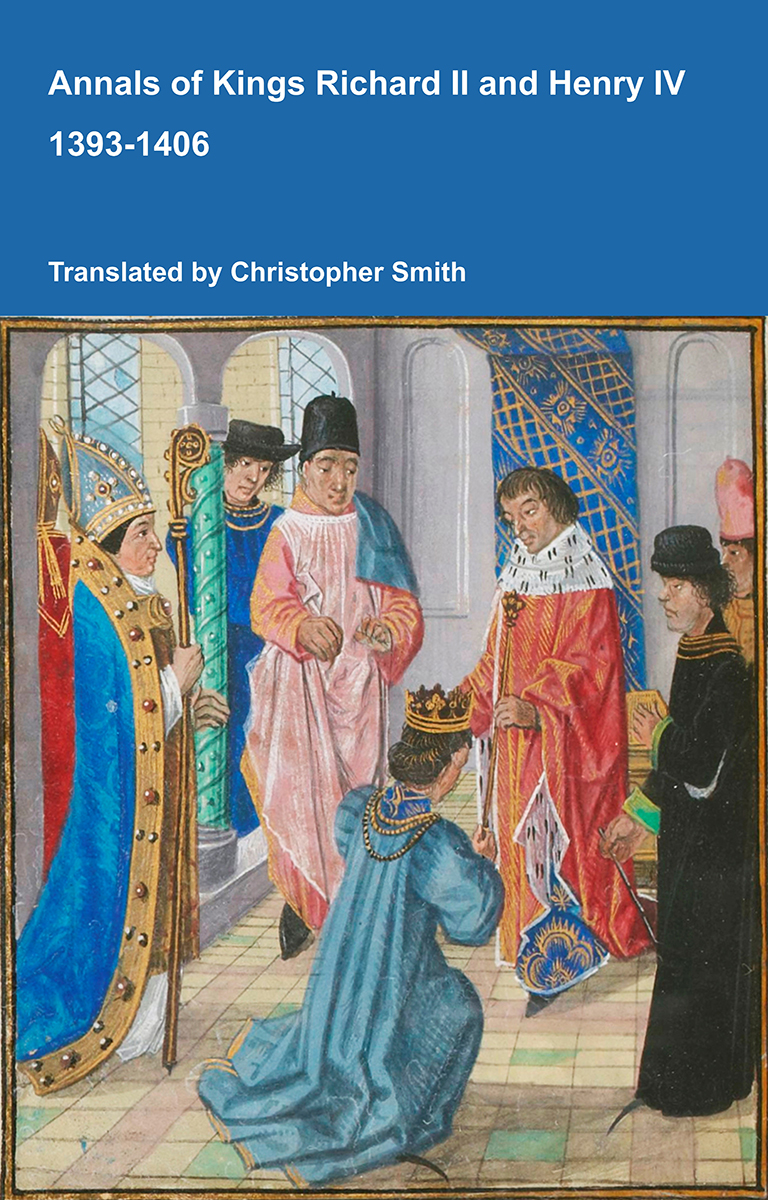
Annals of Kings Richard II and Henry IV 1393-1406
The Annals of Kings Richard II and Henry IV offers a vivid contemporary account of one of the most turbulent periods in late medieval England. Covering the reigns of Richard II and Henry IV, the chronicle records royal ceremonies, political conflict, rebellion, war, taxation, religious controversy, executions, popular unrest and remarkable portents. Its pages include a detailed description of Richard II’s coronation, the fall and deposition of the king, Henry IV’s seizure of the throne, the Percy rebellion, the execution of Archbishop Richard Scrope, the campaigns of Owain Glyndŵr, and England’s relations with Scotland, France, Portugal and Scandinavia. Alongside affairs of state, the annalist preserves reports of miracles, eclipses, prophecies, supernatural events and the experiences of ordinary townspeople, clergy, soldiers and travellers. Written from a monastic perspective, the work combines political observation with moral judgement, presenting victories and disasters as evidence of divine favour or punishment. At once a historical record and a reflection of medieval belief, the Annals provides an invaluable window into the challenges, ceremonies and conflicts of England at the turn of the fifteenth century.
Available at Amazon in eBook and Paperback format.
 Catesby Arms. Argent, two lions passant sable crowned or. Source.
 West Arms. Argent, a fess dancetté sable. Source.
 Delves Arms. Argent, a chevron gules fretty or between three delves sable. Source.
 Baron Annaly Arms. Argent, on a chevron engrailed gules, between three roses of the last, a cross crosslet or. Source.
 Duke Montrose Arms. Quarterly, 1&4
  Graham Arms 2&3 Argent three roses gules barbed and seeded proper (Montrose).
 Wingfield Arms. Argent, a bend gules three wings conjoined in lure of the field. Source.
 Eyre Arms. Argent, a chevron gules.
 Keilway Arms. Argent, two grozing irons in saltire sable between four Kelway pears proper. An example of Canting arms Kelway Pear = Keilway. Source
NO IMAGE. Argent, a cross moline sable.
 Woodville Arms. Argent, a fess and a canton conjoined gules. Source.
 Worsley Arms. Argent, a chief gules. Source.
Annals of the six Kings of England by Nicholas Trivet
Translation of the Annals of the Six Kings of England by that traces the rise and rule of the Angevin aka Plantagenet dynasty from the mid-12th to early 14th century. Written by the Dominican scholar Nicholas Trivet, the work offers a vivid account of English history from the reign of King Stephen through to the death of King Edward I, blending political narrative with moral reflection. Covering the reigns of six monarchs—from Stephen to Edward I—the chronicle explores royal authority, rebellion, war, and the shifting balance between crown, church, and nobility. Trivet provides detailed insight into defining moments such as baronial conflicts, Anglo-French rivalry, and the consolidation of royal power under Edward I, whose reign he describes with particular immediacy. The Annals combines careful year-by-year reporting with thoughtful interpretation, presenting history not merely as a sequence of events but as a moral and political lesson. Ideal for readers interested in medieval history, kingship, and the origins of the English state, this chronicle remains a valuable and accessible window into the turbulent world of the Plantagenet kings.
Available at Amazon in eBook and Paperback format.
 Wotton Arms. Argent, a saltire engrailed sable. Source.
 Bowes Lyon Arms. Quarterly 1&4 Argent a lion rampant azure, armed and langued gules within a double tressure flory counter-flory of the second (for Lyon); 2&3 ermine three bows stringed palewise in fess proper (for Bowes).


.svg)


.svg)


.svg)


#/media/File:Arms_of_Cockayne.svg)

.svg)

#/media/File:Craven_arms.svg)



.svg)


#/media/File:Blason_Thomas_Le_Despencer.svg)


_Arms.png)
.svg)
.svg)

.svg)

.svg)


.svg)


#/media/File:Southwell_OfWoodrisingNorfolk_Arms.svg)



#/media/File%3AClement_OfIghtham_Arms_(Bordure_OrAndAzure).svg)


#/media/File:HampdenArms.svg)


.svg)


#/media/File:Vernon_of_Haddon_arms.svg)

#/media/File:Hastings.svg)


