

Paternal Family Tree: Melton
Around 1275 Archbishop William Melton was born to Nicholas Melton [aged 25] in Melton Welton.
In 1307 Archbishop William Melton [aged 32] was appointed Controller of the Wardrobe.
Close Rolls Edward II 1307-1313. 8th January 1308 King Edward II of England [aged 23] To the Sheriff of Leicester. Order to cause a coroner for that county to be elected in place of John de Noveray, of Burton, lately elected in the late King's reign, who is insufficiently qualified.
Memorandum, that on Sunday before the Feast of St Vincent the Martyr [22 Jan], at Dover, Kent [Map] in the King's chamber in the Priory of St Martin, Dover [Map], in the evening (crepsusculo noctis), in the presence of William Inge, knight, William de Melton and Adam de Osgoodby, clerks, Bishop John Langton, the King's Chancellor, delivered under his seal to the said King his great seal; and the King received the said seal in his own hands, and delivered it to Sir William Melton [aged 33] to be carried with him in the wardrobe beyond sea; and the King straightaway delivered by his own hand another seal of his shortly before made anew at London for the government of the realm in the King's absence in a red bag (bursa) sealed with the seal of William Inge to the chancellor. With which seal the chancellor caused writs to be sealed, after the King's passage, in the hospital of Domus Dei, under the testimony of Piers Gaveston 1st Earl Cornwall [aged 24] then Keeper of the realm of England, on the Monday next following, on which day the King in the early morning (summo mane) passed the sea at Dover, Kent [Map].
Fine Rolls. On 7th February 1308 King Edward II of England [aged 23] and Isabella of France Queen Consort England [aged 13] returned from their wedding in Boulogne sur Mer [Map] to Dover, Kent [Map].
7th February 1308. Be it remembered that on Wednesday after the Purification, Edward II, the king, returning from beyond seas, to wit, from Boulogne sur Mer [Map], where he took to wife Isabel, daughter of the king of France [aged 39], touched at Dover, Kent [Map] in his barge about the ninth hour [1500], Hugh le Despenser [aged 46] and the lord of Castellione of Gascony being in his company, and the Queen a little afterward touched there with certain ladies accompanying her, and because the great seal which had been taken with him beyond seas then remained in the keeping of the keeper of the wardrobe who could not arrive on that day, no writ was sealed from the hour of the king's coming until Friday following on which day the bishop of Chichester, chancellor, about the ninth hour [1500] delivered to the king in his chamber in Dover castle [Map] the seal used in England during the king's absence, and the king, receiving the same, delivered it to William de Melton [aged 33], controller of the wardrobe, and forthwith delivered with his own hand to the chancellor the great seal under the seal of J. de Benstede, keeper of the wardrobe, and Master John Painter Fraunceis, in the presence of Thomas, Earl of Lancaster [aged 30], Peter, Earl of Cornwall [aged 24], and Hugh le Despenser, William Martyn and William Inge, knights, and Adam de Osgodby, clerk; and the chancellor on that day after lunch in his room (hospicio) in God's House, Dover, sealed writs with the great seal.
In January 1315 Archbishop William Melton [aged 40] was elected Archbishop of York.
In September 1317 Archbishop William Melton [aged 42] was consecrated Archbishop of York at Avignon [Map] by Pope John XII.
On 17th September 1318 Archbishop William Melton [aged 43] was enthroned as Archbishop of York.
Life of Edward II of Carnarvan by a Monk of Bridlington. Likewise, in the same year, around the feast of All Saints [1st November], William Melton returned from the papal court, having been confirmed as Archbishop of York. On the Sunday [17th September 1318] immediately before the feast of Saint Matthew the Apostle and Evangelist, he was solemnly enthroned in the great church of Saint Peter at York.
Item codem anno, circa festum Omnium Sanctorum, dominus Willelmus de Meletone in archiepiscopum Eboracensem de curia rediit confirmatus; et, die Dominica proxima ante festum Sancti Mathæi apostoli et evangelistæ, in majori ecclesia beati Petri Eboraci fuit solemniter intronisatus.
On 24th January 1328 King Edward III of England [aged 15] and Philippa of Hainaut [aged 17] were married at York Minster [Map] by Archbishop William Melton [aged 53]. She by marriage Queen Consort England. She was crowned the same day. She the daughter of William of Avesnes I Count Hainaut III Count Avesnes III Count Holland II Count Zeeland [aged 42] and Joan Valois Countess Zeeland Holland Avesnes and Hainaut [aged 34]. He the son of King Edward II of England and Isabella of France Queen Consort England [aged 33]. They were second cousins. She a great x 5 granddaughter of King Stephen I England.
The marriage was the quid pro quo for her father William of Avesnes I Count Hainaut III Count Avesnes III Count Holland II Count Zeeland having supported his mother Isabella of France Queen Consort England and Roger Mortimer 1st Earl March [aged 40] returning to England to usurp the throne of Edward's father King Edward II of England.
In 1330 Archbishop William Melton [aged 55] was appointed Lord High Treasurer.
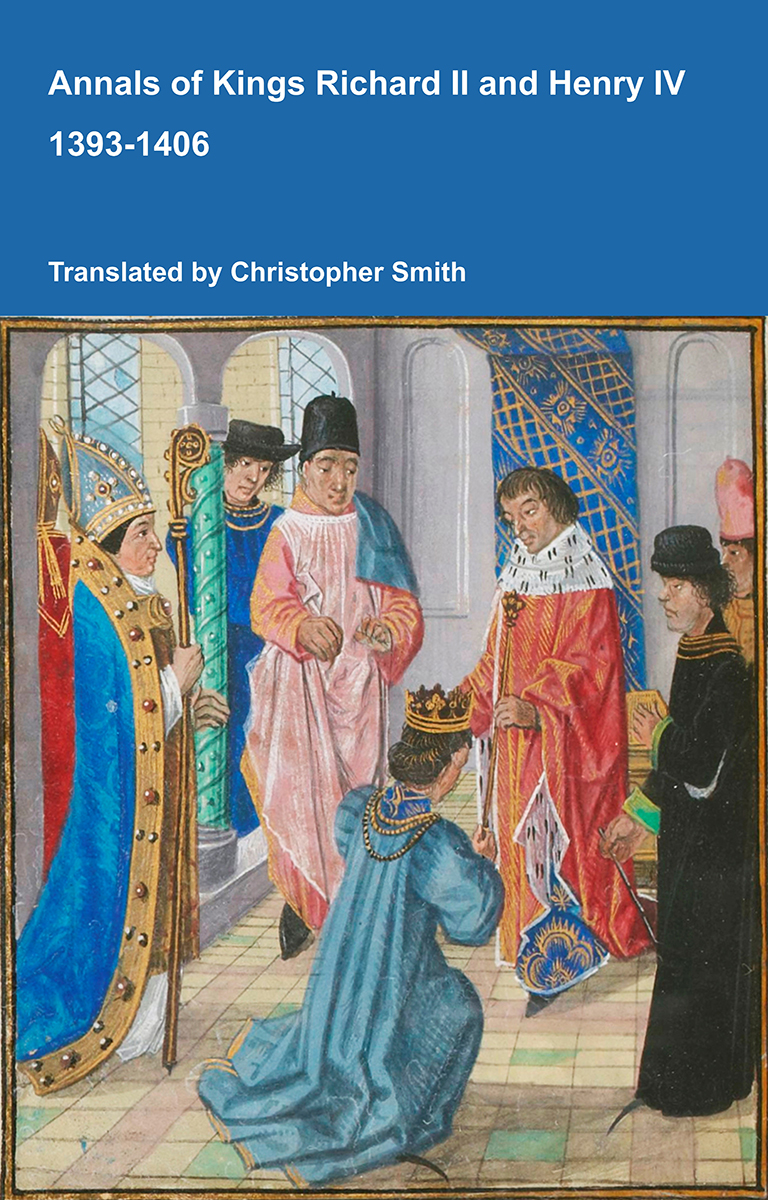
Annals of Kings Richard II and Henry IV 1393-1406
The Annals of Kings Richard II and Henry IV offers a vivid contemporary account of one of the most turbulent periods in late medieval England. Covering the reigns of Richard II and Henry IV, the chronicle records royal ceremonies, political conflict, rebellion, war, taxation, religious controversy, executions, popular unrest and remarkable portents. Its pages include a detailed description of Richard II’s coronation, the fall and deposition of the king, Henry IV’s seizure of the throne, the Percy rebellion, the execution of Archbishop Richard Scrope, the campaigns of Owain Glyndŵr, and England’s relations with Scotland, France, Portugal and Scandinavia. Alongside affairs of state, the annalist preserves reports of miracles, eclipses, prophecies, supernatural events and the experiences of ordinary townspeople, clergy, soldiers and travellers. Written from a monastic perspective, the work combines political observation with moral judgement, presenting victories and disasters as evidence of divine favour or punishment. At once a historical record and a reflection of medieval belief, the Annals provides an invaluable window into the challenges, ceremonies and conflicts of England at the turn of the fifteenth century.
Available at Amazon in eBook and Paperback format.
In 1330 [his father] Nicholas Melton [aged 80] died.
On 5th April 1340 Archbishop William Melton [aged 65] died at Cawood Palace [Map].
 Adam Murimuth Continuation. Also in that year, in [5th] April 1340, William Melton [aged 65], archbishop of York, died; and afterwards two were elected in dispute, namely William la Zouche and William Killesby.
Hoc anno Domini MCCCXL, mense Aprilis, moritur Willelmus de Meltone, archiepiscopus Eboracensis, et postea eliguntur duo in discordia, scilicet Willelmus la Zouche et Willelmus de Killesby.
Life of Edward II of Carnarvan by a Monk of Bridlington. Likewise, on the feast of Saint Nicholas [6th December], William Greenfield, Archbishop of York, departed this mortal life. He was buried on the feast of Saint Lucy the Virgin [13th December] in the great church of Saint Peter at York. Likewise, on the feast of Saint Agnes the Virgin [21st January 1316], William Melton, then Provost of Beverley, was elected Archbishop of York. Having been presented to and accepted by the King, he remained at the papal court for almost two years before he was consecrated. In the year of Our Lord 1317, he returned from the court around the feast of All Saints.
Item dominus Willelmus de Grenefelde, archiepiscopus Eboracensis, die Sancti Nicholai viam carnis generalem est ingressus, et in majori ecclesia beati Petri Eboraci die Sanctæ Luciæ virginis est sepultus. Item die Sanctæ Agnetis virginis Willelmus de Meltone, tuncpræpositus Beverlaci, in archiepiscopum Eboraci est electus, dominoque regi præsentatus et acceptus traxit moram in curia fere per duos annos antequam fuerat consecratus; qui anno Domini MCCCXVII rediit de curia circa festum Omnium Sanctorum.