All About History Books on Amazon

Annals of Kings Richard II and Henry IV 1393-1406

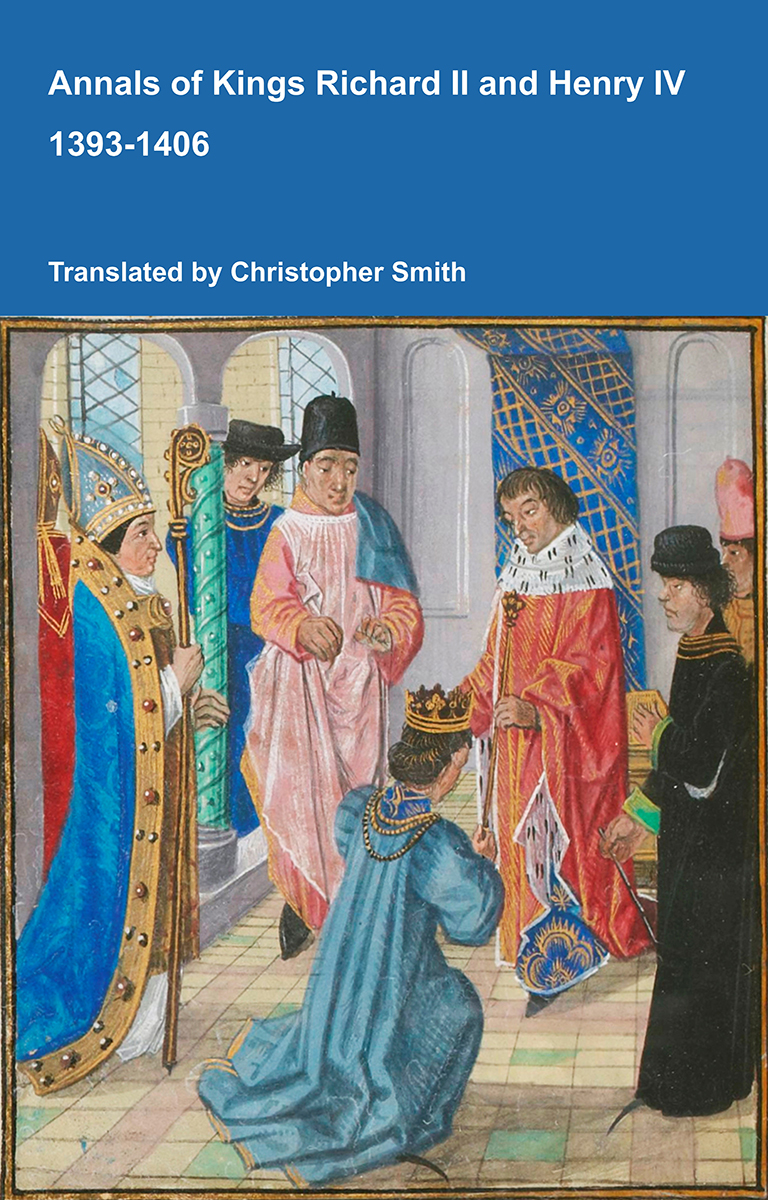
The Annals of Kings Richard II and Henry IV offers a vivid contemporary account of one of the most turbulent periods in late medieval England. Covering the reigns of Richard II and Henry IV, the chronicle records royal ceremonies, political conflict, rebellion, war, taxation, religious controversy, executions, popular unrest and remarkable portents. Its pages include a detailed description of Richard II’s coronation, the fall and deposition of the king, Henry IV’s seizure of the throne, the Percy rebellion, the execution of Archbishop Richard Scrope, the campaigns of Owain Glyndŵr, and England’s relations with Scotland, France, Portugal and Scandinavia. Alongside affairs of state, the annalist preserves reports of miracles, eclipses, prophecies, supernatural events and the experiences of ordinary townspeople, clergy, soldiers and travellers. Written from a monastic perspective, the work combines political observation with moral judgement, presenting victories and disasters as evidence of divine favour or punishment. At once a historical record and a reflection of medieval belief, the Annals provides an invaluable window into the challenges, ceremonies and conflicts of England at the turn of the fifteenth century.

Available at Amazon in eBook and Paperback format.

Nicholson's Cambrian Guide

Nicholson's Cambrian Guide is in Georgian Books.

At a little distance is a large Carnedd [Plas Newydd Burial Chamber [Map]]; which once covered a space of ground 142 yards in circumference, raised into a pyramid with stones, nearly the same size, thrown promiscuously together and mixed with soil to favour the growth of trees on the surface. One of it's recent proprietors, supposing this mound a mere heap of rubbish, began to level it, but meeting with human bones the workmen were ordered to desist. The present state of the Carnedd is a bank about 90 yards in circumference, and 14 feet high, composed of stones covered with grass, and here and there a tree. This bank is also sloped down on the inside, in the form of a bowl or dish. At the bottom of this hollow lies a flat stone, 6 feet square, which, supported at one end and two sides by other upright stones, leaves an opening into which a man might creep. At the far end is another stone, which lies in the same state, but is only about 4 feet square. At six yards distance, are some other parts.

Two hundred yards N. of this carnedd [Plas Newydd Burial Chamber [Map]], and the same distance from the Menai, stands the completest Cromlech in Anglesea, perhaps in Britain. The cap stone of this ancient british monument is 12 feet long in the centre, and 10 broad. On one side it is 12½ feet long, and only 8 on the other. A corner seems always to have been wanting. The head or upper end of this stoné, which lies flat, and points towards the E., is, in the thickest part, 4½ feet, and the otherend 3½. This ponderous weight was supported by 7 upright stones, 4 feet high, or rather the irregular points of 7, but two of them have fallen. One lies within and the other is in an inclined position near the foot. It may give an idea of this druidic erection,which has weathered out more than 2000 years, to suppose it the inside of a small room, 4 feet high, and 6 wide, supported by five stones. As the Cromlech stands on the declivity of an eminence, the cap-stone, on one side, is only 2 feet from the ground, that ground being also a little elevated, but on the other side 4 feet. Eleven inches from the lower end stands a much smaller Cromlech. ¢

November 1777. Mr. Wyndham says that in the beginning of November 1777, there was accidentally discovered, at the hamlet of Brynkelly [Bryn Celli Ddu Burial Mound [Map]], between Plas Newydd and Moel y Bon ferry, a subterraneous gallery, 18 feet in length, 3 in breadth, and 6 in height, This led to a chamber of the same height, covered with a stone 12 feet long and 9 wide. A small round pillar, seemed to afford some support to this stone from the centre of the room. Many human bones were upon the floor, which mouldered into dust on being touched.