
New York Times is in Newspapers.
28th October 1892. A BALTIMORE GIRL ENGAGED. LONDON, Oct. 28. — The Telegraph this morning announces that marriage has been arranged between Sir Philip Henry Brian Grey Egerton [aged 28] and Miss Cuyler of Baltimore [aged 20], Md.
The wedding, it is said, will take place early next year.
4th January 1893. MISS CUYLER'S WEDDING.
ARRANGEMENTS FOR CEREMONY TO-DAY IN LONDON. LONDON. Jan. 3. The whole American colony is astir with preparatfons for the wedding of Miss Wayne Cuyler [aged 21] of Baltimore and Sir Philip Henry Brian Grey-Egerton [aged 28]. The ceremony will take place to-morrow afternoon in St Peter's Church, Eaton Square. The Rev. William Egerton, the Rev. George Egerton, and the Vicar of St. Peter's will officiate. The service will be full choral. The altar, choir loft, and body of the church have been decorated elaborately with flowere to-day.
The best man will be Lord Grosvenor. The bride will be attended by three young girls, Misses Cornwallis, Corbet, and Egerton, and will be given away by Henry White, the United States Chargé d'Affaires in London. Her gown is heavy white satin, with a Watteau train, bordered with orange blossoms, Empire girdle, and Empress Josephine sleeves embroidered white crystals pearls. The Empire scarf of old point which she will wear is a present from the bride'e aunt. Her [?] and the bottom of the skirt will bé trimmed with long sprays of orange blossoms. Her tulle veil will be fastened with a diamond star, the glft or her grandmother, Mrs. Holton, and diamond butterfly. The bridal wreath will be of natural orange blossoms. The pearl-and-diamond necklace and the bracelet which Miss Cuyler will wear are presents from Sir Philip.
Among the 150 wedding presents many pieces of superb jewelry. Mrs. Cuyler's gift is a diamond tiara; Lady Selkirk, aunt of the groom, has given a diamond-and-sapphire bracelet; Col. Egerton, diamond-and-ruby necklace ana tiara; the groom's tenants, diamond tiara. In acknowledgment ot the thoughtfulness of his tenants Sir Philip has given to the village churoh a peal of bells, each inscribed with the date of the wedding. Sir Phllip ønd Lady Egerton will pass their honeymoon on the Riviera.
MARRIED TO AN EARL.
Miss Adele Grant or New-York Becomes the Countess of Essex.
LONDON, Dec. 14 [1893].—The marriage of Miss Adele Grant [aged 27], daughter of the late Beach Grant of New-York, to the Earl of Essex [aged 36] took place at 2:30 0'clock this afternoon at St. Margaret's Church, Westminster [Map]. Archdeacon Farrar [aged 62], assisted by the Rev. Mr. Lee, the Rev. Mr. James, and the Chaplain of the Duke of Essex, the Rev. George Chapel, officiated.
The bride wore a white satin dress, the train of which was embroidered with silver sunrays. The bodice was trimmed with point d'Alençon lace. The bridal veil was of Alençon lace, which the bride's mother wore at her wedding. The only ornament worn by the bride was a diamond tiara, the gift of the Earl of Essex. Instead of a bouquet, she carried an ivory Prayer Book.
There were seven bridesmaids. Those were Edythe Grant, Alberta Paget, Mary Colebrooke, Diana Sturt, the Hon. Eustace Daunay, the Hon. Leila Daunay, and Gwenfra Williams. They wore white satin dresses, draped in soft folds and bordered with mink, and velvet toques trimmed with fur. Each of them carried a long Louis XV. stick, with a gold tip, decorated with roses, the gift of the Earl of Essex. Baron Tuyll was the best man. Suydam Grant, a brother [a mistake for uncle] of the bride, gave her away. The service was full choral. Sir Arthur Sullivan presided at the organ. The floral decorations were extensive and rich.
After the ceremony, a reception was given at the residence of Mrs. Grant, 35 Great Cumberland Place. It was largely attended. In the early afternoon, the newly-married couple departed for their honeymoon, which will be spent at Cassiobury, Watford.
Over 300 presents were received, many of which came from the United States and the Continent.

13th November 1904. VAL PRINSEP [deceased], R. A., DEAD. Well-Known English Artist Was Born in India in 1838.
LONDON, Nov. 12.—Valantine Cameron Prinsep, R. A., better known as Val Prinsep, Professor of Painting to the Royal Academy, died yesterday from the effects of an operation.
It was thought in 1896 that Val Prinsep would be elected President of the Royal Academy, but Sir Edward Poynter was [aged 68] the successful candidate.
Mr. Prinsep was born in India in 1838. but was educated in England, returning to the land of his birth in 1876 to paint what is perhaps his best-known work, the "Declaration of the Queen as Empress" at the famous Delhi Durbar. A pupil of Watts and Gleyre, Prinsep exhibited his first picture at the Academy in 1862, when he was twenty-four years old. He achieved rapid success and became an A. R. A. in and an R. A. in 1894. He was an author and playwright as well as a painter.
Mr. Prinsep married a daughter [Florence Leyland [aged 45]] of the late F. R. Leyland, the patron of Whistler and Rossetti. When Mr. Leyland died there was a good deal of criticism of the Prinseps because the "Peacock Room" in his London house was not preserved where the public could see it. This work of Whistler, who was a fellow-pupil of Prinsep under Gleyre, has recently been bought by an American.


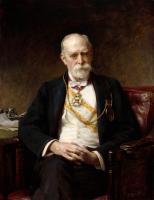


July 28, 1907. $240,000 INCOME; BANKRUPT.; Amazing Financial Career of Sir Humphrey De Trafford.
LONDON, July 27.-Sir Humphrey Francis De Trafford, Bart., who, with his beautiful wife [Violet Franklin Lady de Trafford], is a well-known figure in the cosmopolitan society of Europe, has had a remarkable financial career, which has now landed him in the Bankruptcy Court.
At the age of 24, in 1886, the Baronet inherited an estate with a gross annual income of nearly $350,000, subject to certain jointures which still left the De Trafford income $240,000 a year. However, he got into debt and contract-ed loans with the result that in 1890 he owed over $500,000. His indebtedness continued to increase until, in 1904, there were creditors holding charges on his life interest to the value of $2,300,000, while an additional $200,000 was owing to unsecured creditors.
Although Sir Humphrey was receiving out of the De Trafford estate $240,000 a year, he was paying out of that $110,000 a year for interest on loans and $125,000 in premiums on life insurance policies; this left him only $5,000 a year with which to keep up establishments in Berkeley Square and Market Harboro and educate his children.
A special act of Parliament was passed in 1904 to help him out of his difficulties, but since then he again got into debt, which has resulted in the present bankruptcy proceedings.
When asked how he came to get through such a vast sum as $2,500,000 in eighteen years, Sir Humphrey admitted that he had lost large amounts in betting and had to have recourse to money lenders, to one of whom he paid 15 per cent. interest. The Baronet said that the De Trafford estates, which were mainly in Manchester, were increasing greatly in value and he was prepared to pay his creditors 20s. in the pound.
19th May 1910. DE CRESPIGNY A SUICIDE.
British Officer Who Recently Played Polo in America Self-Slain.
Special Cable to the New York Trans.
LONDON, May 18. Capt. Claude Champion De Crespigny [deceased]; D. S. O., who was recently in New. York, where he had many friends, was found dead today, by the roadside at Kingscliffe, Northamptonshire. He was shot through the head, and a revolver was in his hand.
Capt. Champion De Crespigny arrived at Kingscliffe Station from London at 10:30 last night and set oùt to walk In the direction of Apethorpe Hall, the residence of Leonard Brassey [aged 40] and Lady Violet Brassey [aged 38], where he had been an occasional visitor. At 5 o’clock this morning a workman came across his body.
The dead officer was the eldest son and heir of Sir Claude Champion De Crespigny, the well-KInown sportsman, of whom ft has been said that he can ‘hunt like a hound, swim like a fish, run like à hare, and box like Jeffries.
Capt. Champion De Crespigny was in the Second Life Guards.
Capt. Claude Champion De Crespigny wvas a member of the Hurlingsham Club polo team that recently visited the United States.
The Captain was 37 years of age. He served with the British Army in South Africa in 1899 and 1900, and with the West African frontier force in 1903. He wass twice wounded, and was twice recommended by his commanding officers for the Victoria Cross because of deeds of conspicuous gallantry.
Capt. Champion De Crespigny was made a member of the Distinguished Service Order in 1900, and in that year became an aid de camp to the Viceroy of India, returning to England in 1002. He was educated at Eon, and entered the army in 1895.
The Champion De Crespignys are a very old Norman family who fought in the first crusade under St. Louis and took the name "Champion"' from ths circumstance that the head of the family was hereditary champion of the Dukes of Normandy and Brittany.
Claude Chammplon De Crespigny, Escuier, Sieur De Crespigny, was an officer of high rank in the French army, but after the revocation of the Edict of Nantes went with all his family to England, where he was received by the Pierponts, being alllied bv marriage with that noble house. He obtained a Colonel’s commission in the Englisn army. His great-grandson was created a baronet In 1800 after receiving the Prince Regent at his home, Champion Lodge.
The present baronet, Sir Ciaude Champion De Chespigny, has five sons, each of whom is named Claude. Capt. De Crespigny, who has committed suicide, bore no other Christian name, while each of the others has two Christian names. The heir is now Claude Raoul Champion De Crespigny [aged 32], an officer of the Grenadier Guards.
Suicide Had Been Named as Correspondent in a Divorce Suit. 20th May 1910.
RESPONDENT AN AMERICAN
Story Hushed Up at Inquest on British Captain, and Verdict of Suicide. While Temporarily Insane ls Returned.
Special Cable to the NEW YORK TIMES.
LONDON, May 19. Behind the death of Capt. Claude Champion De Crespigny [deceased], who committed suicide yesterday, is a story of infatuation for a prominent young American woman, who. since her marrriage two years ago, has been living here, where she is well known and extremely popular.
For some time past there had been a good deal of gossip concerning the evident strong attachment between the unfortunate officer and the young woman in question, the culmination being reached a few days since, when Capt. Champion De Crespigny is understood to have been served with papers in a divorce suit brought by the husband of the woman, in which Capt. De Crespigny was named as co-respondent. The latter was a man of highly strung. temperament and took the matter very much to heart, and it is supposed that he believed the only possible chance .to save the woman’s name and honor was to commit suicide.
There was somè belief that the whole story would come out at the inquest, which was held to-night at Kingscliffe, but this was not the case. The jury's verdict was that the deceased shot himself while temporarily insane.
A physician testified that the Captain had suffered from infiuenza, which was very likely a cause of mental derangement.
Sir Claude Champion De Crespigny [aged 63], the father, said his son had suffered many severe falls in steeplechasing and polo, which might have caused temporary insanity. So far as he knew his son had nothing to trouble him. There had been no quarrels or family discord.
The Coroner, in summing up, said he felt confident that the shooting was a result of temporary derangement, explainable by illness, and especially by the deceased’s influenza, falls, and wounds.
6th July 1912. SALISBURY PLAIN, England, July 5. — Capt. E. B. Loraine [deceased] and Sergt. Major Wilson of the Army Flying Corps were killed this morning, while flying over the great military encampment here.
They were taking their usual early morning practice, and the aeroplane had reached a height of 400 feet, when the machine lost its balance, turned over and fell with a crash to the roadway.
Sergt. Major Wilson was killed Instantly, but Capt. Loraine lived a short time, although he was unconscious when picked up.
The two persons killed in England yesterday bring the list of victims of the aeroplane to 159. Five persons had previously been killed during the present 'week. On July 1 Miss Harriet Quimby and William A. P. Willard fell from a height of 1,000 feet Into Dorchester Bay; Benno Koenig, a German aviator, was killed at the start of the Northwest Aviation Circuit Race, and Capt. Boyvo of the Spanish army died of injuries received in a fall on June 29. Three days later Lieut. Caranda of the Roumanian army was killed by a fall at Budapest.
Besides these victims of the aeroplane, there was the death of Melvin Vaniman and his four companions, who were killed by the bursting of Vaniman's dirigible Akron at Atlantic City on July 2, and two days later 'Tom' Moore, a professional balloonist, plunged to death at Hillslide Park, Belleville, N. J., when his parachute failed to open.
This double fatality is the sixteenth during the four years of aviation.
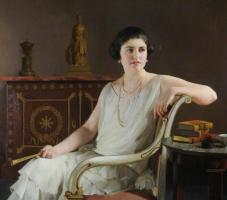
Peer To Marry Heiress.
26th May 1914. Lord Lisburne to Wed Miss Bittencourt of Rich Chilean Family. Special Cable to THE NEW YORK TIMEs. LONDON, May 26.—One of the most interesting engagements of the London season is announced today. It is between the young Earl of Lisburne [aged 22] and Miss Bittencourt, daughter of Jules Bittencourt, an attaché of the Chilean Legation here. Lord Lisburne is 22 years old and a Lieutenant in the Scots Guards. He is the owner of 42,000 acres in Wales. which have been in the possession of his family since 1200, an unaparalleled record of undisturbed possession. His fiancée belongs to one of the wealthiest families of Chile. She already enjoys an income of $60,000 in her own right, and has prospects of inheriting several millions.
DUCHESS [aged 42] MARRIED TO ARMY AVIATOR. Former Wife of Duke of Westminster Got Absolute Divorce Last Month.
ROMANCE OF WAR HOSPITAL. Bride Is Daughter of Col. Cornwallis West and Married the Duke. in 1901.
Special Cable to The New York Times.
LONDON, Jan. 23 [1920]—A society romance is revealed by the marriage of the Duchess of Wesiminster to Captain James Fitzpatrick Lewis, late of the Royal Air Force. The wedding took place at the Registry Office at Lyndhurst, where the Duchess has a country residence, on Jan. 14, a maid being the only witness.
Only a limited circle of intimate friends knew the marriage was to take place, and the actual ceremony was as secret as could be arranged. It was the Duchess’s wish that no announcement should be made until after she and her husband left for the Continent, where they are visiting her mother, Mrs. Cornwailis-West.
It was early in the war that Lewis first met the Duchess. He was then in the Royal Flying Corps, stationed near le Touquet, close to the hospital established by the Duchess. Early acquaintance ripened into deep friendship, and when the Captain was demobilized he became private secretary and agent of the Duchess. News of their marriage will be no surprise to their intimate friends. Lewis is about 30 years of age, a keen sportsman, and before the war was in business in London.
The Duchess obtained a divorce from the Duke [aged 40] last June, the decree being made absolute Dec. 19 last. An extraordinary story of domestic unhappiness was revealed at the hearing of the case. The Duchess said it was in 1909 that her relations with the Duke first became unhappy. In the three years which followed she continued to occupy the same house, but they lived almost entirely separate lives. Then the Duke ceased to live with the Duchess and in spite of her repeated requests to him to return "for the children's sake if not for your own and mine."
He refused to come back and the Duchess finally instituted proceedines for divorce. Three children were born to the Duke and the Duchess. The son and heir died at the age of 5, in 1909. King Edward being godfather. Two daughters are Lady Ursula Grosvenor and Lady Mary Grosvenor.
The Duchess rendered hospital service in the war which earned mention in dispatches.
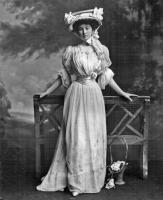
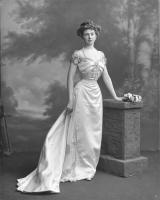


29th July 1922. Obituary. New York Times.
Former Adele Grant of New York Stricken With Heart Attack After Dinner Party.
TRIED TO SUMMON HELP
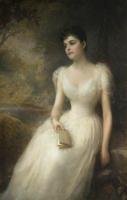
Dowager, Once Famous Beauty, Was Model for Herkomer's "A Lady in White." [Note. This appears to be a mistake - A Lady in White]
1922 by The New York Times Company. By Wireless to The New York Times.
London, July 28. Dowager Countess Essex [deceased], who was the daughter of the late Beach Grant of New York and the second wife of the Seventh Earl of Essex, was found dead in her bath today at her home, 72 Brook Street, by one of her maids.
Lady Essex attended last night a dinner party given by the Hon. Mrs. Rupert Beckett and appeared in the best of spirits. She was driven home by Mrs. Asquith, with whom she was to have lunched today.
Apparently she took her bath before going to bed and had the seizure. She seemed to have endeavored to get help as the hanging electric bell push had been pulled into the bath. The tragedy was not discovered until this morning when Lady Essex's maid found her bed had not been slept in.
The bath room door was locked and the electric lights were full on. When the door was forced Lady Essex was found dead. She had suffered for years from a weak heart and it is presumed that she had the seizure when she could not help herself.
In her prime Lady Essex was famed for her beauty, being tall and graceful, with soft eyes and dark hair. Indeed she belonged to the group that was playfully christened "Lovely Five" and included Lady Warwick [aged 60], Lady Lytton [aged 80], Lady Westmoreland and the Duchess of Sutherland [aged 54]. She was the model for Herkomer's famous picture "A Lady in White."
A coroner's inquest into Lady Essex's death will be held on Monday.
Adele Grant. daughter of the late Beach Grant of this city, was married to the seventh Earl of Essex in St. Margaret's Church, Westminster [Map], Dec. 14 1893. Archdeacon Farrar performed the ceremony, the occasion being one of the brilliant social events of that Winter in London. There have been two children, Lady Iris Mary [aged 27] and Lady Joan Rachel [aged 23], respectively 26 and 22 years old. Presumably they will share their mother's fortune, which is not inconsiderable since her inheritance in 1915 of some $600,000 from her uncle, R. Suydam Grant, of the New York Stock Exchange.
Her husband was a widower when she married him. The present Earl [aged 38], son of his father's first marriage, did not have sufficient income to keep up the magnificent ancestral estate of Cassiobury Park, and last Fall it was offered for sale. On previous occasions it had been rented to Americans, among others to Otto H. Kahn.
An anecdote of the family that reveals the firmness of the Countess is that of her refusal of the tempting offers repeatedly made to her by Lady Meux, widow of Sir Henry Meux, the wealthy brewer. The story has it that Lady Meux, originally a "queen of burlesque" and aunt by marriage of the Earl of Essex, offered to make the Earl her heir if only the Countess would introduce her to society. But the Countess did not allow her thorough disapproval of the brewer's widow to be overcome by the bribe.
Before her marriage Adele Grant had been engaged to the late Earl Cairns, the unfortunate man who acquired the nickname of "Gumboil," thanks to his courtesy title of Lord Garmoyle. She broke off the match on the eve of the wedding owing to the prospective bridegrooms extortionate demands for a settlement. And, in 1920, after the death of her husband, she was reported, not on the highest authority, however, to be engaged to the Duke of Connaught [aged 72], brother of Edward Vll. The affair progressed no further than the circulation of the report.
During the World War the Countess did much relief work, serving with Queen Mary's Needlework Guild, on the Urban Executive Committee of the Urban Council for War Relief, and also as President of the Soldiers and Sailors Families' Association.