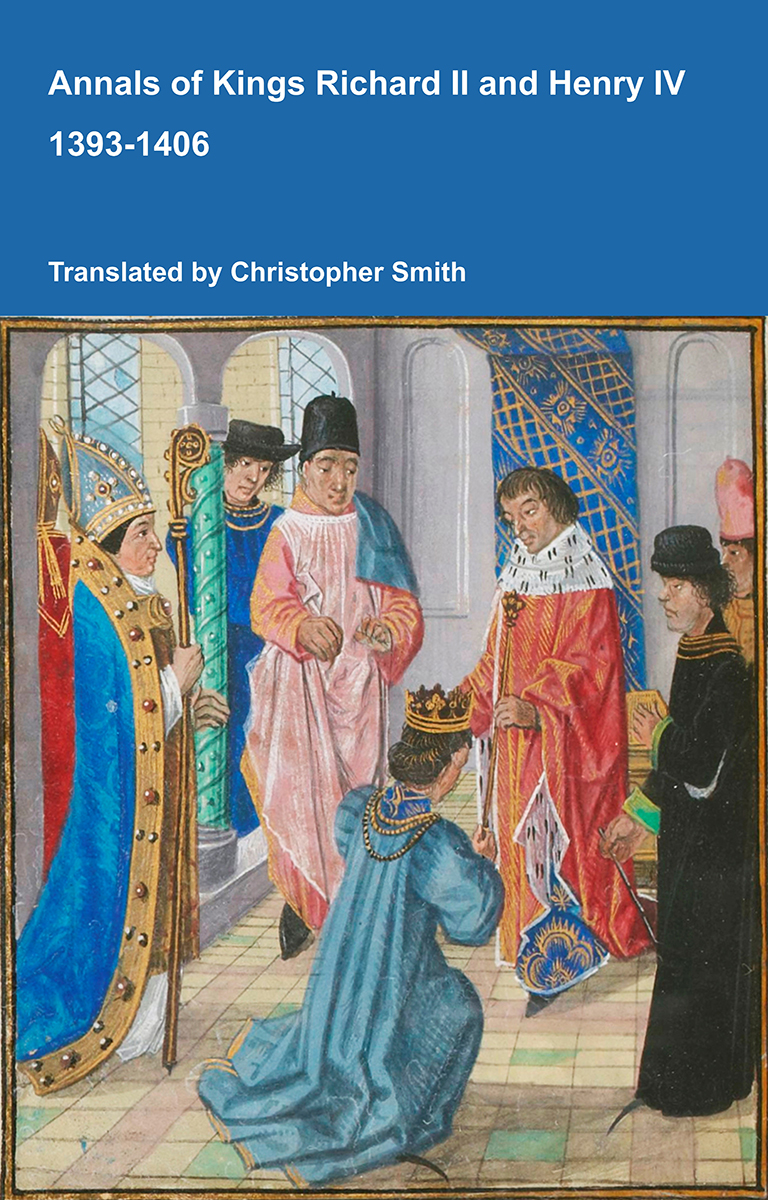
Annals of Kings Richard II and Henry IV 1393-1406
The Annals of Kings Richard II and Henry IV offers a vivid contemporary account of one of the most turbulent periods in late medieval England. Covering the reigns of Richard II and Henry IV, the chronicle records royal ceremonies, political conflict, rebellion, war, taxation, religious controversy, executions, popular unrest and remarkable portents. Its pages include a detailed description of Richard II’s coronation, the fall and deposition of the king, Henry IV’s seizure of the throne, the Percy rebellion, the execution of Archbishop Richard Scrope, the campaigns of Owain Glyndŵr, and England’s relations with Scotland, France, Portugal and Scandinavia. Alongside affairs of state, the annalist preserves reports of miracles, eclipses, prophecies, supernatural events and the experiences of ordinary townspeople, clergy, soldiers and travellers. Written from a monastic perspective, the work combines political observation with moral judgement, presenting victories and disasters as evidence of divine favour or punishment. At once a historical record and a reflection of medieval belief, the Annals provides an invaluable window into the challenges, ceremonies and conflicts of England at the turn of the fifteenth century.
Available at Amazon in eBook and Paperback format.

Criminal Trials in Scotland is in Tudor Books.
The King's anger still continued against them (the Douglasses) in such sort, that nine years after, in [17th July] 1537, he was contented that Jeane Douglas [aged 39] Lady Glumes, (who was Angus' Sister,) should be accused by false Witnesses, condemned, and execute. The point of her accusation was, that she, and her Husband, (Archibald Campbell then,) and her Sonne [aged 16], and an old Priest, had gone about to make away the King by Witchecraft. Their servants were tried and racked, but confessed nothing; the Accuser, John [William] Lyon a kinsman of her first husband, when he saw how they were like to be used, and that the House of Glames would be ruined, repenting of what he had done, confessed to the King that he had wronged them; but it did no good.
She was burnt upon the Castle-Hill, with great commiseration of the people, in regard of her noble bloud, of her husband, being in the prime of her years, of a singular beauty, and suffering all, though a woman, with a man-like courage; all men conceiving that it was not this fact, but the hatred the King carried to her brothers, that had brought her to this end. Her husband, seeking to escape over the wall of the Castle, fell, and broke his leg, and so died. Her sonne was kept in prison, because he was so young that the law could not strike against him.