Chronicle of the Abbey of Evesham
The Chronicle of the Abbey of Evesham is a remarkable medieval history of one of England’s great Benedictine monasteries. Beginning with the abbey’s legendary and royal foundations, it traces the fortunes of Evesham through centuries of religious devotion, political conflict, legal struggle, rebuilding, reform, and royal patronage. At the heart of the chronicle is the abbey’s determination to defend its ancient liberties. Its monks record disputes with bishops, appeals to popes and papal legates, contested elections of abbots, lawsuits over lands and privileges, and the long struggle to preserve Evesham’s exemption from episcopal control. Alongside these institutional battles are vivid accounts of saints and miracles, including St Ecgwine, St Odulf and the royal martyr St Wistan, whose relics and cult formed an important part of the abbey’s identity. The chronicle also preserves a wealth of detail about everyday monastic life. It describes the building and repair of churches, cloisters, chapels, halls, mills, granges and fishponds; the acquisition of estates and revenues; the making of vestments, shrines, bells and liturgical books; and the provision of food, clothing, recreation and medical care for the monks. Successive abbots emerge not merely as religious superiors but as administrators, builders, patrons, diplomats and defenders of the community. Extending into the later Middle Ages, the narrative reflects the changing political world around Evesham, from the Norman Conquest and the Angevin kings to the Wars of the Roses and the reign of Henry VIII. The result is both a history of a single monastery and a richly detailed record of medieval English religious, legal, economic and political life. This edition offers modern readers direct access to one of the most important monastic chronicles of medieval England, revealing how the monks of Evesham understood their saints, their privileges, their rulers and their place in history.
Available at Amazon in eBook and Paperback format.

St Mary's Abbey, York is in York [Map], Abbeys in England.
In 1055 St Mary's Abbey, York [Map] was founded. It was originally dedicated to Saint Olaf aka Olave. After the Norman Conquest the church came into the possession of the Anglo-Breton magnate Alan Rufus who granted the lands to Abbot Stephen and a group of monks from Whitby.
Chronicon ex Chronicis by Florence and John of Worcester. 1055. Siward [aged 45], earl of Northumberland, died at York, and was buried in the monastery at Galmanho [Map]72, which he had himself founded: his earldom was given to Tosti [aged 29], earl Harold's [aged 33] brother. Shortly afterwards, king Edward [aged 52], in a council held at London, banished earl Algar, earl Leofric's son, without any just cause of offence. Algar presently went to Ireland, and having collected eighteen pirate ships, returned with them to Wales, where he implored Griffyth the king to lend him his aid against king Edward. Griffyth immediately assembled a numerous army from all parts of his dominions, and directed Algar to join him and his army at a place appointed with his own troops; and having united their forces they entered Herefordshire, intending to lay waste the English marshes.
Note 72. An abbey at York, afterwards restored, and called St. Mary's [Map].
The abbey church of St Mary's Abbey, York [Map] was refounded in 1088 when King William "Rufus" II [aged 32], visited York in January or February of that year and gave the monks additional lands.
Chronicle of the Abbey of Evesham. After these things had been done, the lord legate came to us on the feast of Saints Fabian and Sebastian [20th January 1214] and advised us to elect that same prior [Randulf], saying that nothing in our petition prevented us from having him as abbot, since many of those among us of sounder judgement had already chosen him in the first examination. We therefore elected him, and the lord legate confirmed his election. We requested him from the chapter of Worcester, and he came to us on the feast of St Vincent [22nd January]. He was then sent by the lord legate, as Prior of Worcester, to the lord Archbishop of Canterbury to seek from him confirmation of the Bishop-elect of Worcester, and he obtained it. There was some murmuring there at the time because he did not seek confirmation of his own election, but when the reason was heard why the lord legate had confirmed him, the murmuring and complaint ceased. Afterwards, by command of the lord legate, he proceeded to York, and there the lord legate blessed him. After the blessing he placed the mitre upon his head, on the second Sunday [9th] of March, in the church of St Mary [Map]. That monastery had been so closely united with the monastery of Evesham from its foundation that they were regarded almost as one body and one church.
Quibus ita peractis venit ad nos dominus legatus in die sanctorum Fabiani et Sebastiani, et consuluit nobis ut eundem priorem eligeremus, dicens nihil obstare de petitione nostra quin illum haberemus abbatem quum etiam plurimi ex nobis sanioris consilii in prima examinatione illum elegissemus. Et elegimus eum, et dominus legatus confirmavit electionem ejus, et petivimus eum a capitulo Wigorniæ, et venit ad nos in die sancti Vincentii. Tunc missus est a domino legato ut prior Wigorniæ ad dominum Cantuariensem ut peteret ab eo confirmationem electi Wigornensis, et obtinuit. Factum est autem tunc ibi murmur eo quod non peteret propriæ electionis confirmationem, sed audita ratione quare dominus legatus eum confirmasset, cessavit murmur et querimonia. Deinde ex præcepto domini legati processit Eboracum, et benedixit ei ibidem dominus legatus, et post benedictionem imposuit mitram capiti ejus Dominica secunda mensis Martii in ecclesize sanctæ Mariæ, quod monasterium a fundatione sua ita confœderatum est monasterio Eveshamensi ut quasi unum corpus et una ecclesia reputentur.
On 9th March 1214 Abbot Randulf was blessed by the papal legate at St Mary's Abbey, York [Map].
1829. Frederick Nash [aged 47]. View of the Ruins adjoining the South Transept of the Church [St Mary's Abbey, York [Map]], with the Palace of K. James 2nd and the Tower of the Minster in the Back Ground.".
Around 1855. Benjamin Brecknell Turner [aged 40]. St Mary's Abbey, York [Map].
Before 1899. William Richardson [aged 84]. "St Mary's Abbey, York [Map]".
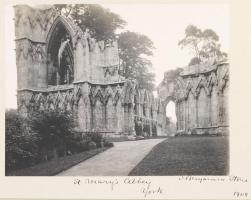
1908. John Benjamin Stone [aged 69]. Photograph of St Mary's Abbey, York [Map].