

The Blessed Damozel is in Poems by Dante Gabriel Rossetti.
The blessed damozel leaned out
From the gold bar of Heaven;
Her eyes were deeper than the depth
Of waters stilled at even;
She had three lilies in her hand,
And the stars in her hair were seven.
Her robe, ungirt from clasp to hem,
No wrought flowers did adorn,
But a white rose of Mary's gift,
For service meetly worn;
Her hair that lay along her back
Was yellow like ripe corn.
Herseemed she scarce had been a day
One of God's choristers;
The wonder was not yet quite gone
From that still look of hers;
Albeit, to them she left, her day
Had counted as ten years.
(To one, it is ten years of years.
. . Yet now, and in this place,
Surely she leaned o'er me — her hair
Fell all about my face. . .
Nothing: the autumn-fall of leaves.
The whole year sets apace.)
It was the rampart of God's house
That she was standing on;
By God built over the sheer depth
The which is Space begun;
So high, that looking downward thence
She scarce could see the sun.
It lies in Heaven, across the flood
Of ether, as a bridge.
Beneath, the tides of day and night
With flame and darkness ridge
The void, as low as where this earth
Spins like a fretful midge.
Around her, lovers, newly met
'Mid deathless love's acclaims,
Spoke evermore among themselves
Their heart-remembered names;
And the souls mounting up to God
Went by her like thin flames.
And still she bowed herself and stooped
Out of the circling charm;
Until her bosom must have made
The bar she leaned on warm,
And the lilies lay as if asleep
Along her bended arm.
From the fixed place of Heaven she saw
Time like a pulse shake fierce
Through all the worlds. Her gaze still strove
Within the gulf to pierce
Its path; and now she spoke as when
The stars sang in their spheres.

Anne Boleyn. Her Life as told by Lancelot de Carle's 1536 Letter.
In 1536, two weeks after the execution of Anne Boleyn, her brother George and four others, Lancelot du Carle, wrote an extraordinary letter that described Anne's life, and her trial and execution, to which he was a witness. This book presents a new translation of that letter, with additional material from other contemporary sources such as Letters, Hall's and Wriothesley's Chronicles, the pamphlets of Wynkyn the Worde, the Memorial of George Constantyne, the Portuguese Letter and the Baga de Secrets, all of which are provided in Appendices.
Available at Amazon in eBook and Paperback format.
The sun was gone now; the curled moon
Was like a little feather
Fluttering far down the gulf; and now
She spoke through the still weather.
Her voice was like the voice of the stars
Had when they sang together.
(Ah sweet! Even now, in that bird's song,
Strove not her accents there,
Fain to be hearkened? When those bells
Possessed the mid-day air,
Strove not her steps to reach my side
Down all the echoing stair?)
'I wish that he were come to me,
For he will come,' she said.
'Have I not preyed in Heaven? -- on earth,
Lord, Lord, has he not pray'd?
Are not two prayers a perfect strength?
And shall I feel afraid?
'When round his head the aureole clings,
And he is clothed in white,
I'll take his hand and go with him
To the deep wells of light;
As unto a stream we will step down,
And bathe there in God's sight.
'We two will stand beside that shrine,
Occult, withheld, untrod,
Whose lamps are stirred continually
With prayer sent up to God;
And see our old prayers, granted, melt
Each like a little cloud.
'We two will lie i' the shadow of
That living mystic tree
Within whose secret growth the Dove
Is sometimes felt to be,
While every leaf that His plumes touch
Saith His Name audibly.
'And I myself will teach to him,
I myself, lying so,
The songs I sing here; which his voice
Shall pause in, hushed and slow,
And find some knowledge at each pause,
Or some new thing to know.'
(Alas! We two, we two, thou say'st!
Yea, one wast thou with me
That once of old. But shall God lift
To endless unity
The soul whose likeness with thy soul
Was but its love for thee?)
'We two,' she said, 'will seek the groves
Where the lady Mary is,
With her five handmaidens, whose names
Are five sweet symphonies,
Cecily, Gertrude, Magdalen,
Margaret and Rosalys.
'Circlewise sit they, with bound locks
And foreheads garlanded;
Into the fine cloth white like flame
Weaving the golden thread,
To fashion the birth-robes for them
Who are just born, being dead.

The Deeds of the Dukes of Normandy
The Gesta Normannorum Ducum [The Deeds of the Dukes of Normandy] is a landmark medieval chronicle tracing the rise and fall of the Norman dynasty from its early roots through the pivotal events surrounding the Norman Conquest of England. Originally penned in Latin by the monk William of Jumièges shortly before 1060 and later expanded at the behest of William the Conqueror, the work chronicles the deeds, politics, battles, and leadership of the Norman dukes, especially William’s own claim to the English throne. The narrative combines earlier historical sources with firsthand information and oral testimony to present an authoritative account of Normandy’s transformation from a Viking settlement into one of medieval Europe’s most powerful realms. William’s history emphasizes the legitimacy, military prowess, and governance of the Norman line, framing their expansion, including the conquest of England, as both divinely sanctioned and noble in purpose. Later chroniclers such as Orderic Vitalis and Robert of Torigni continued the history, extending the coverage into the 12th century, providing broader context on ducal rule and its impact. Today this classic work remains a foundational source for understanding Norman identity, medieval statesmanship, and the historical forces that reshaped England and Western Europe between 800AD and 1100AD.
Available at Amazon in eBook and Paperback format.
'He shall fear, haply, and be dumb:
Then will I lay my cheek
To his, and tell about our love,
Not once abashed or weak:
And the dear Mother will approve
My pride, and let me speak.
'Herself shall bring us, hand in hand,
To him round whom all souls
Kneel, the clear-ranged unnumbered heads
Bowed with their aureoles:
And angels meeting us shall sing
To their citherns and citoles.
'There will I ask of Christ the Lord
Thus much for him and me: —
Only to live as once on earth
With Love, — only to be,
As then awhile, for ever now
Together, I and he.'
She gazed and listened and then said,
Less sad of speech than mild, —
'All this is when he comes.' She ceased.
The light thrilled towards her, fill'd
With angels in strong level flight.
Her eyes prayed, and she smil'd.
(I saw her smile.) But soon their path
Was vague in distant spheres:
And then she cast her arms along
The golden barriers,
And laid her face between her hands,
And wept. (I heard her tears.)

Between 1875 and 1878. Dante Gabriel Rossetti [aged 46]. The Blessed Damozel. Models centre Alice aka Alexa Wilding [aged 28], probably left-hand angel Mary "May" Morris [aged 12]. The first four verses of his poem The Blessed Damozel are written on the frame. In the collection of the Lady Lever Art Gallery [Map].
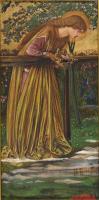
1856 to 1861. Edward Coley Burne-Jones 1st Baronet [aged 22]. "The Blessed Damozel".
Watercolor, gouache, and shell gold on paper mounted on canvas.