

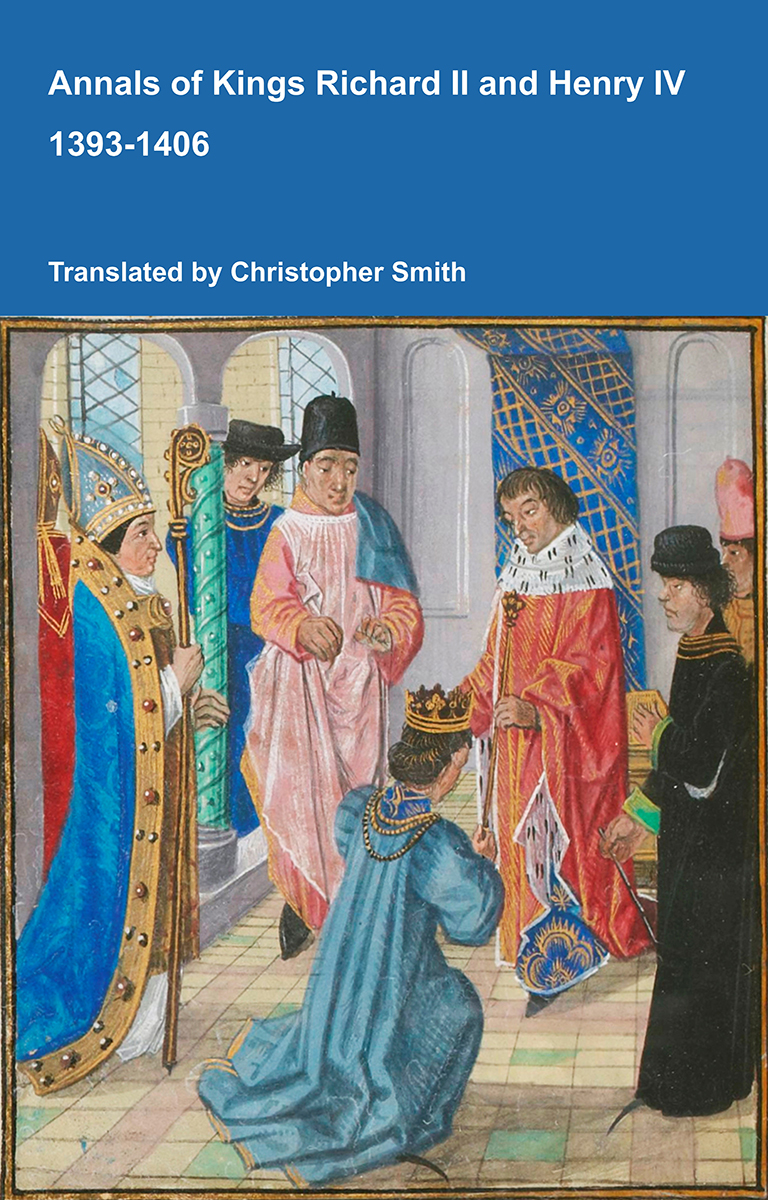
 Annals of Kings Richard II and Henry IV. In this year John Waltham, Bishop of Salisbury and Treasurer of the realm, died. He had so pleased the King that, although many murmured at it, by the King’s command he received burial at Westminster among the kings. He was succeeded in the office of Treasurer by Sir Roger Walden, formerly the King’s Secretary and Treasurer of Calais. In the bishopric, however, he was succeeded by Sir John [Richard] Mitford, Bishop of Chichester. To Mitford’s bishopric the Archbishop of Dublin [Robert Waldby] was translated, because the greater bishopric was lesser in secular substance. Thomas Brantingham, Bishop of Exeter, also died. By the King’s insistence, he was succeeded by Master Edmund Stafford [aged 51], Keeper of the Privy Seal.
Hoc anno obiit J[ohannes] Waltham, Sarisburiensis Episcopus, regni Thesaurarius; qui tantum Regi complacuerat, ut, licet multis murmurantibus, Rege jubente, apud Westmonasterium inter Reges acciperet sepulturam. Huic successit, in officio Thesaurarii, Dominus Rogerus Waldene, prius Regis Secretarius, et Calesiæ Thesaurarius: in Episcopatu vero Dominus J[ohannes] Mytford, Cicestrensis; ad cujus Episcopatum Dublinensis Archiepiscopus est translatus, quia major pontificatus in sæculari substantia minor erat. Obiit etiam Thomas Brantyngham, Exoniensis Episcopus; cui successit, Regis instantia, Magister Edmundus de Staffor[d], Portitor Privati Sigilli.
Annals of Kings Richard II and Henry IV. In this year, Master William Courtenay [aged 54], Archbishop of Canterbury, bade farewell to the world [on 31st July 1396]. He was succeeded, by the postulation of the Chapter, by Sir Thomas Arundel, brother of the Earl of Arundel [aged 50], Archbishop of York and Chancellor of the realm. Arundel immediately resigned the office of Chancellor and its burdens, and, with the King’s assent, entrusted it to Master Edmund Stafford [aged 52], Bishop of Exeter. He was succeeded in the archbishopric of York by [....]1, a friar of the Order [....], by papal provision, against the wishes of the whole clergy of York.
Hoc anno, Magister Willelmus Courtenay, Cantuariensis Archiepiscopus, sæculo valefecit; cui successit, postulatione Capituli, Dominus Thomas Arundele, frater Comitis Arundeliæ, [Archiepiscopus Eboraci] regnique Cancellarius; qui mox Cancellariæ dimisit officium, et illius sollicitudinem, per assensum regium, Magistro Edmundo de Stafford commendavit, Episcopo, videlicet, Exoniensi; successitque in Archipræsulatu Eboracensi [....], Frater de Ordine [....], provisione Papali, contra vota totius cleri Eboracensis.
Note 1. The names are missing in the Latin text. The missing name is Robert Waldby, an Augustinian friar. So the end would be: "He was succeeded in the archbishopric of York by Robert Waldby, a friar of the Order of Saint Augustine, by papal provision, against the wishes of the whole clergy of York."
On 5th October 1396 Archbishop Robert Waldby was appointed Archbishop of York.
On 29th December 1397 Archbishop Robert Waldby died. He was buried at the Chapel of St Edmund, Westminster Abbey [Map].
Parliament Rolls Richard II. 6. The following are assigned to be triers of petitions from Gascony and from other lands and countries overseas, and from the Channel Islands:
The archbishop of York.
The Bishop of Chester.
The Abbot of Waltham.
Lord Despenser.
John Hull.
Hugh Huls.
to act all together, or six of the aforesaid prelates and lords; consulting with the chancellor, treasurer, steward, and chamberlain, and also the king's serjeants when necessary. And they shall hold their session in the Marcolf Chamber.
And those who wish to submit petitions should hand them in between now and next Friday evening [26 January 1397].


Parliament Rolls Richard II. 22. Also, immediately afterwards, the archbishops of Canterbury and York, for themselves and for the other prelates of their provinces, spoke to the king openly in parliament, making protestation that they had made profession, and were sworn to our most holy father the pope and to the court of Rome, and therefore, if any ordinance or other thing were made or assented by the king or lords temporal upon the power and authority of parliament touching the provisions of the court of Rome which should restrict apostolic power, or be derogatory to the liberty of holy church, they neither would nor could nor ought to assent or agree thereto in any way, but oppose it and dissent on their part, in whatsoever pertained to them; saving also their estate towards the royal person of the king, to whom they gave fealty by oath for their temporalities, which they intend to guard loyally as they are bound, saving the liberty of holy church and their profession to our holy father, as is said above. And they prayed of the king that their said protestation be entered of record on the roll of parliament: which the king agreed and ordered.
Parliament Rolls Richard II. 27. Be it remembered that the venerable father Thomas, archbishop of Canterbury, primate of all England, earnestly prayed to the lord king in the present parliament that whereas his church of Canterbury, by the gift and grant of his noble and holy progenitors, which the same king graciously confirmed, had such prerogative over the other churches of England that whatsoever archbishop of Canterbury for the time being had custody of all lordships, manors, tenements, and rents with appurtenances which were held of the same church in chief during the minority of the heirs of their tenants, even though the same tenants elsewhere held in chief of the lord king; and now concerning the castle and manor of Tonbridge, Kent [Map], which by virtue of this prerogative were in the custody of William de Courtenay, late archbishop of Canterbury now deceased, predecessor of the present archbishop, on the day on which he died, by reason of the minority of the heir of the earl of Stafford deceased, who held the aforesaid castle and manor from the aforesaid former archbishop in chief, dispute and controversy between the present archbishop and the executors of the will of the aforesaid late archbishop are pending at present. And whereas a certain composition was drawn up a short while ago between the archbishop of Canterbury and the prior and chapter of the church of Canterbury on the matter, it pleased the lord king, having inspected and examined that composition, to order a view and settlement of the matter for the peace and right of his said church of Canterbury, as should seem best to his royal majesty, to whose ordinance and decree on the foregoing the same archbishop proclaimed himself to be firmly obedient in all things, whereupon the same lord king immediately appointed the venerable fathers Robert archbishop of York, Robert Bishop of London and John Bishop of Ely, and John duke of Aquitaine and Lancaster, and John Earl of Huntingdon, and Thomas the earl marshal, to inspect and examine that composition, and further to discuss and settle the matter at their discretion, and fully to inform the lord king of what their deed and action should be. And later on Monday, the last day of the aforesaid parliament [10 February 1397], the archbishop of York, and the bishops, and the aforesaid duke and earls thus appointed by order of the lord king in the same parliament returned their decree and ordinance on the aforesaid matter by Walter Clopton, the lord king's justice, in this form - namely, that the third part of all manors, lands, and tenements of the inheritance of the aforesaid heir, and the issues, profits, and revenues of the same from the time of the death of the aforesaid late archbishop, should, according to the form of the aforesaid composition, remain and be in the hands of the aforesaid prior and chapter, to be used for their own purposes; and that two parts of the aforesaid lands and tenements, with the issues, profits, and revenues of the same two parts, should remain likewise in the hands of that prior and chapter, safely and securely to keep until the lord king shall have ordained to whom those said two parts of the issues, profits, and revenues shall be delivered and has declared his will thereon. And the castle of Tonbridge [Map] will be delivered to the aforesaid present archbishop of Canterbury without delay, to remain in his hands and keeping until the the coming of age of the aforesaid heir. The which ordinance and decree thus rendered by the archbishop of York, bishops, duke and earls, the aforesaid lord king, approving thereof, ordered to be placed on record on the roll of parliament at the request of the aforesaid present archbishop of Canterbury.