

The Illustrated London News 1862 is in The Illustrated London News.
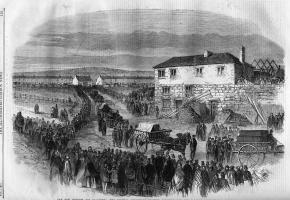
Saturday, January, 1862.
DREADFUL COLLIERY ACCIDENT. Loss of Two Hundred and twenty lives. The New Hartley Mining Disaster.
On 16 January 1862, tragedy struck the Northumberland village of New Hartley when the pumping engine beam of the Hartley Colliery snapped, blocking the only shaft and trapping over two hundred miners underground ...
One of the worst colliery accidents which has occurred in this country took place on the morning of Thursday week (Jan 16th) at New Hartley Colliery, near Newcastle-on-Tyne, resulting in the immediate death of five poor fellows and the suffocation of 215 others. Hartley new pit is situated close to the Hartley junction of the Blyth and Tyne Railway, on the western side of the line. This colliery, like the majority of the mines in the northern coal district, has only one shaft, which is made to serve the double purpose of upcast and downcast work. For this purpose a wooden partition or "brattice" divided the shaft from top to bottom, and ventilation was by this means secured. The shaft itself was lined with wood, and part of the wall through which the shaft descended was built up with masonry to make it more secure. The colliery had been subject to inundations, and additional precautions were used to keep down the water. An immense pumping apparatus was erected close to the mouth of the colliery - the beam of the pump amost, indeed, projected over the shaft, and was of enormous strength. It weighed above forty tons, was 8ft broad in the centre and 5in. thick in the thinnest part, and, as such a beam should be, it was of the best material. I t was the breaking of this beam which caused the accident. It snapped in the middle, and, pitching direct down the shaft, smashed the brattice in its ponderous fall, pulling down after it the wooden lining of the shaft, bringing away masses of masonry, and, as it is supposed, stopping midway in its flight, and acting as a platform on which to pile an immense heap of broken timber, stone and rubbish.
The first victims of the accident were some poor fellows who were "riding" up the shaft in the iron "cage" when the beam fell. Strange to say, the immense mass of metal appears to have passed them without materially injuring any of the number; but the falling timber and stone made short work of the majority, and three of them were killed immediately, while three more were saved by hanging on the cage, and two were thrown, mortally wounded, on the rubbish which choked up the pit.
It is a very touching memorial of this part of the calamity that one of the wounded men prayed in the midst of his sufferings, and one of his comrades climbed down from the cage where he had been suspended, and prayed with him till the hour when death released him. The living men in the cage were many hours before they were relieved.
Dreadful as the situatuion of these men was it was an enviable one compared to that of the poor fellows in the mine , 215 in number, now seperated from them by a fatal barrier. the misfortune of the miners who were down below was aggravated by the fact that it was about the time of changing "shifts". The day men were already at their labour, whilst the night men were about to leave it. Two lots had reached the top, the third were stopped in their progress, and the remainder were shut up as in a tomb.
In Hartley Colliery there are 3 seams of coal. The first or "high main" is completely worked out, and just as completely cut off from other parts of the colliery, it is, in fact, a large cave in the shaft, and as the rubbish passed it in its flight it was used as a receptacle in which to cast the material dug up from the fallen mass. The next halting-place was the yard seam, and thirty fathoms below that was the "low main." Here the men were at work, and this place, it is believed, would be flooded in a short time after the necessary suspension of pumping operations, caused by the breaking of the beam of the pump. The men were not, however, in the first instance, obliged to remain in the "low main." From that place to the yard seam there is a passage, well known, and easy of access. But the mass of debris was stopped in its fall before it came to the yard seam.
The ablest mining engineers and pitmen in the coal trade were engaged day and night in attempting to force a way through the obstructions in the shaft to reach the men and boys below, who at times were distinctly heard working. But difficulties in clearing it away were enormous. In the first place, though hundreds, to their honour be it said, volunteered to work, only two or three had room to do so, and, lest the temporary but fatal platform on which they worked should give way, it was necessary to suspend the workmen by the waist or under the shoulders. In the second place, the water began to pour out of the crevices in the sides of the shaft, and the shaft itself, with the stones at its sides, began to give way. The men were constantly in danger of their lives, and the work was stopped, in order that the sides should be properly "bratticed." The last danger was the carbonic acid gas which was emitted from the pit on Tuesday night, nearly depriving the workmen of life, entirely suffocating them for a time ; stopping the whole of the operations, and stopping, too, every hope that relief could reach the imprisoned men.
During the whole of Tuesday night workmen were employed in putting up a cloth brattice in the shaft, and pipes were also fixed between the engine-furnace and the high seam, to improve the ventilation. The sad trgedy was now revealed in all its horror. The cloth brattice was completed on Wednesday afternoon, and cleared the shaft to some extent of gas. Three pitmen (volunteers) went down, penetrated the obstruction, got into the yard seam by the engine drift, and found men lying dead at the furnace. They pushed their way through. The air was bad. Within this door they found a large body of men sleeping the sleep of death. They retreated and came to bank with the appalling intelligence.
Mr. Humble, viewer of the colliery, and Mr. Hall, immediately went down, and returned in an hour and a half. Both had to be taken off the sling, seriously affected by gas. They went through the works, and found no living man, but a hetacomb of dead bodies. The bulk of the bodies were lying in the gallery near the shaft. An affecting report, which has touched all hearts, was made by them. Families were lying in groups; children in the arms of their fathers; brothers with brothers. Most of them looked placid, as if asleep; but higher up, near the furnace, some tall, stout men seemed to have died hard. The corn-bins were all cleared. Some few of the men had a little corn in their pockets. A pony was lying dead among the men but untouched.
Several volunteers subsequently penetrated the workings, and confirmed this statement. Nearly all of them, however, were brought to bank seriously affected by gas. There was great danger of more men losing their lives. Medical men, of whom there were large numbers at the colliery, held a council at eight o'clock, and, by their advice, no more men were allowed to go down until the ventilation should be better. The village of New Hartley is a scene of misery, desolation, and woe, as nearly the entire working population have been stricken with death. The scenes at the pit's mouth during the long attempt to clear the shaft were most heart rending.
The Newcastle Daily Chronicle gives the following report of the proceedings on Tuesday:- "The flaming beacons on the high platform of Hartley Pit glared steadily in the eyes of weary-footed pedstrians approaching from Deleval or from nearer cottages. A thin cover of snow overspread the ground, and had changed the dark dry brown of the coaly roadways to a path of clear whiteness. The pit-heaps are ashy grey, and the stillness of death reigned around, broken only by the interminable orders for the gin, the crab, and the jack, which is heard through the morning air. Black figures bent their steps noiselessly towards the gleaming fires, where groups of persons were sitting or reclining quietly, the fountains of their grief being wellnigh exhausted, and the anguish of their minds, great as it is, being almost overpowered by the sleepy influences of the hour. Around the pit's mouth, however, eager spectators still watched the indications of the progress of the work, as if at any moment friends might be brought to bank whose lives depended on their presence at the moment of arrival. Meanwhile the ponderous machinery worked smoothly on; the ropes, as thick as a mans leg, glided up and down like greasy, slimy serpents, and in the hollow depths of the pit the lights burnt distinctly in a matery atmosphere."
1st February 1862. In this issue, extensive illustration and commentary on the "Hartley-Pit Tragedy" (New Hartley in Northumberland), detailing that fatal mining accident.
Picture below. The Fatal accident at New Hartley Colliery: Entrance to the shaft, viewed from the horse-hole
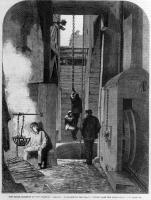
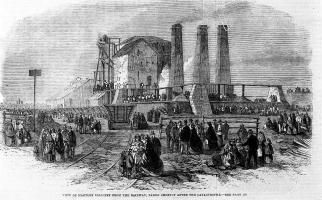
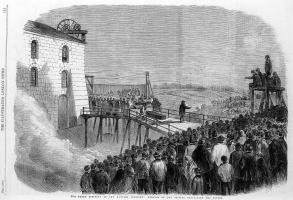
Scarcely yet though the worst of the event was ascertained upwards of a week ago - scarcely yet has the agony of excitement occasioned by the awful calamity at the Hartley Colliery calmed down sufficiently to allow of its being treated with collected thoughts or sobriety of reflection. Even now the "jowling" of that buried multitude, immured in darkness, cut off by they knew not what obstruction from the homes and families they had erewhile left in peace, and struggling day by day to fight off grim despair, rings in our ears, haunts our recollection, and fills our hearts with the dismay of utter helplessness. We hardly know which affliction was most poignant - that in the abyss below or that upon the surface above, save that in the latter case the fearful suspense was more protracted. It is said that a drowning man lives over again in a few moments, by an instantaneous act of memory, his whole life. Who, then, can imaginethe intense action of those two hundred and fifteen souls during the long interval between their first consciousness of peril and their ultimate death? What vivid flashes of recollection!- what voices of conscience!- what strainings of hope!- what hurried counsels!- what earnest prayers and vows!- ay, and, doubtless, there were men there whose steady faith in "things unseen as yet" strengthened them to minister consolation to their fellow - victims and to beget resignation where most it was needed! Seldom has human congregation passed through such a baptism of tears and fears to the shades of death. Not one of them survives to tell the awful story. Mystery has sealed it as her own for ever. We can only be silent in presence of the dread catastrophe, or, if we speak at all utter the prayer, "God's peace be with their spirits!" We are all but too familiar with the outlines of the facts - such of them, we mean, as were not entombed forever with the only person who could tell them - to require any detailed repetition of them here. They differed somewhat from the too common run of coalpit accidents.
A mine the working level of which, a hundred fathoms deep, was accessible by only a single shaft, and bordering so closely upon the sea as to render neccessary the incessant action of a pumping engine of 400 - horse power to keep it sufficiently free of water for the safe employment of the men - a ponderous iron beam from this engine, serving as the gigantic arm to lift the water to the surface, outstretched over the mouth of the shaft - a sudden fracture of the limb at the very moment when a shift of hands was taking place - the fall of the heavy fragment down the shaft, but, unfortunately, not to the bottom - the consequent formation of an effectual obstruction in the shaft, nearly seventy fathoms down, but above all means of egress made up of broken timber, canvas, and earth which the falling half of the beam had carried down with it - heroic and desperate attempts from above, for several days and nights successively, to clear away the obstruction in time to set free the imprisoned hands - the ascent of nearly the whole number of the victims through a "man-hole" to the "yard-seam" whence they made themselves heard occasionally to those who were working for their rescue by "jowling" - the rise of "stythe," a carbonic oxide fatal to life - and death, either by water in the main level or by suffocation in the yard-seam, to everyone of the hapless workmen down in the mine when the accident occurred; - such is a brief dry epitome of a casualty more appalling, more fatal, and marked from beginning to end with a greater and protracted intensity of excitement than any that has occurred in England within our recollection. Now that all is over, it were useless to dwell upon the heart sickening details. All that can be learnt from the most minute narrative of events to lead us to practical inferences of the slightest value, or to guide us to the performance of duty, may be learnt equally well without harrowing up the feelings afresh by a repetition of the of the sad details of this tragic story.
The time will come we devoutly trust and confidently believe, and perhaps is not far distant, when those of our countrymen whose lot it is to labour in darkness and in danger deep down below the surface of the earth, and to win from murky depths the mineral which is a principle source of the wealth to the country and a means of comfort to every household in the land, will be able to carry on their toilsome operations, if not as commodiously and pleasantly to themselves, as safely at least as the farm labourers who prepare the soil for our crops, and who reap them when they have arrived at maturity. Every accident, and, alas! they are sadly frequent, which overtakes these hardy delvers, contributes its share towards attracting careful attention to a field for beneficent exploration and study in which the triumphs yet to be won will be appreciated alike by the votaries of science, economy and philanthropy. Much has already been done to free from peril the occupation of miners. Several inventions have been made and generally adopted, and some laws have been enacted the effect of which has ver materially lessened the dangers and mitigated the hardships of those who accept for themselves and their families a vocation sinularly devoid of pleasant associations at best. We are apt enough while enjoying the fruits of these poor men's toil as to be utterly incurious as to the cost to human thews and sinews, and, we may add to domestic comfort and peace to which they are obtained. We content ourselves with the blessing without caring to inquire as to the process by which it has been placed within our reach. It is only when some terrible calamity occurs that we are startled by a discovery of the habitual risks, privations, exposure, and fatigue which have been unmurmuringly encountered in order to supply us with the raw material of so many of our means of civilisation and so large a proportion of our fireside enjoyments. Such painful occurrences as that at Hartley Pit give us, if we may say so, a section of mining life laying bare to our perception and sympathies the various strata of hardship, amounting at times to misery, which overlap each other in a miner's ordinary occupation, but which are usually concealed from all but initiated or inquisitive eyes. Nor is the information thus diffused through the public mind entirely unproductive. Many minds are set athinking as to how the lot of these men may be alleviated, and science is stimulated to make active and perservering search for protective agencies in their behalf. This is almost the only compensation which humanity derives from these terrible calamities. We may reasonably hope that the Hartley Pit tragedy will be the occasion of a large eventual amelioration of the miner's hazardous calling; and that in this as in many other instances out of the frightful death of some of its members Divine Providence will deduce means for bettering the normal conditions of all the rest.
One very obvious method of diminishing risk the workmen in coal pits is the provision of duplicate means of entry and exit. It cannot be pretended, indeed, that the catastrophe at Hartley Pit was needed to suggest this common-sense precaution. The habits of every animal that burrows in the ground, to say nothing of the mining experience of men capable of reflection, must long since demonstrated the reckless negligence of congregating men in narrow galleries running hundreds of feet beneath the earth's surface, and exposed to a frightful variety of destructive contingencies, without opening for them some other way of return to light, safety, and home than the single one by which they descend to their work. It is said that the pit men have long agitated for the adoption of this indispensable requisite for their security, that in some instances their desires has been acceeded to, and that no reason but that of economy can be assigned for neglecting to provide this additional means of safety and comfort in every coalmine in the kingdom. What the dictates of common sense and the suggestions of humanity have hitherto failed to enforce, the recent calamity, no doubt, will be the means of obtaining. Already, we understand the Home Secretary, Sir George Grey, has put into circulation a series of official queries, the drift of which leads us to infer that he contemplates early legislation on the subject. We are always better pleased when such arrangements as are plainly necessary for the protection of working men originate with, or are spontaneously adoptedby, their employers. But in all hazardous occupations, it would seem, the interposition of law between masters and men for the security of the latter, has been found necessary; and, assuredly, if in any conceivable case such legislative interference can be held to be justifiable and imperiously called for, mine proprietors can have no reason to complain of the meddling propensities of the Legislature in insisting upon their provision of a duplicate shaft in every case in which men are sent below the surface of the earth to dig the coal from which they derive their wealth.
It is impossible to pass the Hartley Pit catastrophe under review without paying our tribute of heartfelt admiration of the bravery, the devotion, the disinterestedness, the perseverance, the heroism so largely displayed in the efforts made to rescue the imprisoned miners from their impending doom. Those efforts, continued over a space of many days, have made us proud of our countrymen, and have disclosed to us a rich vein of character embedded beneath the the uncomely exterior of a rude and uncultivated class which ought to raise them in the estimation of the public and bespeak for them its warmest sympathy.
Within a few yards of the mouth of that coalpit-shaft occurred, we are bold to say, mainifestations of self sacrificing courage, of magnanimous oblivion of self, of cool presence of mind in view of appalling dangers, of readiness to do and to dare anything for the sake of saving life - more numerous, more heroic, and fitted to shed a brighter lustre upon our common nature than have distinguished any battle-field of which history makes mention. The risks voluntarily encountered by not a few, and which were all eager to encounter if thereby any good end could be gained, were equal to those of a deadly seige. But, although necessity was laid upon no one, no one flinched. The work to be done must be done in darkness, occasionally almost in solitude , quite out of sight of applauding companions and the only excitement to sustain men in the doing of it was that which grows out of sympathy with the suffering. Yet there was no task, however perilous, which human ingenuity could devise, or human energy perform, for which there were not more than a sufficient number of volunteers; there was no visible effect produced by the destructive agencies that surrounded them upon the working companies who went below which scared from the same active but dangerous service those who waited above to take their turn. I ever men have earned the thanks of their countrymen these men have; and right sorry and ashamed we are that political etiquette, whilst it formally acknowledges, and by acknowledgment, rewards the courage of men when for patriotic ends they risk life to destroy it, will not admit of displaying similar gratitude to , and of conferring similar honour upon, men equally brave and patriotic who risk life to save it.
An admiring and kind hearted-community will doubtless do that which the Houses of Parliament are precluded by tradition from undertaking - and in so doing will only be following the example of their beloved Queen. The Royal widow and mother of orphaned Princes is not so absorbed in her own domestic grief but that she can hasten to offer her tribute of sympathy to the lowliest who suffer from a like bereavment. It is, after all, but little that the pity or benevolence of the public can do towards supplying to a stricken village of mourners all that they have lost by the calamity that has snatched from them the stay and staff of family life. But the little that it can do we trust it will do promptly and generously, and with a spontaneity indicative of genuine fellow-feeling. Indeed, we cannot harbour a doubt about it. The magnamimity of which we have had such glowing specimens among the mining class cannot but reproduce some semblance of its self through all ranks of society; and while but few, from the nature of the case, could be volunteers in facing danger and death to avert possible calamity, there will be many who, now that the calamity has happened, will cheerfully come forward to mitigate its effects, and, by showing kindness to the hopelessly breaved, prove how gladly they would have done their part, if the duty had been assigned them, in attempting to prevent the bereavement.
The bodies of the unfortunate miners who, as recorded in our last number, died of suffocation in Hartley pit , have been brought to the surface and buried. After much labour, attended with the greatest danger, the sinkers were enabled commence their melancholy work last Saturday morning, and early on Sunday morning the whole of the bodies, it is believed, have been recovered. From the various accounts given by the reporters of the local journals we select the following particulars:
THE SCENE IN THE PIT
By actively working Friday se'nnight Mr Coulson's sinkers got the cloth bratticing completed; and, having erected a platform below the yard seam, which directed a good current of air into that intake, and Mr. T. R. Foster and Mr. Coulson, who had gone down the shaft and examined it carefully, having come to "bank" and reported that the shaft was clear of gas, and that all was safe, a large working gang of colliers proceeded down into the workings to send the bodies to bank.
As soon as the men got into the yard seam they encountered the first dead man, a fine looking fellow, who was sitting, apparently sleeping, in seat made in the side of the seam coal only a few feet from the shaft. His name was John Galligar. His flannel trousers were doubled up, and he looked as if he was resting after a hard day's toil. Five or ten yards within the seam is a gallery five or six yards from the shaft. Here a large body of men and boys were lying in rows -- those next',the wall of the coal sleeping in a sitting position, and the next row in advance of them resting on the others' knees. They were lying in three rows on each side, all quiet and placid, as if sleeping off a heavy day's work. Boys were lying with their heads on the shoulders of their fathers; and one poor fellow had his arms clasped around the neck of his brother. One or two brothers were locked in each other's arms, but all lying as if death had crept quiety upon them and stole away their lives whilst they might be dreaming of home and liberty. Beyond the company of sleepers a man lay propping open a door, as if he had resisted the poison of the mine longer than the rest, and had arisen to open one of the doors to bring a little more fresh air in. Two men were lying on the ashes at the furnace, but beyond that point, and farther within the workings, we believe the working parties have not deemed it wise or prudent to go until the whole of the bodies have been sent up out of the galleries and those parts next the shaft, where they lie within an area of something like fifty or sixty yards. The men that went down were in charge of a viewer.
BRINGING THE BODIES TO THE SURFACE AND PLACING THEM IN COFFINS
It was at first intended to coffin the bodies down the pit, and send them to bank; but, as it was discovered that they were not so far advanced in decomposition as was at first anticipated, it was determined to save time by bringing them up in slings and coffining them at bank. A considerable staff of surgeons was assembled at the pit mouth, and every precaution was adopted, both at the pit mouth and in the workings, by the plentiful supply and use of disinfecting fluids, to neutralise any ill effects that were likely to arise through the effluvium from the bodies. It was hoped that the pitmen, who were urged to do so by the medical men for sanitary reasons, would have prevailed upon the widows to allow the bodies not to be removed to their dwellings , but out of regard to the feelings of the poor widows they absolutely refused to interfere. A long relay of colliery team-carts was kept on the road leading from the pit. A large number of pitmen who remained at bank , as well as others who were employed below, were each furnished with a pair of gloves , and about a quarter before eleven the signal was given to the engine-man, and the first two bodies were brought to bank. They were slung by the middle, and were attired in the usual pit garb -- a flannet jacket and waistcoat, blue stockings, and strong shoes, the knees and part of the leg exposed, as is seen in the dress of a Highlander. The first two men brought to bank did seem to have suffered seriously from the effects of starvation. Several of the men brought up had some corn in their pockets, evidently a part of the division which they must have made from the horse bin in the stable. During daylight, with the exception of some two or three upon whom decomposition had rapidly set in, the aspect of the dead was far from repulsive: many had evidently slept quietly away. Their clothes were drenched with wet, arising from being brought up the shaft, down which the water seemed to pour in a perfect torrent. The bodies, as soon as they were brought to bank, were wrapped in a cotton sheet, and, if identified, their names were incribed on the coffins in which they were placed. The coffins were put upon rolleys, and removed to the carts in waiting, and thence immediately taken to their bereaved homes. Those not identified were coffined as "unknown," written in chalk on the coffins, which were then taken away to a storehouse, and, thence removed to their homes as soon as identified. Many pitiful and distressing scenes were witnessed. The pit rows in which are the cottages of the pitfolk, are no great distance from the mine---indeed, a view of the shaft can be commanded from most of the cottage doors. Upon the discovery of the bodies in the mine the "fountain of tears" had been nearly dried up. But, as each poor wife began to put her house in order to receive home the remains of her lost husband, or a mother her child, the scene of misery in this bereaved community cannot be described. And it is but right to state that, while large crowds of persons were assembled round the pit all day, but few persons led away by curiousity obtruded themselves upon the sorrows of those poor widows and fatherless children by wandering about the rows of cottages.
Early on Sunday morning the work of bringing up the bodies of the unfortunate sufferers was ended. At that time 199 bodies had been recovered, and, after a very careful search through the workings of the middle seam, no more could be found. Notwithstanding that the ventilation of the further workings is still very incomplete, two or three daring men penetrated to the "staple" which communicates with the lower seam, where they found that the water had risen in the lower workings to the height of 18ft. It will therefore be impossible for some time to get at those whose retreat may have been cut off in the lower seam.