
The Orkneys in Early Celtic Times is in Victorian Books.
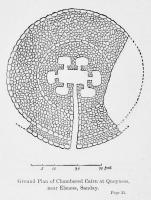
The cairn of Quoyness [Map], in Sanday, has been a large circular mound fully 60 feet in diameter, with an average height, even now, of nearly 10 feet ; while, from the accumulation of debris, it must have been much higher originally. The passage leading into the interior was about 24 feet in length, and led directly to an oblong shaped chamber, nearly rectangular, 124 feet in length, 5½ feet in width, with walls upwards of 12 feet in height. From this there were six passages leading to an equal number of irregularly-formed oval cells, two on each side, and one on each end of the central chamber. Fragments of upwards of twelve human skulls were found in these cells, of all ages; one or more had the appearance of having been cleft prior to being interred. With these fractured skulls were found some animal bones, supposed to be those of the ox. No pottery was found, but two stone implements of unknown use, and a third, made of bone, resembling an elongated borer, 7 inches in length.
It has been suggested that possibly this cairn was originally a broch, and that within its central area the building just described was subsequently constructed. But the essential features of a broch are conspicuous by their absence, and the relics found are those associated with the chambered sepulchral cairns. Its design, and the character of its contents, clearly indicate its typical relationship.