

Usk, Monmouthshire is in Monmouthshire South East Wales.
The River Usk rises at Fan Brycheiniog [Map] after which it flows broadly east through Sennybridge [Map], Brecon [Map], then south-east, under Crickhowell Bridge, Monmouthshire [Map], Abergavenny, Monmouthshire [Map], then under the Chain Bridge [Map] at Kemeys Commander, south through Usk, Monmouthshire [Map], under the bridge at Newbridge-on-Usk [Map], past Caerleon [Map] to Newport, Monmouthshire [Map] where it joins the Severn Estuary.
Welsh Border Road describes an unamed Roman Road, and unnumbered by Margery, that went from Caerleon [Map] to Wroxeter, Shropshire [Map], passing through Usk, Monmouthshire [Map], Abergavenny, Monmouthshire [Map], Hereford [Map], Mortimer's Cross, Herefordshire [Map], Wigmore, Herefordshire [Map] and Leintwardine Bridge, Herefordshire [Map] where it crosses the River Teme just after its convergence with the River Clun.
On 12th February 1371 Elizabeth Mortimer Baroness Camoys was born to Edmund Mortimer 3rd Earl March, Earl of Ulster [aged 19] and Philippa Plantagenet Countess March 2nd Countess Ulster [aged 15] at Usk, Monmouthshire [Map]. She a great granddaughter of King Edward III of England. She married 1. before 1393 her second cousin once removed Henry "Hotspur" Percy, son of Henry Percy 1st Earl of Northumberland and Margaret Neville, and had issue 2. after 21st July 1403 her half second cousin twice removed Thomas Camoys 1st Baron Camoys and had issue.
On 11th April 1374 Roger Mortimer 4th Earl March 3rd Earl of Ulster was born to Edmund Mortimer 3rd Earl March, Earl of Ulster [aged 22] and Philippa Plantagenet Countess March 2nd Countess Ulster [aged 18] at Usk, Monmouthshire [Map]. He a great grandson of King Edward III of England. He married 7th October 1388 his second cousin once removed Eleanor Holland Countess March and Ulster, daughter of Thomas Holland 2nd Earl Kent and Alice Fitzalan Countess Kent, and had issue.
On 5th May 1405 Richard Grey 1st or 4th Baron Grey of Codnor [aged 34] and Dafydd Gam Brecon [aged 25] decisively defeated the Welsh army at the Battle of Pwll Melyn aka Usk. Gruffudd ab Owain Glyndŵr Mathrafal [aged 30] was captured. Tudur ap Gruffudd Lord Gwyddelwern [aged 48] was killed. The Welsh lost around 1500 men with 300 prisoners being beheaded following the battle. The battle marked the beginning of the end of Owain Glyndŵr's [aged 46] revolt.
In 1138 Usk Castle, Monmouthshire [Map] was captured by the Welsh.
In 1184 Usk Castle, Monmouthshire [Map] was captured by the Welsh.
The Itinerary of Archbishop Baldwin through Wales: Book 1 Chapter 5. At the castle of Usk [Map], a multitude of persons influenced by the archbishop's sermon, and by the exhortations of the good and worthy William bishop of Landaf,65 who faithfully accompanied us through his diocese, were signed with the cross; Alexander archdeacon of Bangor66 acting as interpreter to the Welsh. It is remarkable that many of the most notorious murderers, thieves, and robbers of the neighbourhood were here converted, to the astonishment of the spectators. Passing from thence through Caerleon [Map] and leaving far on our left hand the castle of Monmouth [Map], and the noble forest of Dean, situated on the other side of the Wye and on this side the Severn, and which amply supplies Gloucester with iron and venison, we spent the night at Newport [Map], having crossed the river Usk three times.67 Caerleon [Map] means the city of Legions, Caer, in the British language, signifying a city or camp, for there the Roman legions, sent into this island, were accustomed to winter, and from this circumstance it was styled the city of legions. This city was of undoubted antiquity, and handsomely built of masonry, with courses of bricks, by the Romans. Many vestiges of its former splendour may yet be seen; immense palaces, formerly ornamented with gilded roofs, in imitation of Roman magnificence, inasmuch as they were first raised by the Roman princes, and embellished with splendid buildings; a tower of prodigious size, remarkable hot baths, relics of temples, and theatres, all inclosed within fine walls, parts of which remain standing. You will find on all sides, both within and without the circuit of the walls, subterraneous buildings, aqueducts, underground passages; and what I think worthy of notice, stoves contrived with wonderful art, to transmit the heat insensibly through narrow tubes passing up the side walls.
Note 65. William de Salso Marisco, who succeeded to the bishopric of Llandaff, A.D. 1185, and presided over that see during the time of Baldwin's visitation, in 1188.
Note 66. Alexander was the fourth archdeacon of the see of Bangor.
Note 67. Once at Usk, then at Caerleon, and afterwards on entering the town of Newport.
Before 23rd June 1314 Usk Castle, Monmouthshire [Map] was held by Gilbert de Clare 8th Earl Gloucester 7th Earl Hertford [aged 23].
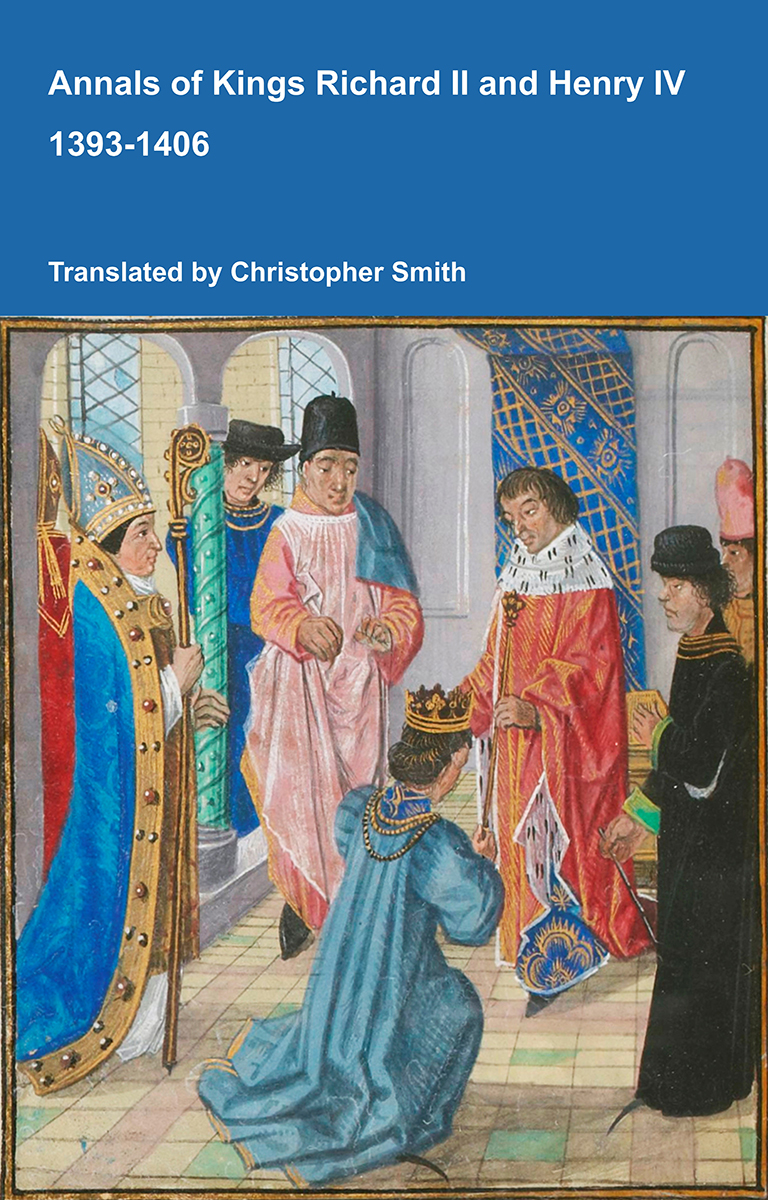 Annals of Kings Richard II and Henry IV. In that year, on Ash Wednesday [4th March], a great slaughter of the Welsh took place. On 5th May, in another battle fought at Usk between the Welsh and the English retainers of the Prince, a son1 of Owain Glyndŵr was captured, while fifteen hundred men on the rebel side were either taken prisoner or killed.
Later, around the feast of St Dunstan [19th May 1405], Owain Glyndŵr’s chancellor was captured in battle, and many of the Welsh were killed. In the same year, John Hanmer, Glyndŵr’s son-in-law, was also captured in battle. They were all taken to London and imprisoned in the Tower.
Eo anno, Die Cinerum, facta est magna strages Wallensium, et quinto die mensis Maii, altero facto conflictu, apud Usk, inter Wallicos et Anglicos, familiares Domini Principis, captus est filius Oweni Glendor, captis cum eo, vel peremptis, mille quingentis de parte rebellium.
Expost, circa festum Sancti Dunstani, captus est in bello Cancellarius Oweni Glendor, multis ex Wallensibus interemptis. Et eodem anno captus est Johannes Hanmere, gener ejus, in bello: qui omnes ducti sunt Londonias, et in Turri clausi.
Note 1. Gruffudd ab Owain [aged 30], 1375-1412. He died seven years later in the Tower of London. Owain's brother Tudur ap Gruffudd [aged 48] was killed in the battle. Compare with the account by Adam of Usk who places the battle in March although the text notes he may have been confused with the battle at Grosmont on 11th March: "On the feast of Saint Gregory [12th March] Griffith, eldest son of Owen, with a great following made assault, in an evil hour for himself, on the castle of Usk [Map], which had been put into some condition for defence, and wherein at that time were the lord Grey, of Codnor, sir John Greyndour, and many other soldiers of the king. For those same lords, sallying forth manfully took him captive, and pursuing his men even to the hill-country of Higher Gwent, through the river Usk, there slew with fire and the edge of the sword many of them, and above all the abbot of Llanthony, and they crushed them without ceasing, driving them through the monks wood, where the said Griffith was taken. And their captives, to the number of three hundred, they beheaded in front of the same castle near Ponfald; and certain prisoners of more noble birth they brought, along with the same Griffith, to the king. The which Griffith, being held in captivity for six years, at last in the Tower of London was cut off by a pestilence. And from that time forth in those parts the fortunes of Owen waned." Thomas of Otterbourne's 'Chronica Regum Angliae' places the battle on the 15th March which is consistent with Adam of Usk.
Chronicle of Adam of Usk [~1352-1430]. On the feast of Saint Gregory [12th March]1 Griffith, eldest son of Owen, with a great following made assault, in an evil hour for himself, on the castle of Usk [Map], which had been put into some condition for defence, and wherein at that time were the lord Grey, of Codnor, sir John Greyndour, and many other soldiers of the king. For those same lords, sallying forth manfully [on 5th May 1405], took him captive, and pursuing his men even to the hill-country of Higher Gwent, through the river Usk, there slew with fire and the edge of the sword many of them, and above all the abbot of Llanthony, and they crushed them without ceasing, driving them through the monks wood, where the said Griffith was taken. And their captives, to the number of three hundred, they beheaded in front of the same castle near Ponfald; and certain prisoners of more noble birth they brought, along with the same Griffith, to the king. The which Griffith, being held in captivity for six years, at last in the Tower of London was cut off by a pestilence. And from that time forth in those parts the fortunes of Owen waned.
Note 1. This defeat of Glendower’s followers took place at "Pwl-Melyn mountain near Usk." Owen’s brother Tudor was slain. It followed immediately on the defeat at Grosmont of 11th March, 1405. Adam’s date is a little too early: perhaps he has confused the dates of the two battles. The Annals of Kings Richard II and Henry IV, gives the date as the 5th May. Otterbourne, 251, on the other hand, places the battle as early as the 15th March. See Wylie, Henry the Fourth, ij. 171 ; Kingsford, Henry V., 52. lies about a mile and a half north-west of Usk.