

Dublin Penny Journal is in Victorian Books.

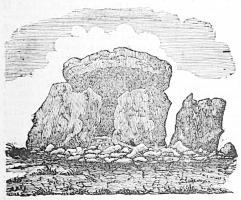
Cromleach, at Knockeen [Map], County of Waterford.
The annexed cut is a faithful representation of a Cromleach at a place called Knockeen, about five miles north of the celebrated watering-place, Tramore, in the County of Waterford. I should more properly have written that my drawing correctly represents what that Druidical monument was in the year 1825, because I cannot say what damage it may have since received, as I have not seen it for the last seven years.
The word Cromleach is from the Irish, Cromleac, a pagan altar, which is a compound of, Crom, God, and leac, a flat stone. The one now about to be described is situate on the gentle declivity of a small hill, as the name of the place, i. e. "the little hill," indicates, and was constructed of eight huge rocks, six of which stood upright, and the remaining two were laid flat upon some of the erect ones. One of the latter stones, which is about sixteen feet in length, and of proportionate breadth and thickness, weighing five or six tons, appears to have been balanced on the top of one of the upright rocks, as on a pivot. At the time I saw it, one end of this stupendous block seemed to be suspended in the air, but the other end was overgrown with ivy, which con- nected it with the stones beneath, and gave the whole group a very fantastic and grotesque effect. It is to be remarked that this structure lay due east and west, in conformity with the ancient custom, which assigned amongst the cardinal points a religious pre-eminence to the east. 1826. This superiority of the east over the other points of the compass in religious worship at the first glance strikes one as strange, nay, almost, as pagan and ridiculous, but many important reasons for its continuance are to be found in an anonymous work, entitled " The Picture of Parsonstown," published by subscription in The author of that work, in describing the new Roman Catholic Chapel of Parsonstown, animadverts on the In position in which that edifice was placed, and quotes from scripture, the primitive fathers, and profane writers, a Egeat number of curious and interesting authorities on the subject.
In proof that the early preachers of christianity were unwilling to divert their converts from those places of worship which they had while pagans been accustomed to resort to, in order thereby the more readily to win their attendance at their new devotions, we find mouldering in decay, within twenty yards of this Cromleach, the more modern yet venerable ruins of a Christian Church, and there also is to be seen a burial ground adjoining. A countryman I happened to meet on the spot, informed me that hard-by was one of those subterranean dwellings which were inhabited by the ancient Druids, and which are so often to be read of in Irish history. However, at the time of my visit the entrance to this cave, unfortunately for me, was closed up.
There cannot be a doubt but that the huge stones now being written of served formerly as an altar for sacrifice. The kind of altars which, Wormius informs us, were used by the northern nations and Cimbri, is similar to that just described. This amazing pile of ponderous granite presents a specimen of the Rocking-stones or Baetylia, (i. e. moving or animated stones) which the Jate learned Dr. Lanigan finds fault with Bochart for calling anointed stones, although perhaps either epithet is equally appropriate. It is worthy of note that Dr. Smith, notwithstanding his acknowledged research, industry, and learning, has omitted to notice this Cromleach at Knockeen in his able and laborious work on the County of Waterford. B.
Midway from Ballymena to Ballymoney, somewhat to the left, are seen the Craigs rocks, or Fort of Craigs, which form a square of nine thousand feet in area, with a very deep trench, close to which are three pillars erect and tapering, supposed to have bean placed there in honour of some valiant chieftan slain in battle; and but a short distance from them, in the hollow of a high and craggy ridge, there is a cromlech [The Broad Stone aka Craigs Passage Tomb [Map]], or druidical altar—a slab of black heavy stone, one foot in thickness, ten feet long, and eight broad, originally placed upon five supporters. Beneath this is a chamber which communicates with two others, about seven feet square, and arched over—the whole standing within a circle of one hundred and thirty five feet in circumference, the ground underneath having formerly been hollowed into a kind of cavern. A writer in Mason's Statistical Survey, speaking of this place, observes that it must have been the theatre of great events: in former times; that it posesses more remains of antiquity than he has any where seen in the same space of ground. The place where the altar is erected is lonely; and awful—it induces thought, and brings back the memory to former days, over which the mind broods with pent e pleasure. Here Fingal and his clans of Mourné and Beiskeré may have displayed their valour—Torgis and his Scandinavians committed their ravages—Sourleboy (i.e. Yellow Chorley) and his Scotch played off their stratagems—or De Courcey and his English showed forth their heroism. All are now gone; a total change of laws, manners, religion, and war, has taken place—and a rational religion and mild government have blessed us with peace and know ledge.—See "Northern Tourist," published fs Curry and Co.
THE BROAD STONE [Map], PARISH OF FINVOY, COUNTY OF ANTRIM.
In the recess of a mountainous ridge, called the Craigs, the surface of which is highly diversified by wild flowers and heath, dividing into serpentine walks its carpet of the richest green, stand the ruins of a magnificent temple, supposed to have been of druidical erection, called the: Broad-stone. The altar, or covering stone, was formerly, supported by five others, upwards of four feet in height; three of these have been taken away within memory, leaving one end of the altar on the ground, and the other, leaning against the remaining supporters, as seen in the annexed view.
This stone is ten feet in length, nine feet in breadth, by one thick, beneath which is said to have been formerly a chamber communicating with two smaller apartments, extending northward, and covered with stone. At present no certainty on this head can be obtained, as where those excavations are said to have been, are filled up. Adjoining, on the north-cast, is a round cavity about two feet in diameter, neatly faced with stone, called the giant's-pot, which is said to have extended into the adjoining chambers. The ruinous state of the structure frustrates all researches as to this statement, which, however, would seem to have been true. On the south of the altar is a large stone detached from the supporters; and on the opposite side stood formerly another of similar dimensions: the probable use of these has not been even surmised. Adjoining, on the north-west, are the remains of a stone circle; and vestiges of a similar erection are seen on the south-east. These, as well as the altar, appear to have been formerly encompassed by a circle of large stones, forty-three feet in diameter; the greater part of the ground within this enclosure is said to have been excavated.
According to tradition, an ancient giant lies here interred; the Broad-stone is said to mark out his grave; and a little northward are three stones nearly seven feet high, said to point out the tombs of an equal number of his followers.

The Druid Stone aka Mount Druid Cromlech [Map].
This memorial of the superstitious customs of our country, previous to the introduction of Christianity, stands on an eminence in the grounds of the Rev. Robert Trail, of Ballintoy, in the immediate vicinity of the Giants' Causeway, in the county of Antrim.
This species of rude altar is very common in many parts of Ireland; it is called both in the Irish and old British language Crom-liagh and Crom-leche, which signify in both a crooked stone, not from any crookedness, but from their inclining posture. They are supposed to have been so formed, in order to allow the blood of the victims slain upon them to run off freely. Mr. Rowland, in his Mona Antiqua, (page 47) conjectures that the word is derived from the Hebrew, Cærumluach, i.e., a devoted table or altar. Noah, after he left the ark, was to build an altar and offer up sacrifice on it to the Lord—Genesis viii. 20. And it is to be supposed that he built it of such coarse and rude stones as the mountains where the ark rested, afforded. In Exodus xx. 25, they had a command not to build them of hewn stone, which seems to show that the British Cromleche, and the Irish Cromliagh are only the remaining effects of that ancient law and custom of not striking a tool upon the stones of their altars.—Deut. xxvii. 5. These rude altars are sustained in some places by rows of pillars, and sometimes by three or more large stones, something similar, though smaller, than the table or covering stone. The Cromliagh at Mount Druid appears to be of the latter class.
Of the Druidic system very little is actually known; and that little can be collected only from Greek and Latin authors. Tt was doubtless a system of profound mystery. Its priests, designated by the name of Druids, were forbidden by the inviolable rules of their institution to divulge to the laity any of their dogmas, or to commit to writing any part of their doctrines, which were composed in verses merely oral, and treasured in the mind by a tedious course of study. Their places of worship were lonely groves, awful to the vulgar by gloomy shades and religious consecration. For the oak tree they enjoined extraordinary reverence. On their altars they offered bloody sacrifices, and among the victims were frequently men, commonly such as were condemned for supposed or real crimes. Among them was said to be maintained a kind of hierarchy, terminating in Archdruid, President of all. To the vulgar they communicated some instructions of a moral nature; and, to inspire them with courage in battle, are said to have given them, in the doctrine of the metempsychosis, some faint idea of the soul's immortality. It is to them the following allusion is made by Ossian.
"There, mixed with the murmurs of waters, rose the voice of aged men, who called the forms of night to aid 'them in their war."