


Laura Theresa Epps. "Battledore and Shuttlecock".

Laura Theresa Epps. "A Carol".
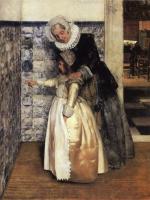
Laura Theresa Epps. "The Bible Lesson".

Laura Theresa Epps. "The Tea Party".
On 16th April 1852 Laura Theresa Epps was born.
Life of Lawrence Alma-Tadema by Helen Zimmern. Four years after joining her son [[her future husband] Lawrence Alma-Tadema [aged 28]], Madame Tadema died. It is sad to think that this good parent did not live to witness her son's world-wide fame, but pleasant to know that she still heard the praise aroused by some of his first exhibited pictures, and to see him the recipient of his first gold medal, that accorded to him at Amsterdam in 1862. In 1865 Tadema married a French lady, and removed to Brussels, where he remained until his wife's death. This occurred in 1869, when he was left alone with his sister and two little girls, the eldest, Laurence, who has developed into a gifted writer, and the second, Anna, the delicate, dainty artist who has inherited so much of her father's power for reproducing detail.
It was during the lifetime of his first wife that Alma Tadema paid his first visit to Italy and saw with his own eyes the homes of those Romans who were destined to become his most familiar friends.
Lawrence Alma-Tadema and Marie-Pauline Gressin-Dumoulin were married at the City Hall in Antwerp.
Letters of Christina Rossetti. 56 Euston Square, N.W.
Friday afternoon, 14th. [May 1869]1
My dear Miss Boyd [aged 44]
Thank you warmly for so exceedingly kind an invitation, concerning which I will only put forward one regret, that Mrs Epps [Note. Not clear who Mrs Epps is since Laura Theresa Epps [aged 17] didn't marry [her future husband] Lawrence Alma-Tadema [aged 33] until 1871] should lose what might so have refreshed her both in mind and in body. And indeed, if I may, I will say that should it after all turn out that she could visit lovely Penkill you will without hesitation let me know your altered plans to which I shall most readily conform mine. On the other hand if I go, it will be a special indulgence to travel with the Scotts [Note. William Bell Scott [aged 58] and Letitia Margery Norquoy] and as you give me so generous a latitude I will even feel housed at the Castle until a companion offers with whom to start south again;-the journey being somewhat formidably lengthy. But this, of course, only in case it brings my visit within not altogether unreasonable dimensions. How very kind you are to me, and how much I should like to make my gratitude obvious to you. Knowing what a Dear Mrs Scott is, I think she will kindly let me know her plans in due course: meanwhile I expect to run down to Gloucester next week on a little visit to my Uncle if he will have me, but to be up again in time for Penkill.
My love, please, to Mrs Scott, and a kindred sentiment to Mr Scott. We saw Gabriel [aged 41] last night, but I know nothing at all about his summer plans.2
My Mother [aged 69] desires her most cordial remembrances to you, and adds her thanks to mine on my behalf.
Always and affectionately yours
Christina G. Rossetti [aged 38].
I expect you will find me quite a different order of being this year as regards walking, and I mean to trim up my old hat for possible croquet.
Note 1. Endorsed: "1867." CGR returned to Penkill in 1869, from 9 June to 22 July, not in 1867.
Note 2. DGR was at Penkill from mid-August to 20 September.
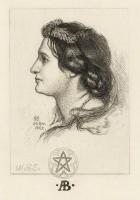


Life of Lawrence Alma-Tadema by Helen Zimmern. An accident brought Tadema to London in 1870, and here he at once took root. A year later he remarried1, his wife this time being Miss Laura Theresa Epps [aged 19], a woman of rare beauty, and herself a painter of distinction.
Note 1. In July 1871 Lawrence Alma-Tadema [aged 35] and Laura Theresa Epps were married.
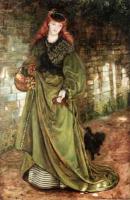
After July 1871. Catherine Emily Brown [aged 20]. Portrait of Laura Theresa Epps [aged 19].
Chronicle of Walter of Guisborough
A canon regular of the Augustinian Guisborough Priory, Yorkshire, formerly known as The Chronicle of Walter of Hemingburgh, describes the period from 1066 to 1346. Before 1274 the Chronicle is based on other works. Thereafter, the Chronicle is original, and a remarkable source for the events of the time. This book provides a translation of the Chronicle from that date. The Latin source for our translation is the 1849 work edited by Hans Claude Hamilton. Hamilton, in his preface, says: 'In the present work we behold perhaps one of the finest samples of our early chronicles, both as regards the value of the events recorded, and the correctness with which they are detailed; Nor will the pleasing style of composition be lightly passed over by those capable of seeing reflected from it the tokens of a vigorous and cultivated mind, and a favourable specimen of the learning and taste of the age in which it was framed.'
Available at Amazon in eBook and Paperback format.

1876. Laura Theresa Epps [aged 23]. "World of Dreams".

1876. [her husband] Lawrence Alma-Tadema [aged 39]. Portrait of Laura Theresa Epps [aged 23].
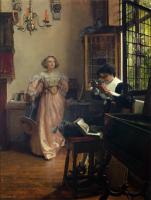
Before 1878. Laura Theresa Epps [aged 25]. "The Persistent Reader".

1879 to 1880. Laura Theresa Epps [aged 26]. "With a Babe in the Woods".
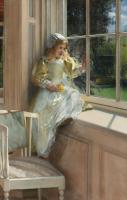
1881. Laura Theresa Epps [aged 28]. "A Looking out o'Window, Sunshine".
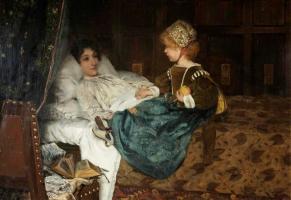
1887. Laura Theresa Epps [aged 34]. "Always Welcome".

1887. [her husband] Lawrence Alma-Tadema [aged 50]. "The Women of Amphissa". The artist's wife Laura Theresa Epps [aged 34] centre beneath the shield.

Around 1891. [her husband] Lawrence Alma-Tadema [aged 54]. "Interrupted". Portrait of Laura Theresa Epps [aged 38].
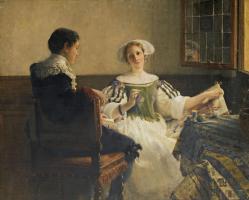
1896. Laura Theresa Epps [aged 43]. "Love's Beginning".
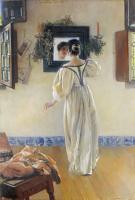
1897. Laura Theresa Epps [aged 44]. "A Knock at the Door".

1898. Laura Theresa Epps [aged 45]. "At the Doorway".

1904. Laura Theresa Epps [aged 51]. "The Pledge".
On 15th August 1909 Laura Theresa Epps [aged 57] died.

Adam Murimuth's Continuation and Robert of Avesbury’s 'The Wonderful Deeds of King Edward III'
This volume brings together two of the most important contemporary chronicles for the reign of Edward III and the opening phases of the Hundred Years’ War. Written in Latin by English clerical observers, these texts provide a vivid and authoritative window into the political, diplomatic, and military history of fourteenth-century England and its continental ambitions. Adam Murimuth Continuatio's Chronicarum continues an earlier chronicle into the mid-fourteenth century, offering concise but valuable notices on royal policy, foreign relations, and ecclesiastical affairs. Its annalistic structure makes it especially useful for establishing chronology and tracing the development of events year by year. Complementing it, Robert of Avesbury’s De gestis mirabilibus regis Edwardi tertii is a rich documentary chronicle preserving letters, treaties, and official records alongside narrative passages. It is an indispensable source for understanding Edward III’s claim to the French crown, the conduct of war, and the mechanisms of medieval diplomacy. Together, these works offer scholars, students, and enthusiasts a reliable and unembellished account of a transformative period in English and European history. Essential for anyone interested in medieval chronicles, the Hundred Years’ War, or the reign of Edward III.
Available at Amazon in eBook and Paperback format.
On 25th June 1912 [her former husband] Lawrence Alma-Tadema [aged 76] died at Kaiserhof Spa, Wiesbaden, Germany where he had travelled with his daughter [her former step-daughter] Anne [aged 45] for treatment of his stomach ulcers. He was buried in the crypt of St Paul's Cathedral [Map].


