

Netherlands is in Low Countries.
John Evelyn's Diary. 20th August 1641. Next day (the 20th) I returned to Delft, thence to Rotterdam, the Hague, and Leyden, where immediately I mounted a waggon, which that night, late as it was, brought us to Haerlem. About seven in the morning, after I came to Amsterdam, where being provided with a lodging, the first thing I went to see was a Synagogue of the Jews (being Saturday), whose ceremonies, ornaments, lamps, law, and schools, afforded matter for my contemplation. The women were secluded from, the men, being seated in galleries above, shut with lattices, having their heads muffled with linen, after a fantastical and somewhat extraordinary fashion; the men, wearing a large calico mantle, yellow coloured, over their hats, all the while waving their bodies, whilst at their devotions. From thence, I went to a place without the town, called Overkirk, where they have a spacious field assigned them to bury their dead, full of sepulchres with Hebraic inscriptions, some of them stately and costly. Looking through one of these monuments, where the stones were disjointed, I perceived divers books and papers lie about a corpse; for it seems, when any learned Rabbi dies, they bury some of his books with him. With the help of a stick, I raked out several, written in Hebrew characters, but much impaired. As we returned, we stepped in to see the Spinhouse, a kind of bridewell, where incorrigible and lewd women are kept in discipine and labour, but all neat. We were showed an hospital for poor travellers and pilgrims, built by Queen Elizabeth of England; and another maintained by the city.
Samuel Pepys' Diary. 4th May 1664. Thence to the Coffee-house and to the 'Change [Map] a while. News uncertain how the Dutch proceed. Some say for, some against a war. The plague increases at Amsterdam.
John Evelyn's Diary. 22nd August 1641. Sunday. The next day, we were entertained at a kind of tavern, called the Briloft, appertaining to a rich Anabaptist, where, in the upper rooms of the house, were divers pretty waterworks, rising 108 feet from the ground. Here were many quaint devices, fountains, artificial music, noises of beasts, and chirping of birds; but what pleased me most was a large pendant candlestick, branching into several sockets, furnished all with ordinary candles to appearance, out of the wicks spouting out streams of water, instead of flames. This seemed then and was a rarity, before the philosophy of compressed air made it intelligible. There was like-wise a cylinder that entertained the company with a variety of chimes, the hammers striking upon the brims of porcelain dishes, suited to the tones and notes, without cracking any of them. Many other water-works were shown.
John Evelyn's Diary. 24th August 1641. Upon St. Bartholomew's day I went amongst the booksellers, and visited the famous Hondius and Bleaw's shop, to buy some maps, atlases, and other works of that kind. At another shop, I furnished myself with some shells and Indian curiosities; and so, towards the end of August, I returned again to Haerlem by the river, ten miles in length, straight as a line, and of competent breadth for ships to sail by one another. They showed us a cottage where, they told us, dwelt a woman who had been married to her twenty-fifth husband, and being now a widow, was prohibited to marry in future; yet it could not be proved that she had ever made away with any of her husbands, though the suspicion had brought her divers times to trouble.
John Evelyn's Diary. 2nd October 1641. With a gentleman of the Rhyngraves, I went in a cart, or tumbrel (for it was no better; no other accommodation could be procured) of two wheels and one horse, to Bergen-op-Zoona, meeting by the way divers parties of his Highness's army now retiring towards their winter quarters; the convoy skiffs riding by thousands along the harbour. The fort was heretofore built by the English.
Around 1330 Sanchet Abrichecourt was born to Nicholas Abrichecourt [aged 40] at Bugnicourt.

On 14th November 1659 Thomas Butler 6th Earl Ossory [aged 25] and Emilia Nassau Beverweert Countess Ossory [aged 24] were married at Den Bosch. He the son of James Butler 1st Duke Ormonde [aged 49] and Elizabeth Preston Duchess Ormonde [aged 44].
On 1st September 1711 Prince William of Orange was born to John William Friso Orange Nassau Prince Nassau Dietz and Marie Louise Hesse-Kassel Princess Nassau Dietz [aged 23] at Leeuwarden. He married 25th March 1734 his fourth cousin Princess Anne Hanover, daughter of King George II of Great Britain and Ireland and Caroline Hohenzollern Queen Consort England, and had issue.
On 12th October 1343 Reginald "Black" I Duke Guelders [aged 48] died from a fall from a horse at Arnhem [Map]. His son Reginald [aged 10] succeeded II Duke Guelders, III Count Guelders. His wife acted as Regent to her nine year old son until 1344. His brother Edward Duke Guelders [aged 7], however, also claimed the title and a war of succession commenced.
On 16th February 1402 William Jülich 3rd Duke Guelders 3rd Duke Jülich [aged 37] died at Arnhem [Map]. His brother Reinald [aged 37] succeeded 4th Duke Guelders, 3rd Duke Jülich.

Chronicle of Geoffrey le Baker of Swinbroke
Baker was a secular clerk from Swinbroke, now Swinbrook, an Oxfordshire village two miles east of Burford. His Chronicle describes the events of the period 1303-1356: Gaveston, Bannockburn, Boroughbridge, the murder of King Edward II, the Scottish Wars, Sluys, Crécy, the Black Death, Winchelsea and Poitiers. To quote Herbert Bruce 'it possesses a vigorous and characteristic style, and its value for particular events between 1303 and 1356 has been recognised by its editor and by subsequent writers'. The book provides remarkable detail about the events it describes. Baker's text has been augmented with hundreds of notes, including extracts from other contemporary chronicles, such as the Annales Londonienses, Annales Paulini, Murimuth, Lanercost, Avesbury, Guisborough and Froissart to enrich the reader's understanding. The translation takes as its source the 'Chronicon Galfridi le Baker de Swynebroke' published in 1889, edited by Edward Maunde Thompson.
Available at Amazon in eBook and Paperback format.
On 28th June 1061 Floris Gerulfing I Count Holland [aged 36] was killed when he was ambushed retreating from Zaltbommel and killed in battle at Hamerth. His son Dirk [aged 9] succeeded V Count Holland.
In 1036 Henry "Black Pious" Salian III Holy Roman Emperor [aged 18] and Gunhilda Knytlinga [aged 16] were married at Nijmegen [Map]. She the daughter of King Cnut of England and Emma aka Ælfgyfu of Normandy Queen Consort England [aged 51].
In May 1332 Reginald "Black" I Duke Guelders [aged 37] and Eleanor of Woodstock Plantagenet [aged 13] were married at Nijmegen [Map]. She by marriage Countess Guelders. His second marriage; he had four daughters from his first marriage. He subsequently sent her from court to Deventer Abbey [Map] in 1336 under the pretext that she had leprosy. He subsequently tried to annul the marriage but she contested the annulment by proving she wasn't a leper. The difference in their ages was 23 years. She the daughter of King Edward II of England and Isabella of France Queen Consort England [aged 37]. He the son of Reginald I Count Guelders and Margaret Dampierre Countess Guelders. They were second cousin once removed. He a great x 4 grandson of King Stephen I England.
John Evelyn's Diary. 31st May 1641. To Nimeguen [Map]: and on the 2nd of August we arrived at the League, where was then the whole army encamped about Genep, a very strong castle situated on the river Waal; but, being taken four or five days before, we had only a sight of the demolitions. The next Sunday was the thanksgiving sermons performed in Colonel Goring's [aged 32] regiment (eldest son of the since Earl of Norwich) by Mr. Goffe [aged 36], his chaplain (now turned Roman, and father-confessor to the Queen-Mother [aged 31]). The evening was spent in firing cannon and other expressions of military triumphs.


John Evelyn's Diary. 31st May 1641. To Nimeguen [Map]: and on the 2nd of August we arrived at the League, where was then the whole army encamped about Genep, a very strong castle situated on the river Waal; but, being taken four or five days before, we had only a sight of the demolitions. The next Sunday was the thanksgiving sermons performed in Colonel Goring's [aged 32] regiment (eldest son of the since Earl of Norwich) by Mr. Goffe [aged 36], his chaplain (now turned Roman, and father-confessor to the Queen-Mother [aged 31]). The evening was spent in firing cannon and other expressions of military triumphs.

John Evelyn's Diary. 18th September 1641. I went to see that most impregnable town and fort of Hysdune, where I was exceedingly obliged to one Colonel Crombe, the Keutenant-govemor, who would needs make me accept the honour of being captain of the watch, and to give the word this night. The fortification is very irregular, but esteemed one of the most considerable for strength and situation in the Netherlands. We departed towards Gorcum. Here Sir Kenelm Digby [aged 38], travelling towards Cologne, met us.
Around 1434 Mary of Guelders Queen Consort Scotland was born to Arnold Egmont Duke Guelders [aged 23] and Catherine de la Marck [aged 16] at Grave. She married 3rd July 1449 her fourth cousin once removed King James II of Scotland, son of King James I of Scotland and Joan Beaufort Queen Consort Scotland, and had issue.
On 12th February 1438 Adolf Egmont 2nd Duke Guelders was born to Arnold Egmont Duke Guelders [aged 27] and Catherine de la Marck [aged 20] at Grave. He married 17th December 1463 his first cousin once removed Catherine Bourbon Duchess Guelders, daughter of Charles Bourbon I Duke Bourbon and Agnes Valois Duchess Bourbon, and had issue.
Around 1310 Giles "Payne" Roet was born at Hainaut.
On 20th September 1752 Louise Stolberg Gedern was born to Gustav Adolh Stolberg Gedern at Mons. She married 28th March 1772 Charles Edward "Bonnie Prince Charlie" Stewart.
In 1618 Isaac Vossius was born at Leiden.

Adam Murimuth's Continuation and Robert of Avesbury’s 'The Wonderful Deeds of King Edward III'
This volume brings together two of the most important contemporary chronicles for the reign of Edward III and the opening phases of the Hundred Years’ War. Written in Latin by English clerical observers, these texts provide a vivid and authoritative window into the political, diplomatic, and military history of fourteenth-century England and its continental ambitions. Adam Murimuth Continuatio's Chronicarum continues an earlier chronicle into the mid-fourteenth century, offering concise but valuable notices on royal policy, foreign relations, and ecclesiastical affairs. Its annalistic structure makes it especially useful for establishing chronology and tracing the development of events year by year. Complementing it, Robert of Avesbury’s De gestis mirabilibus regis Edwardi tertii is a rich documentary chronicle preserving letters, treaties, and official records alongside narrative passages. It is an indispensable source for understanding Edward III’s claim to the French crown, the conduct of war, and the mechanisms of medieval diplomacy. Together, these works offer scholars, students, and enthusiasts a reliable and unembellished account of a transformative period in English and European history. Essential for anyone interested in medieval chronicles, the Hundred Years’ War, or the reign of Edward III.
Available at Amazon in eBook and Paperback format.
John Evelyn's Diary. 28th May 1641. I went to Leyden; and the 29th to Utredit, being thirty English miles distant, (as they reckon by hours). It was now Kermas, or a fair, in this town, the streets swarming with boors and rudeness, so that early the next morning, having visited the ancient Bishop's court, and the two famous churches, I satisfied my curiosity till my return, and better leisure. We then came to Hynen, where the Queen of Bohemia hath a neat and well-built palace or country-house, after the Italian manner, as I remember; and so, crossing the Rhine, upon which this villa is situated, lodged that night in a countryman's house.
John Evelyn's Diary. 20th August 1641. Next day (the 20th) I returned to Delft, thence to Rotterdam, the Hague, and Leyden, where immediately I mounted a waggon, which that night, late as it was, brought us to Haerlem. About seven in the morning, after I came to Amsterdam, where being provided with a lodging, the first thing I went to see was a Synagogue of the Jews (being Saturday), whose ceremonies, ornaments, lamps, law, and schools, afforded matter for my contemplation. The women were secluded from, the men, being seated in galleries above, shut with lattices, having their heads muffled with linen, after a fantastical and somewhat extraordinary fashion; the men, wearing a large calico mantle, yellow coloured, over their hats, all the while waving their bodies, whilst at their devotions. From thence, I went to a place without the town, called Overkirk, where they have a spacious field assigned them to bury their dead, full of sepulchres with Hebraic inscriptions, some of them stately and costly. Looking through one of these monuments, where the stones were disjointed, I perceived divers books and papers lie about a corpse; for it seems, when any learned Rabbi dies, they bury some of his books with him. With the help of a stick, I raked out several, written in Hebrew characters, but much impaired. As we returned, we stepped in to see the Spinhouse, a kind of bridewell, where incorrigible and lewd women are kept in discipine and labour, but all neat. We were showed an hospital for poor travellers and pilgrims, built by Queen Elizabeth of England; and another maintained by the city.
John Evelyn's Diary. 24th August 1641. At Leyden, I was carried up to the castle, or Pyrgus, built on a very steep artificial mount, cast up (as reported) by Hengist the Saxon, on his return out of England, as a place to retire to, in case of any sudden inundations. The churches are many and fair; in one of them lies buried the learned and illustrious Joseph Scaliger, without any extraordinary inscription, who, having left the world a monument of his worth more lasting than marble, needed nothing more than his own name; which I think is all engraven on his sepulchre. He left his libraiy to this University.
John Evelyn's Diary. 24th August 1641. Haerlem is a very delicate town, and hath one of the fairest churches of the Gothic design I had ever seen. There hang in the steeple, which is very high, two silver bells, said to have been brought from Damietta, in Egypt, by an Earl of Holland, in memory of whose success they are rung out every evening. In the nave, hang the goodliest branches of brass for tapers that I have seen, esteemed of great value for the curiosity of the work-manship; also a fair pair of organs, which I could not find they made use of in diviae service, or so much as to assist them in singing psalms, but only for show, and to recreate the people before and after their devotions, whilst the burgomasters were walking and conferring about their affairs. Near the west window hang two models of ships, completely equipped, in memory of that invention of saws under their keels, with which they cut through the chain of booms, which barred the port of Damietta. Having visited this church, the fish-market, and made some inquiry about the printing-house, the invention whereof is said to liave been in this town, I returned to Leyden.
On 28th July 1702 Jeremiah Dummer [aged 21] was educated at University of Leiden.
On 2nd July 1747 Edward Dillon was killed at Lauffeld during the Battle of Lauffeld.
In 1638 Ferdinando Carey [aged 48] died at Maastricht.
On 29th December 1655 Charles Killigrew was born to Thomas Killigrew [aged 43] and Charlotte Hesse [aged 26] in Maastricht.


John Evelyn's Diary. 21st August 1674. In one of the meadows at the foot of the long Terrace below the Windsor Castle [Map], works were thrown up to show the King [aged 44] a representation of the city of Maestricht, newly taken by the French. Bastians, bulwarks, ramparts, palisadoes, graffs, horn-works, counter-scarps, etc., were constructed. It was attacked by the Duke of Monmouth [aged 25] (newly come from the real siege) and the Duke of York [aged 40], with a little army, to show their skill in tactics. On Saturday night they made their approaches, opened trenches, raised batteries, took the counter-scarp and ravelin, after a stout defense; great guns fired on both sides, grenadoes shot, mines sprung, parties sent out, attempts of raising the siege, prisoners taken, parleys; and, in short, all the circumstances of a formal siege, to appearance, and, what is most strange all without disorder, or ill accident, to the great satisfaction of a thousand spectators. Being night, it made a formidable show. The siege being over, I went with Mr. Pepys [aged 41] back to London, where we arrived about three in the morning.


On 2nd December 1690 John Ernest Saxe Coburg Saalfeld IV Duke Saxe Coburg Saalfeld [aged 32] and Charlotte Johanna Waldeck Wildungen Duchess Saxe Coburg Saalfeld were married at Maastricht. She by marriage Duchess Saxe Coburg Saalfeld. He the son of Ernest "The Pious" Saxe Gotha I Duke Saxe Gotha and Elisabeth Sophie Saxe Altenburg Duchess Saxe Gotha.
In 1572 Cornelis Jacobszoon Drebbel was born in Alkmaar.
Abbot John Whethamstede’s Chronicle of the Abbey of St Albans
Abbot John Whethamstede's Register aka Chronicle of his second term at the Abbey of St Albans, 1451-1461, is a remarkable text that describes his first-hand experience of the beginning of the Wars of the Roses including the First and Second Battles of St Albans, 1455 and 1461, respectively, their cause, and their consequences, not least on the Abbey itself. His text also includes Loveday, Blore Heath, Northampton, the Act of Accord, Wakefield, and Towton, and ends with the Coronation of King Edward IV. In addition to the events of the Wars of the Roses, Abbot John, or his scribes who wrote the Chronicle, include details in the life of the Abbey such as charters, letters, land exchanges, visits by legates, and disputes, which provide a rich insight into the day-to-day life of the Abbey, and the challenges faced by its Abbot.
Available at Amazon in eBook and Paperback format.
John Evelyn's Diary. 20th August 1641. Next day (the 20th) I returned to Delft, thence to Rotterdam, the Hague, and Leyden, where immediately I mounted a waggon, which that night, late as it was, brought us to Haerlem. About seven in the morning, after I came to Amsterdam, where being provided with a lodging, the first thing I went to see was a Synagogue of the Jews (being Saturday), whose ceremonies, ornaments, lamps, law, and schools, afforded matter for my contemplation. The women were secluded from, the men, being seated in galleries above, shut with lattices, having their heads muffled with linen, after a fantastical and somewhat extraordinary fashion; the men, wearing a large calico mantle, yellow coloured, over their hats, all the while waving their bodies, whilst at their devotions. From thence, I went to a place without the town, called Overkirk, where they have a spacious field assigned them to bury their dead, full of sepulchres with Hebraic inscriptions, some of them stately and costly. Looking through one of these monuments, where the stones were disjointed, I perceived divers books and papers lie about a corpse; for it seems, when any learned Rabbi dies, they bury some of his books with him. With the help of a stick, I raked out several, written in Hebrew characters, but much impaired. As we returned, we stepped in to see the Spinhouse, a kind of bridewell, where incorrigible and lewd women are kept in discipine and labour, but all neat. We were showed an hospital for poor travellers and pilgrims, built by Queen Elizabeth of England; and another maintained by the city.
John Evelyn's Diary. 24th August 1641. Haerlem is a very delicate town, and hath one of the fairest churches of the Gothic design I had ever seen. There hang in the steeple, which is very high, two silver bells, said to have been brought from Damietta, in Egypt, by an Earl of Holland, in memory of whose success they are rung out every evening. In the nave, hang the goodliest branches of brass for tapers that I have seen, esteemed of great value for the curiosity of the work-manship; also a fair pair of organs, which I could not find they made use of in diviae service, or so much as to assist them in singing psalms, but only for show, and to recreate the people before and after their devotions, whilst the burgomasters were walking and conferring about their affairs. Near the west window hang two models of ships, completely equipped, in memory of that invention of saws under their keels, with which they cut through the chain of booms, which barred the port of Damietta. Having visited this church, the fish-market, and made some inquiry about the printing-house, the invention whereof is said to liave been in this town, I returned to Leyden.
John Evelyn's Diary. 3rd October 1697. So great were the storms all this week, that near a thousand people were lost going into the Texel.
John Evelyn's Diary. 20th August 1641. Next day (the 20th) I returned to Delft, thence to Rotterdam, the Hague, and Leyden, where immediately I mounted a waggon, which that night, late as it was, brought us to Haerlem. About seven in the morning, after I came to Amsterdam, where being provided with a lodging, the first thing I went to see was a Synagogue of the Jews (being Saturday), whose ceremonies, ornaments, lamps, law, and schools, afforded matter for my contemplation. The women were secluded from, the men, being seated in galleries above, shut with lattices, having their heads muffled with linen, after a fantastical and somewhat extraordinary fashion; the men, wearing a large calico mantle, yellow coloured, over their hats, all the while waving their bodies, whilst at their devotions. From thence, I went to a place without the town, called Overkirk, where they have a spacious field assigned them to bury their dead, full of sepulchres with Hebraic inscriptions, some of them stately and costly. Looking through one of these monuments, where the stones were disjointed, I perceived divers books and papers lie about a corpse; for it seems, when any learned Rabbi dies, they bury some of his books with him. With the help of a stick, I raked out several, written in Hebrew characters, but much impaired. As we returned, we stepped in to see the Spinhouse, a kind of bridewell, where incorrigible and lewd women are kept in discipine and labour, but all neat. We were showed an hospital for poor travellers and pilgrims, built by Queen Elizabeth of England; and another maintained by the city.
On 26th October 1132 Floris "The Black" Gerulfing I Count Holland [aged 17] was murdered. He was buried at Rijnsburg Abbey.
In 1197 William Gerulfing I Count Holland [aged 30] and Adelaide Guelders Countess Holland were married at Stavoren. She by marriage Countess Holland. She the daughter of Otto I Count Guelders [aged 47] and Richardis Wittelsbach Countess Guelders [aged 24]. He the son of Floris Gerulfing III Count Holland and Ada Dunkeld Countess Holland [aged 58].

Samuel Pepys' Diary. 8th June 1665. VICTORY OVER THE DUTCH, JUNE 3RD, 1665.
This day they engaged; the Dutch neglecting greatly the opportunity of the wind they had of us, by which they lost the benefit of their fire-ships. The Earl of Falmouth [deceased], Muskerry, and Mr. Richard Boyle killed on board the Duke's ship, the Royall Charles, with one shot: their blood and brains flying in the Duke's [aged 31] face; and the head of Mr. Boyle striking down the Duke, as some say. Earle of Marlborough [deceased], Portland [deceased], Rear-Admirall Sansum (to Prince Rupert [aged 45]) killed, and Capt. Kirby and Ableson. Sir John Lawson [aged 50] wounded on the knee; hath had some bones taken out, and is likely to be well again. Upon receiving the hurt, he sent to the Duke for another to command the Royall Oake. The Duke sent Jordan1 out of the St. George, who did brave things in her. Capt. Jer. Smith of the Mary was second to the Duke, and stepped between him and Captain Seaton of the Urania (76 guns and 400 men), who had sworn to board the Duke; killed him, 200 men, and took the ship; himself losing 99 men, and never an officer saved but himself and lieutenant. His master indeed is saved, with his leg cut off: Admirall Opdam blown up, Trump killed, and said by Holmes; all the rest of their admiralls, as they say, but Everson (whom they dare not trust for his affection to the Prince of Orange), are killed: we having taken and sunk, as is believed, about 24 of their best ships; killed and taken near 8 or 10,000 men, and lost, we think, not above 700. A great[er] victory never known in the world. They are all fled, some 43 got into the Texell, and others elsewhere, and we in pursuit of the rest.
Note 1. Afterwards Sir Joseph Jordan, commander of the "Royal Sovereign", and Vice-Admiral of the Red, 1672. He was knighted on July 1st, 1665. B.
Samuel Pepys' Diary. 22nd July 1665. To my office, where late writing letters, and getting myself prepared with business for Hampton Court [Map] to-morrow, and so having caused a good pullet to be got for my supper, all alone, I very late to bed. All the news is great: that we must of necessity fall out with France, for He will side with the Dutch against us. That Alderman Backewell [aged 47] is gone over (which indeed he is) with money, and that Ostend is in our present possession. But it is strange to see how poor Alderman Backewell is like to be put to it in his absence, Mr. Shaw his right hand being ill. And the Alderman's absence gives doubts to people, and I perceive they are in great straits for money, besides what Sir G. Carteret [aged 55] told me about fourteen days ago. Our fleet under my Lord Sandwich [aged 39] being about the latitude 55 (which is a great secret) to the Northward of the Texell.


Samuel Pepys' Diary. 1st October 1665. Anon called down to my Lord, and there with him till supper talking and discourse; among other things, to my great joy, he did assure me that he had wrote to the King [aged 35] and Duke [aged 31] about these prize-goods, and told me that they did approve of what he had done, and that he would owne what he had done, and would have me to tell all the world so, and did, under his hand, give Cocke [aged 48] and me his certificate of our bargains, and giving us full power of disposal of what we have so bought. This do ease my mind of all my fear, and makes my heart lighter by £100 than it was before. He did discourse to us of the Dutch fleete being abroad, eighty-five of them still, and are now at the Texell, he believes, in expectation of our Eastland ships coming home with masts and hempe, and our loaden Hambrough ships going to Hambrough. He discoursed against them that would have us yield to no conditions but conquest over the Dutch, and seems to believe that the Dutch will call for the protection of the King of France [aged 27] and come under his power, which were to be wished they might be brought to do under ours by fair means, and to that end would have all Dutch men and familys, that would come hither and settled, to be declared denizens; and my Lord did whisper to me alone that things here must break in pieces, nobody minding any thing, but every man his owne business of profit or pleasure, and the King some little designs of his owne, and that certainly the Kingdom could not stand in this condition long, which I fear and believe is very true.
Samuel Pepys' Diary. 13th December 1667. After dinner comes Mr. Moore, and he and I alone a while, he telling me my Lord Sandwich's [aged 42] credit is like to be undone, if the bill of £200 my Lord Hinchingbrooke [aged 19] wrote to me about be not paid to-morrow, and that, if I do not help him about it, they have no way but to let it be protested. So, finding that Creed hath supplied them with £150 in their straits, and that this is no bigger sum, I am very willing to serve my Lord, though not in this kind; but yet I will endeavour to get this done for them, and the rather because of some plate that was lodged the other day with me, by my Lady's order, which may be in part of security for my money, as I may order it, for, for ought I see, there is no other to be hoped for. This do trouble me; but yet it is good luck that the sum is no bigger. He gone, I with my cozen Roger [aged 50] to Westminster Hall [Map]; and there we met the House rising: and they have voted my Lord Chief Justice Keeling's [aged 60] proceedings illegal; but that, out of particular respect to him, and the mediation of a great many, they have resolved to proceed no further against him. After a turn or two with my cozen, I away with Sir W. Warren, who met me here by my desire, and to Exeter House [Map], and there to counsel, to Sir William Turner, about the business of my bargain with my Lady Batten; and he do give me good advice, and that I am safe, but that there is a great many pretty considerations in it that makes it necessary for me to be silent yet for a while till we see whether the ship be safe or no; for she is drove to the coast of Holland, where she now is in the Texell, so that it is not prudence for me yet to resolve whether I will stand by the bargain or no, and so home, and Sir W. Warren and I walked upon Tower Hill [Map] by moonlight a great while, consulting business of the office and our present condition, which is but bad, it being most likely that the Parliament will change all hands, and so let them, so I may keep but what I have.
Around 1517 Antonis Mor was born in Utrecht.
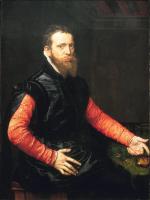
Around 1530 Steven Cornelisz van Herwijck was born at Utrecht.
On 20th March 1616 Utriche Cecil was baptised at Utrecht.
John Evelyn's Diary. 28th May 1641. I went to Leyden; and the 29th to Utredit, being thirty English miles distant, (as they reckon by hours). It was now Kermas, or a fair, in this town, the streets swarming with boors and rudeness, so that early the next morning, having visited the ancient Bishop's court, and the two famous churches, I satisfied my curiosity till my return, and better leisure. We then came to Hynen, where the Queen of Bohemia hath a neat and well-built palace or country-house, after the Italian manner, as I remember; and so, crossing the Rhine, upon which this villa is situated, lodged that night in a countryman's house.
In 1711 William Henry Osborne [aged 21] died of smallpox in Utrecht.
Utriche Cecil was born to Edward Cecil 1st Viscount Wimbledon and Theodosia Noel at Utrecht.

Bede. Pippin gave him a place for his episcopal see, in his famous fort, which in the ancient language of those people is called Wiltaburg, that is, the town of the Wilts; but, in the Gallic tongue, Trajectum. The most reverend prelate having built a church there, and preaching the Word of faith far and near, drew many from their errors, and built many churches and not a few monasteries. For not long after he himself constituted other bishops in those parts from the number of the brethren that either came with him or after him to preach there; of whom some are now fallen asleep in the Lord; but Wilbrord himself, surnamed Clement, is still living, venerable for his great age, having been thirty-six years a bishop, and now, after manifold conflicts of the heavenly warfare, he longs with all his heart for the recompense of the reward in Heaven.
In 1702 Jeremiah Dummer [aged 21] was educated at University of Utrecht.
Henrici Quinti, Angliæ Regis, Gesta, is a first-hand account of the Agincourt Campaign, and subsequent events to his death in 1422. The author of the first part was a Chaplain in King Henry's retinue who was present from King Henry's departure at Southampton in 1415, at the siege of Harfleur, the battle of Agincourt, and the celebrations on King Henry's return to London. The second part, by another writer, relates the events that took place including the negotiations at Troye, Henry's marriage and his death in 1422.
Available at Amazon in eBook and Paperback format.
On 28th June 1061 Floris Gerulfing I Count Holland [aged 36] was killed when he was ambushed retreating from Zaltbommel and killed in battle at Hamerth. His son Dirk [aged 9] succeeded V Count Holland.
In 1634 Pieter Borsseler was born in Middelburg.
After 1687 Pieter Borsseler [deceased] died in Middelburg.