All About History Books on Amazon
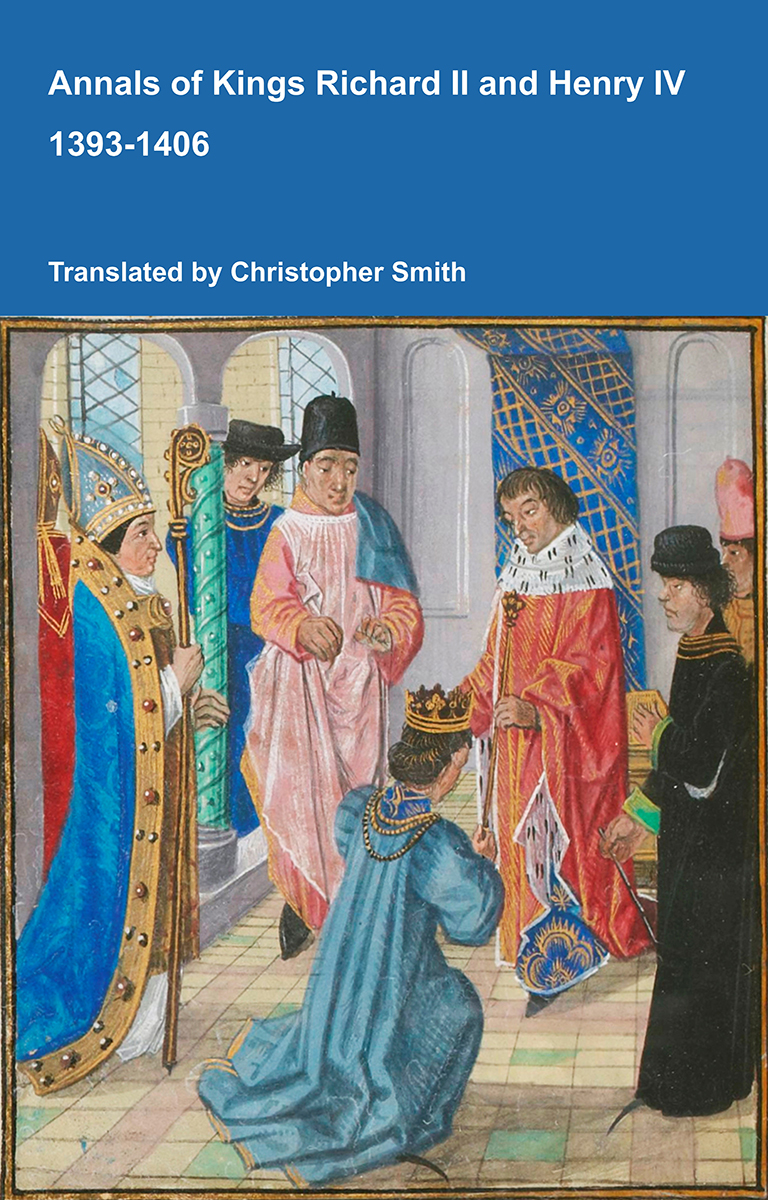
Annals of Kings Richard II and Henry IV 1393-1406
The Annals of Kings Richard II and Henry IV offers a vivid contemporary account of one of the most turbulent periods in late medieval England. Covering the reigns of Richard II and Henry IV, the chronicle records royal ceremonies, political conflict, rebellion, war, taxation, religious controversy, executions, popular unrest and remarkable portents. Its pages include a detailed description of Richard II’s coronation, the fall and deposition of the king, Henry IV’s seizure of the throne, the Percy rebellion, the execution of Archbishop Richard Scrope, the campaigns of Owain Glyndŵr, and England’s relations with Scotland, France, Portugal and Scandinavia. Alongside affairs of state, the annalist preserves reports of miracles, eclipses, prophecies, supernatural events and the experiences of ordinary townspeople, clergy, soldiers and travellers. Written from a monastic perspective, the work combines political observation with moral judgement, presenting victories and disasters as evidence of divine favour or punishment. At once a historical record and a reflection of medieval belief, the Annals provides an invaluable window into the challenges, ceremonies and conflicts of England at the turn of the fifteenth century.
Available at Amazon in eBook and Paperback format.

Winterbourne Stoke East Barrows is in Winterborne Stoke Barrows.
Colt Hoare 1812. In the barrows No. 1 [Winterbourne Stoke East Barrow 1 G60 [Map]] and No. 2 [Winterbourne Stoke East Barrow 2 G59 [Map]], the rites of cremation had been practised, but no circumstances worthy of any particular detail occurred.
Colt Hoare 1812. No. 3 [Winterbourne Stoke East Barrow 3 G59a [Map]] and No. 4 [Winterbourne Stoke East Barrow 4 G58 [Map]] had been opened by shepherds, and contained interments of burned bones. In the former was found a little cup. which Mr. Gunnington purchased.
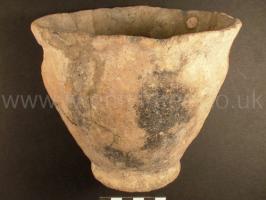
Wiltshire Museum. DZSWS:STHEAD.276. 1 food vessel with no decoration, found with a primary cremation in bowl barrow Winterbourne Stoke G59a [Map], excavated by William Cunnington.
Colt Hoare 1812. No. 3 [Winterbourne Stoke East Barrow 3 G59a [Map]] and No. 4 [Winterbourne Stoke East Barrow 4 G58 [Map]] had been opened by shepherds, and contained interments of burned bones. In the former was found a little cup. which Mr. Gunnington purchased.
Wiltshire Museum. DZSWS:STHEAD.70d. 1 bone pin with flat head and bevelled perforation (broken in half) found with a primary cremation in bowl barrow Winterbourne Stoke G58 [Map], excavated by William Cunnington.
Wiltshire Museum. DZSWS:STHEAD.82. 1 miniature cup (incense cup?) without decoration found with a primary cremation in bowl barrow Winterbourne Stoke G58 [Map], excavated by William Cunnington.
Colt Hoare 1812. No. 5 [Winterbourne Stoke East Barrow 5 G58a [Map]] contained an urn very imperfectly baked, and within it an interment of burned bones, and a very small arrow head of bone.
Colt Hoare 1812. No. 6 [In Winterbourne Stoke East Barrow 6 G55a [Map]] the ceremony of burning had been adopted.
Colt Hoare 1812. No. 7 [Winterbourne Stoke East Barrow 7 G56 [Map]]. This large barrow produced three interments. At the depth of four feet and a half, we discovered the skeleton of an infant, with its head laid towards the south; and immediately beneath it, a deposit of burned bones, and a drinking cup, which was unfortunately broken. At the depth of eight feet, and in the native bed of chalk, we came to the primary interment, viz. the skeleton of a man lying from north to south, with his legs gathered up according to the primitive custom. On his right side, and about a foot or more above the bones, was an enormous stag's horn. This was certainly the original deposit; chough we find the same mode of interment, as well as cremation adopted at a subsequent period near the surface of the barrow.
Wiltshire Museum. DZSWS:STHEAD.71a. 1 fragment of red deer antler found with a primary inhumation in bowl barrow Winterbourne Stoke G56 [Map], excavated by William Cunnington.
Colt Hoare 1812. No. 8 [Winterbourne Stoke East Barrow 8 G57 [Map]] is a large old-fashioned bowl-shaped tumulus, the base diameter being nearly one hundred feet. It contained a skeleton lying on the floor with its bead towards the north, and much decayed from its having been covered with vegetable earth. Mr. Cunnington, supposing that this barrow contained more interments, made a second trial, but procured no further information.
Colt Hoare 1812. The remaining three barrows within this enclosure, viz. 9 [Map], 10 [Map], 11 [Map], which have before mentioned as being placed nearly at equal distances from the vallum, and forming a kind of triangle, afforded, on opening, no one appearance of sepulchral remains; and for what purpose they could have been raised, it is impossible for me to determine; it is rather singular that eiÜht out of the eleven tumuli which are enclosed within this work should have each proved sepulchral, and these not so.