

See Sculptors.
On 21st April 1821 George Gammon Adams was born to James Adams at Staines.
In 1827 George Gammon Adams [aged 5] was apprenticed to the chief engraver, William Wyon RA, at the Royal Mint.
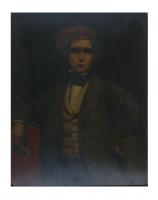
Around 1836. Unknown Painter. Portrait of George Gammon Adams [aged 14].
In 1840 George Gammon Adams [aged 18] was admitted to Royal Academy Schools and exhibited there from 1841. His address at the time was 1 South Place, Pimlico.
In 1846 George Gammon Adams [aged 24] briefly studied under John Gibson in Rome.
In 1847 George Gammon Adams [aged 25] was awarded a Royal Academy Gold Medal for his group "Murder of the Innocents".
On 14th September 1852 Arthur Wellesley 1st Duke Wellington [aged 83] died at Deal Castle [Map]. His son Arthur [aged 45] succeeded 2nd Duke Wellington, 2nd Viscount Wellington of Talavera. Elizabeth Hay Duchess Wellington [aged 31] by marriage Duchess Wellington.
George Gammon Adams [aged 31] took the death mask of the Duke of Wellington, the marble bust he executed from it being highly regarded by the Duke's heirs.
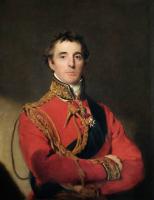
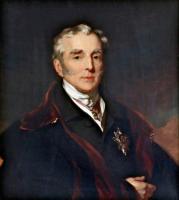
Art Journal 1858. Napier from the statue by G G Adams [aged 36]
This statue of the "Hero of Scinde," the name by which the gallant Napier is familiarly known among us, stands at the south-west angle of Trafalgar Square; it was erected by public subscription, a very considerable amount of the sum collected being contributed by the non-commissioned officers and the privates of the troops who at various times had served under his command.
General Charles James Napier, K.C.B., &c., was eldest son of the Honourable George Napier and Lady Sarah Lennox, daughter of the second Duke of Richmond; he was born in 1782. At the early age of twelve years lie obtaiued a commission in the 33ril, the Duke of Wellington's regiment, but did not join the army for active service till some time after in truth, though war was raging throughout the world, Napier was "on duty" at home, till his twenty-seventh year, when, as major in the 50th regiment, he was suddenly called to Portugal, after the battle of Vimeira. On account of the absence of his colonel, the command of the regiment devolved upon Napier; and it was the 50th that mainly sustained the assailing columns of the French at Corunna in the action he was severely wounded, and made prisoner, was soon after exchanged, by Ney, and returned to England. He remained at home for a few months, and then again joined the British army, as a volunteer, in the Peninsula, and served uuder Wellington, till promotion brought him once more to England.
Art Journal 1858. Mr. Adams's [aged 36] statue is a faithful and characteristic representation of. the "Hero of Scinde;" we see in it the man as he was when living. The sculptor has abstained — notwithstanding he had many inducements, artistically, for so doing — from modifying, to any extent, the peculiarities of personal appearance, and from any sculpturesque introductions that might give additional elegance to the work it is a bold, animated copy of a bold, lion-hearted, and generous soldier. The sculptor, we believe, is at present engaged upon another statue of the general, different in design, to be erected in St. Paul's Cathedral, out of the surplus funds, so we understand, of the public subscription.
After 3rd August 1860. Memorial to Elizabeth Knight [deceased] at St Mary's Church, Elton [Map] sculpted by George Gammon Adams [aged 39].
Elizabeth Knight: On 18th March 1798 she was born to Thomas Andrew Knight of Downton Castle in Herefordshire. On 3rd August 1860 she died.
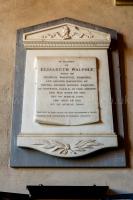
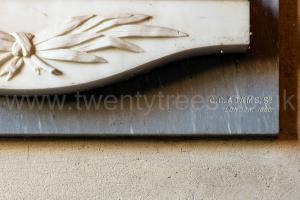

After 10th September 1863. Church of St Mary, East Raynham [Map]. Memorial to John Townshend 4th Marquess Townshend [deceased] sculpted by George Gammon Adams [aged 42].
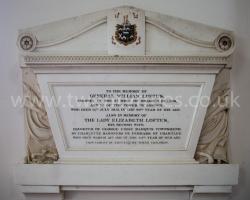
Before 1898. Memorial to General William Loftus and Elizabeth Townshend at the Church of St Mary, East Raynham [Map] sculpted by George Gammon Adams [aged 76].
Elizabeth Townshend: Around 1767 she was born to George Townshend 1st Marquess Townshend and Charlotte Compton 16th Baroness Ferrers Chartley 7th Baroness Compton. On 7th May 1790 General William Loftus and she were married. She the daughter of George Townshend 1st Marquess Townshend and Charlotte Compton 16th Baroness Ferrers Chartley 7th Baroness Compton. On 21st March 1811 she died.
On 4th March 1898 George Gammon Adams [aged 76] died. He was buried in family vault in Staines Cemetery.