

 Minster and Parish Church of Saint Peter-at-Leeds
 Church of the Holy Cross, Gilling East
 Bradford Cathedral
 St Bartholomew's Church, Armley
 Church of St John the Baptist, Stanwick, North Yorkshire
 St Luke's Church Gaddesby, Leicestershire
 Rome, Italy
 Durham Cathedral
Paternal Family Tree: Gott
See Sculptors.

On or before 11th December 1785, the date he was baptised, Joseph Gott was born to Unamed Gott at Calverley. His parentage appears subject to some confusion being described by some sources as the son of Benjamin Gott [aged 23], some as his second cousin; we have adopted the former relationship.
Between 1798 and 1802 Joseph Gott [aged 12] was apprenticed to John Flaxman [aged 42].
In 1806 Joseph Gott [aged 20] won a Royal Academy Silver Medal.
In 1819 Joseph Gott [aged 33] won a Royal Academy Gold Medal for his work "Jacob wrestling with the Angel".
Between 1820 and 1848 Joseph Gott [aged 34] exhibited thirteen times at the Royal Academy, showing some thirty works in all.
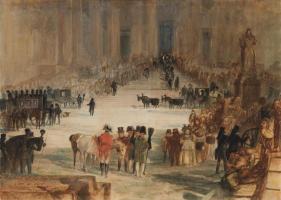
In 1822 Joseph Gott [aged 36] was sent to Rome on a pension from Sir Thomas Lawrence [aged 52] who provided him with a personal letter of introduction to Antonio Canova [aged 64]. Gott remained in Rome for the rest of his life.
1828. Minster and Parish Church of Saint Peter-at-Leeds [Map]. Monument to Tomas Lloyd, died 1828, by Joseph Gott [aged 42].
After 1828. Church of the Holy Cross, Gilling East [Map]. Monument to Thomas Fairfax [aged 27] sculpted by Joseph Gott [aged 42]. White marble figure of Piety reclining over two urns.
To the memory of Thomas Fairfax esq. 2nd son of Charles Gregory Fairfax [aged 60] esq of Gilling Castle and Mary his wife. Born April 12 1800: Died August 18 1828.
Adorned with talent and a mind replete with every kind and benevolent feeling breathing happiness and cheerfulness on all around him fulfilling every social duty in its most extended sense in the midst of receiving and conferring that enjoyment of life which only such a mind can receive and give.
He was suddenly torn from his family, of whom he was the pride and delight, and to whom he was endeared by every filial and fraternal virtue, leaving a void that can never be supplied
Thy will be done, not mine, supreme disposer of events heaven gave him to our wish, that gift heaven has resumed.
Thomas Fairfax: On 12th April 1800 he was born to Charles Gregory Pigot aka Fairfax and Mary Goodricke. On 18th August 1828 he died.


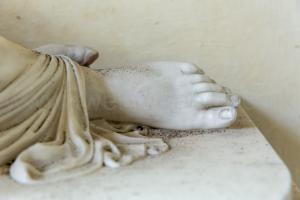
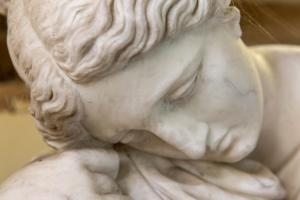

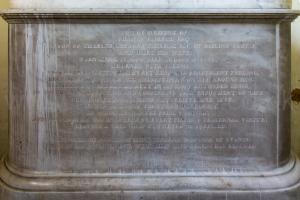

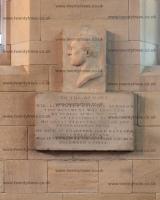
After 1833. Bradford Cathedral [Map]. Memorial to Dr William Sharp, surgeon (d.1833) by Joseph Gott [aged 47].
Around 1838 the workshop of Joseph Gott [aged 52] went into decline following a cholera epidemic that stopped the flow of tourists.
On 14th February 1840 Benjamin Gott [aged 77] died. He was buried at St Bartholomew's Church, Armley [Map] where there is a monument to him sculpted by his son Joseph Gott [aged 54]. The pink veined marble base has a darkened plaque with tribute which includes the words: '...he maintained with inflexible uprightness the character of a merchant with impartial justice the office of a magistrate and with unshaken confidence the warmth of friendship he was always ready to promote the welfare of the town of Leeds...'
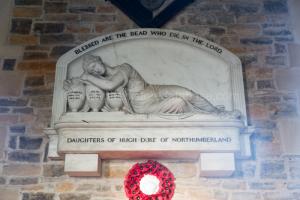
On 20th June 1844 Emily Frances Percy Baroness Goldolphin Helston [aged 56] died.
Monument to the daughters of Hugh Percy 2nd Duke Northumberland in Church of St John the Baptist, Stanwick, North Yorkshire [Map] sculpted by Joseph Gott [aged 58].
Emily Frances Percy Baroness Goldolphin Helston: In 1788 she was born to Hugh Percy 2nd Duke Northumberland and Frances Julia Burrell Duchess Northumberland. On 19th May 1810 James Murray 1st Baron Glenlyon and she were married at St Martin in the Fields Church [Map]. She the daughter of Hugh Percy 2nd Duke Northumberland and Frances Julia Burrell Duchess Northumberland. He the son of John Murray 4th Duke Atholl.
On 3rd March 1848 Edward Hawkins Cheney [aged 69] died. St Luke's Church Gaddesby, Leicestershire [Map]. Monument to Edward Hawkins Cheney of the Royal Scots Greys fighting at Waterloo. His horse shot, collapsing; one of five he rode into battle at Waterloo. The frieze below the sculpture depicts Sergeant Ewart, related to Cheney by marriage, seizing the French Eagle Standard. Sculpted by Joseph Gott [aged 62].
Edward Hawkins Cheney: On 7th November 1778 he was born. On 18th June 1815 Edward Hawkins Cheney fought at the Battle of Waterloo.
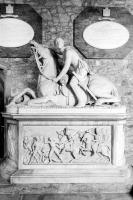


On 8th January 1860 Joseph Gott [aged 74] died at Rome, Italy [Map].
Durham Cathedral [Map]. Memorial to Emily Frances Cadogan died aged five. Sculpted by Joseph Gott.
Emily Frances Cadogan: In 1838 she was born to Henry Cadogan 4th Earl Cadogan and Mary Sarah Wellesley Countess Cadogan. Coefficient of inbreeding 6.25%. On 5th October 1843 she died.
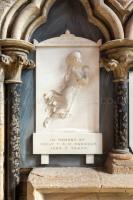

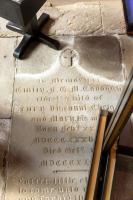
St Bartholomew's Church, Armley [Map].There is a sculpture by Joseph Gott at the west end of the north aisle, a memorial to Benjamin Gott of Armley House who died in 1839. In the south aisle there is Faith comforting the Mourner, commemorating the two sons of Benjamin and Elizabeth Gott who died in Paris and Athens.
Great x 1 Grandfather: Unamed Gott
Grandfather: Unamed Gott
Father: Unamed Gott