

Evesham Abbey is in Evesham, Worcestershire [Map], Abbeys in England.
Between 700 and 710 Evesham Abbey [Map] was a Benedictine founded by Saint Egwin.
Before 946 Abbot Edwin was appointed Abbot of Evesham.
In 975 Abbot Osward was appointed Abbot of Evesham.
Before 983 Abbot Freothegar was appointed Abbot of Evesham.
In 1013 Abbot Æthelwine was appointed Abbot of Evesham.
In 1014 Bishop Ælfweard of London was appointed Abbot of Evesham.
In 1014 Abbot Ælfweard was appointed Abbot of Evesham.
On 10th August 1044 Abbot Mannius was consecrated Abbot of Evesham.
Anglo-Saxon Chronicle. After 27th July 1054. This same year went Bishop Aldred south over sea into Saxony, to Cologne, on the king's errand; where he was entertained with great respect by the emperor, abode there well-nigh a year, and received presents not only from the court, but from the Bishop of Cologne and the emperor. He commissioned Bishop Leofwine to consecrate the minster at Evesham [Map]; and it was consecrated in the same year, on the sixth before the ides of October. This year also died Osgod Clapa suddenly in his bed, as he lay at rest.
In 1058 Abbot Mannius resigned as Abbot of Evesham as a consequence of being stricken by paralysis.
On 23rd April 1058 Abbot Ælfwine was consecrated Abbot of Evesham.
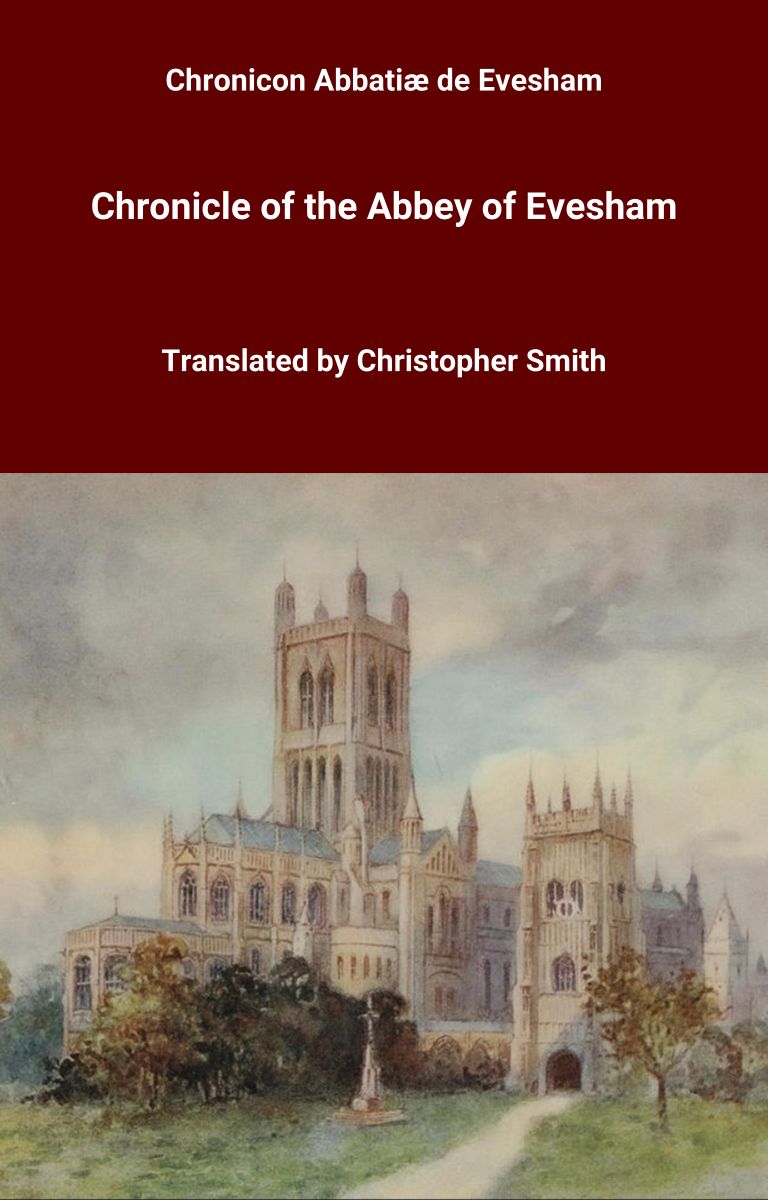 Chronicle of the Abbey of Evesham. A certain matron named Algitha, who during the time of the aforesaid King Edward frequently visited the church of St Ecgwin [Map], conceived the idea, out of love for the saint, of trying by every means to obtain something of his relics. She therefore began cunningly to consider how she might most easily accomplish her desire. Secretly summoning some boys of the place and, as is said, giving them gifts and promising them greater ones, she asked them to obtain for her in secret even some small part of the relics of St Ecgwin, so that they might thereby receive a greater reward from her. For she knew that people of that age had less understanding and could more easily be deceived. The boys agreed and began to look for a time and hour when they might fulfil their promise without anyone else knowing. But what will burning greed not dare? Avarice accomplished its purpose through their immature age. By night the boys went to the shrine of St Ecgwin and, quickly opening the casket, stole away a great treasure, more precious than any pearl. Alas! With irreverent and reckless hands they handled the saint's limbs and, taking away part of an arm together with one tooth, endeavoured secretly to carry them to the matron. But divine vengeance did not long delay in taking punishment for such incredible audacity, as what followed made clear. For the aforesaid matron, receiving the treasure she had so long desired, returned joyfully home. Having honourably placed the relics of St Ecgwin, as well as she could, in a very clean little reliquary, she believed that she would enjoy the fruits of her theft for a long time. But behold, St Ecgwin, the man of God, appeared to the matron in a vision by night and ordered her to carry him back to his proper place, saying that he had been unjustly taken from there by her. She disregarded the command, and a second time she was warned by a similar vision. But when she did not obey even then, and because of her excessive desire to possess the relics dismissed the visions as mere phantoms, St Ecgwin finally appeared to her in a third vision and, greatly angered, ordered her to take him back. When she refused, the saint said, "Before tomorrow's sun shines forth as usual, you will wish that you had obeyed my commands." Why prolong the story? At daybreak the matron arose blind, though her eyes were open, and for as long as she remained alive she continued in perpetual blindness, despite having most beautiful eyes. Afterwards, however, though too late, she sent to Mannius, who at that time was abbot of the monastery of St Ecgwin, asking permission to keep the relics and promising that she would make a shrine adorned with gold and silver in honour of them. She also promised that, when she died, she would without fail give the shrine itself with the relics, and in addition her own estate, which the inhabitants call Suella, to St Ecgwin and his servants. Although she was prevented by the sin of her son from fulfilling this promise herself, Almighty God afterwards brought it to fulfilment through the lord and most prudent Abbot Ælfwine1, successor of the lord and most skilful Abbot Mannius. For that same abbot obtained by judgement the aforesaid estate, which had been given to him as a pledge, because of the difficulty in repaying the money. He also, after identifying the shrine at Worcester, with God's help brought it into his own possession, and it is preserved to the present day in the monastery of St Ecgwin. So much for the matron. The boys mentioned above, who had been responsible for the aforesaid theft, eventually fell grievously under the judgement of God. One of them was drowned in water, while another, for as long as he lived, was continually afflicted without respite by a very severe bodily illness.
Matrona quædam, Algitha nomine, dum sæpius tempore prædicti regis Eadwardi ecclesiam sancti Ecgwini frequentaret, venit ei in mentem ob amorem sancti omnimodis tentare si quicquam de reliquiis ejus valeret acquirere. Cœpit igitur callide volutare qualiter desiderium suum posset facilius perpetrare. Accitis itaque secreto pueris loci, eisque, ut fertur, dona tribuens et ampliora promittens, rogavit quatenus sibi de reliquiis sancti Ecgwini vel modicum quid clam perquirerent, ut per hoc majorem mercedem ab ea perciperent. Sciebat enim illam ætatem minus habilem intelligentiæ leviusque posse decipi. Præbent assensum pueri, et cœpere quærere tempus et horam qua sine notitia aliorum implerent promissum. Verum quid non audet ardens cupiditas? Per infirmam ætatem perficit avaritia suum officium. Pergunt nocte pueri ad sancti Ecgwini feretrum, apertoque velociter scrinio, furto auferunt magnum thesaurum, omni margarita preciosiorem. Proh dolor! Temerariis manibus irreverenter tractant membra sancti, et, sublatas parte brachii cum uno dente, matronæ studuere clanculum deportare. Verum enimvero super tam incredibili audacia non diu distulit, ut in sequenti patuit, vindictam sumere ultio divina. Nam sumens prædicta matrona diu desideratum thesaurum, læta repedavit ad propria. Locatis igitur honorifice secundum suum posse reliquiis sancti Ecgwini in mundissimo locello, credebat se diutius gavisuram de furto. Quum ecce! sanctus Domini Ecgwinus per visionem matronæ noctu apparens, jubet eam se ipsum proprium reportare ad locum, dicens se injuste ab ipsa inde fuisse sublatum. Negligit illa imperata, et identidem secunda admonita est ejusmodi visione. Sed quum nec sic obtemperaret, verum ob nimiam cupiditatem habendi visiones phantasiæ deputasset, tertia demum visione venit sanctus Ecgwinus, [et,] valde commotus, jubet ut se reduceret. Qua negante, "Prius," inquit sanctus, "quam crastinus Titan solito refulserit, velles meis obtempe rasse præceptis." Quid moras nectimus? Matrona diluculo surgit apertis oculis cæca, sicque dum præsenti usa est vita, pulcherrimos habens oculos, permansit in perpetua crecitate. Misit tamen postea, licet sero, ad Mannium, ea tempestate abbatem monasterii sancti Ecgwini, quærens licentiam habendi reliquias, et promittens se feretrum ex auro et argento adornatum ob honorem reliquiarum facturam. Spopondit etiam ipsum scrinium cum reliquiis, et insuper terram propriam quæ Suella ab incolis vocitatur, quum vita decederet proculdubio sancto Ecgwino ejusque servis datuQuam sponsionem, licet peccato filii sui præpedita per se implere nequiret, implevit tamen postea Omnipotens per dominum ac prudentissimum Agelwinum abbatem, successorem videlicet domini et artificiosissimi Mannii abbatis. Nam idem abbas et prædictam villam, quæ sibi in vadimonium tradita fuerat, ob difficultatem reddendæ pecunise judicio obtinuit, et etiam scrinium quum apud Wigorniam recognovisset per Dei adjutorium suo dominio mancipavit, quod usque inpræsentiarum in monasterio sancti Ecgwini servatur. Hactenus de matrona. Pueri vero supra commemorati qui præfati furti auctores exstiterunt, judicio Dei demum graviter subjacuerunt. Nempe quidam ex eis in aqua necatus est, quidam vero quoad vixit molestia corporali pane sine intercapedine gravissime detentus est.
Note 1. Abbot Ælfwine was consecrated on 23rd April 1058 succeeding Mannius who had resigned as consequence of being stricken by paralysis. Mannius died on 5th January 1065.
In May 1077 Abbot Walter was appointed Abbot of Evesham.
In 1086 Abbot Robert was appointed Abbot of Evesham.
After 9th September 1096 Abbot Maurice was appointed Abbot of Evesham.
In 1130 Abbot Reginaldwas appointed Abbot of Evesham.
In 1149 Abbot William of Andeville was appointed Abbot of Evesham.
After 4th January 1159 Abbot Roger was appointed Abbot of Evesham.
In 1161 Abbot Adam de Senlis was appointed Abbot of Evesham.
After 12th November 1191 Abbot Roger Norreis was appointed Abbot of Evesham.
Chronicle of the Abbey of Evesham. In that same year, after Adam’s departure, there died that monk who had been most steadfast in the affairs of the church, namely Master Thomas of Norwich, for whom all friends of this church ought to pray. The tower of the church [Map] also fell and crushed the presbytery. Apart from the shrines of Saint Ecgwine, Saint Odulf and Saint Credan, which were miraculously preserved, it destroyed everything precious there, including the shrine of Saint Wistan and the other shrines, the high altar, the panels, and the other ornaments around it. Of all these things I restored the greater part, both before my priorship and after it, from funds which I had obtained through my own labour and industry, amounting to as much as one hundred marks. The other brethren also worked vigorously with me to restore everything in a better form. For the abbot had appropriated to himself the revenues assigned to the works, and because these funds were lacking, the unfinished tower collapsed.
Eodem vero anno post recessum ejus mortuus est ille in negotiis ecclesiæ constantissimus monachus, magister videlicet Thomas de Northwich, pro quo omnibus hujus ecclesiæ amicis est orandum; et turris ecclesiæ cecidit et comminuit presbyterium et (exceptis feretris sancti Egwini, sancti Thomas de tower of Odulfi, et sancti Credani miraculose conservatis) omnia quæcumque erant preciosa in eo cum feretro sancti Wistani et aliis feretris et majori altari et tabulis et aliis ornamentis circa illud existentibus. Quorum omnium maximam partem tam ante prioratum meum quam post prioratum expensis labore meo et industria acquisitis usque ad summam centum marcarum reparavi, et alii fratres viriliter mecum omnia in melius reformaverunt, quia redditus operis abbas sibi appropriavit, pro quorum defectu turris imperfecta cecidit.
On 22nd November 1213 Abbot Roger Norreis was deposed as Abbot of Evesham.
On 22nd January 1214 Abbot Randulf was elected Abbot of Evesham.
In 1230 Abbot Thomas of Marlborough was appointed Abbot of Evesham.
On 25th September 1236 Abbot Richard le Gras was elected Abbot of Evesham.
On 30th November 1236 Abbot Richard le Gras was consecrated Abbot of Evesham.
On 7th December 1236 Abbot Richard le Gras was installed as Abbot of Evesham.
On 23rd February 1238 Hugh Despencer [aged 41] died at Evesham, Worcestershire [Map]. He was buried at Evesham Abbey [Map].
After 3rd August 1282 Abbot John of Brockhampton was elected Abbot of Evesham.
On 30th August 1316 Abbot William de Chiriton was elected Abbot of Evesham.
On 1st January 1345 Abbot William Boys was elected Abbot of Evesham.
On 4th July 1367 Abbot John of Ombersley was elected Abbot of Evesham.
On 20th November 1379 Abbot Roger Zatton was elected Abbot of Evesham.
On 24th December 1379 Abbot Roger Zatton was installed as Abbot of Evesham.
On 6th December 1418 Abbot richard Bromsgrove was elected Abbot of Evesham.

Minutes of the Society of Antiquaries. 13th November 1718. Mr Norroy [aged 57] brought us an old roll in Parchment of the Blazon of the Coats of Aarms of all the County of Norfolk in the time of Henry VII said to be done by the Botton[?] herald to Sir John Falstaff. An old deed upon parchment of Edward the Confessor, a piece of great antiquity. Its a donation of a Mannor [Manor] in Great Swell [Map] in Gloucestershire to the Abby of Evesham [Map]. Likewise two curious old books of seals of the nobility, with many ancient deeds, &c.