

 Blackhammer Chambered Cairn
 Knowe of Ramsay, Rousay
 Knowe of Rowiegar, Rousay
 Knowe of Yarso Chambered Cairn
 Midhowe Chambered Cairn
 Taversoe Tuick
Rousay is in Orkney Northern Islands.
3000BC. Blackhammer Chambered Cairn [Map] is a Neolithic chambered cairn located on the island of Rousay, in Orkney, Scotland. The tomb, constructed around 3000 BC, is a Orkney–Cromarty chambered cairn, characterized by stalled burial compartments. The oblong tomb measures 22.5 m (74 ft) by 8.9 m (29 ft) externally. The cairn encloses a long burial chamber measuring 13.5 m (44 ft) by 2.0 m (6 ft 7 in), and 2.0 m (6 ft 7 in) in height.
Knowe of Ramsay, Rousay [Map]. An Orkney-Cromarty stalled cairn, near the edge of one of the natural terraces above the shore overlooking the "Knowe of Lairo" (HY32NE 6). It is now a low grass-grown mound with a hollow down the centre from which some flagstones protrude . It had much the same appearance before excavation in 1935, when it was found that it had already been severely robbed and disturbed. The cairn, with its major axis NW-SE, is 103' long; the SE end, which contains the entrance passage, is square, 15' in width. The sides diverge to give a maximum width of 24' and then converge into the rounded NW end. It is edged by a wall face of horizontally laid stones, greatly dilapidated but surviving to a height of 4'2" on the SW side; there is no second wall-face. Against the W side of the NW end is a rough block of masonry, possibly part of an unfinished outer casing to the cairn, and at the SE end on the E side a wall 7'9" long abuts the cairn at right angles. The passage is 6'5" long and 1' 8" wide, with a maximum height of 2'4". The chamber, 88' long and from 3'11" to 6'8" wide, is divided into 14 compartments by pairs of transverse slabs, 2'6" - 4'9" high. The end of the chamber is formed by a large stone on edge. A small stone cist was found near the SW corner of the fifth compartment from the entrance. Finds from the site included: about 6 small sherds of reddish ware, a scraper and 5 pieces of flint, human bones very broken and decayed and numerous animal bones.
Carbon Date. 2340BC. Early Bronze Age Carbon Dates
Report: Bone, id as?bovine ribs, from Knowe of Ramsay [Map], Rousay, Orkney, Scotland.
ID: 4436, C14 ID: Q-1223 Date BP: 4340 +/- 65, Start Date BP: 4275, End BP: 4405
OS Letter: HY, OS East: 400, OS North: 280
Archaeologist Name: Callander and Grant 1936
Reference Name: Antiquity, 50, 1976, 194-203; C Renfrew (ed), 'The prehistory of Orkney' (1985)
Council for British Archaeology (2012) Archaeological Site Index to Radiocarbon Dates from Great Britain and Ireland [data-set]. York: Archaeology Data Service [distributor] https://doi.org/10.5284/1017767
Carbon Date. 2300BC. Early Bronze Age Carbon Dates
Report: Bone, id as red deer humerus, metacarpals and radius, from Knowe of Ramsay [Map], Rousay, Orkney, Scotland.
ID: 4437, C14 ID: Q-1224 Date BP: 4300 +/- 60, Start Date BP: 4240, End BP: 4360
OS Letter: HY, OS East: 400, OS North: 280
Archaeologist Name: Callander and Grant 1936
Reference Name: Antiquity, 50, 1976, 194-203; C Renfrew (ed), 'The prehistory of Orkney' (1985)
Council for British Archaeology (2012) Archaeological Site Index to Radiocarbon Dates from Great Britain and Ireland [data-set]. York: Archaeology Data Service [distributor] https://doi.org/10.5284/1017767
Carbon Date. 2010BC. Early Bronze Age Carbon Dates
Report: Bone, id as Bos metacarpals, tibiae and ulna, from Knowe of Ramsay [Map], Rousay, Orkney, Scotland.
ID: 4438, C14 ID: Q-1222 Date BP: 4010 +/- 60, Start Date BP: 3950, End BP: 4070
OS Letter: HY, OS East: 400, OS North: 280
Archaeologist Name: Callander and Grant 1936
Reference Name: Antiquity, 50, 1976, 194-203; C Renfrew (ed), 'The prehistory of Orkney' (1985)
Council for British Archaeology (2012) Archaeological Site Index to Radiocarbon Dates from Great Britain and Ireland [data-set]. York: Archaeology Data Service [distributor] https://doi.org/10.5284/1017767
Knowe of Rowiegar, Rousay [Map]Knowe of Rowiegar, an Orkney-Cromarty type stalled cairn, now a grass-covered mound with a few slabs projecting near the centre.
The mound was excavated by W G Grant in 1937, who found that the SE end had been so badly damaged that it obscured all trace of the entrance, and that an earth-house had been constructed in the easternmost half of the cairn. Other Iron Age building, datable by pottery (J Phemister 1942) and other relics, lay on and around the cairn.
Carbon Date. 2305BC. Early Bronze Age Carbon Dates
Report: Bone, id as Bos tibia and radius, from Knowe of Rowiegar [Map], Rousay, Orkney, Scotland.
ID: 4439, C14 ID: Q-1221 Date BP: 4305 +/- 60, Start Date BP: 4245, End BP: 4365
OS Letter: HY, OS East: 373, OS North: 298
Archaeologist Name: W G Grant c 1940s
Reference Name: Antiquity, 50, 1976, 194-203; C Renfrew (ed), 'The prehistory of Orkney' (1985)
Council for British Archaeology (2012) Archaeological Site Index to Radiocarbon Dates from Great Britain and Ireland [data-set]. York: Archaeology Data Service [distributor] https://doi.org/10.5284/1017767
Carbon Date. 2005BC. Early Bronze Age Carbon Dates
Report: Charcoal, id as red deer femur, tibia and humerus, from Knowe of Rowiegar [Map], Rousay, Orkney, Scotland.
ID: 4440, C14 ID: Q-1227 Date BP: 4005 +/- 60, Start Date BP: 3945, End BP: 4065
OS Letter: HY, OS East: 373, OS North: 298
Archaeologist Name: W G Grant c 1940s
Reference Name: Antiquity, 50, 1976, 194-203; C Renfrew (ed), 'The prehistory of Orkney' (1985)
Council for British Archaeology (2012) Archaeological Site Index to Radiocarbon Dates from Great Britain and Ireland [data-set]. York: Archaeology Data Service [distributor] https://doi.org/10.5284/1017767
3500BC. Knowe of Yarso Chambered Cairn [Map] is a Neolithic burial monument located on the island of Rousay in Orkney, Scotland. The site was excavated in the 1930s, and uncovered human and animal bones as well as pottery sherds, flint and bone tools, and arrowheads. The tomb, dating to the period between 3500 and 2500 BC, is a stalled chambered cairn. Archaeological excavation during the 1930s revealed a rectangular-shaped cairn measuring 15 m (49 ft) by 8 m (26 ft) externally and situated northwest-southeast. The cairn encloses a burial monument measuring 8 m (26 ft) by 2 m (6 ft 7 in) with a surviving height of 2 m (6 ft 7 in). The roof to the tomb had been removed at some point when the tomb was robbed. The exterior walls of the tomb display decorative stonework which can be seen near the entrance.

The True Chronicles of Jean le Bel Volume 2 Chapters 61-109 1342-1361
The Chronicle of Jean le Bel, Volume 2 continues one of the most important fourteenth-century accounts of the early Hundred Years’ War. Written by the Liège chronicler Jean le Bel, this vivid narrative follows the fortunes of Edward III, Jean II of France, the Black Prince, the great nobles of France and England, and the soldiers, captains and companies who shaped the conflict. This volume covers some of the most dramatic events of the period, including the battles of Crécy and Poitiers, the siege and capture of Calais, the captivity of King John, the rise of the Jacquerie, the turmoil in Paris under Étienne Marcel and Charles of Navarre, the devastation caused by the free companies, Edward III’s great campaign of 1359–1360, and the negotiations leading to the Treaty of Brétigny. Jean le Bel’s chronicle is especially valuable for its lively detail, its interest in chivalry, warfare, politics and reputation, and its influence on later chroniclers, most famously Froissart. This English translation presents the text in clear, readable British English while preserving the force and character of the original narrative. The translation includes extensive notes to help the reader better understand Jean le Bel's text. Volume 2 also includes translated appendices drawn from royal and administrative records, many from the English Record Office, which illuminate Edward III’s campaigns in Brittany, the siege and occupation of Calais, naval preparations, military finance, appointments, safe conducts and related affairs.
Available at Amazon in eBook and Paperback format.
Carbon Date. 2225BC. Early Bronze Age Carbon Dates
Report: Bone, id as?red deer tibiae, from Knowe of Yarso [Map], Rousay, Orkney, Scotland.
ID: 4443, C14 ID: Q-1225 Date BP: 4225 +/- 60, Start Date BP: 4165, End BP: 4285
OS Letter: HY, OS East: 404, OS North: 281
Archaeologist Name: Callander and Grant 1935
Reference Name: Antiquity, 50, 1976, 194-203; Proc Soc Antiq Scot, 69, 1935, 325-51; C Renfrew (ed), 'The prehistory of Orkney' (1985)
Council for British Archaeology (2012) Archaeological Site Index to Radiocarbon Dates from Great Britain and Ireland [data-set]. York: Archaeology Data Service [distributor] https://doi.org/10.5284/1017767

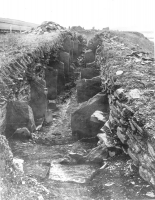
Knowe of Yarso Chambered Cairn [Map]. During excavation in 1934.
Midhowe Chambered Cairn [Map] is a particularly well preserved example of the Orkney-Cromarty type of chambered cairn. Tombs of this type are often referred to as "stalled" cairns due to their distinctive internal structure. Stalled cairns have a central passageway flanked by a series of paired transverse stones that separate the side spaces into compartments that reminded early investigators of horse stalls.
Unstan Ware is finely decorated early Neolithic Pottery from the 4th Millenium BC and the 3rd Millenium BC; elegant shallow bowls with a groove-pattern around the rim, or undecorated round bottomed bowls. The name is from the Unstan Chambered Cairn [Map] where the pottery was first found in 1884. Unstan Ware is found in tombs: Midhowe Chambered Cairn [Map], Tomb of the Eagles [Map], Taversoe Tuick [Map] as well as farmsteads: Knap of Howar [Map].
Midhowe Chambered Cairn [Map]. During excavation 1832.



Carbon Date. 1850BC. Middle Bronze Age Carbon Dates
Report: Bone, id as Bos humerus and femur, from Rinyo, Rousay, Orkney, Scotland.
ID: 4308, C14 ID: Q-1226 Date BP: 3850 +/- 70, Start Date BP: 3780, End BP: 3920
OS Letter: HY, OS East: 440, OS North: 321
Archaeologist Name: Childe and Grant 1939/48
Reference Name: Antiquity, 50, 1976, 194-203; Proc Soc Antiq Scot, 73, 1939, 6-31; Renfrew (ed), Prehistory of Orkney (1985) [synth & calibrn]
Council for British Archaeology (2012) Archaeological Site Index to Radiocarbon Dates from Great Britain and Ireland [data-set]. York: Archaeology Data Service [distributor] https://doi.org/10.5284/1017767
Unstan Ware is finely decorated early Neolithic Pottery from the 4th Millenium BC and the 3rd Millenium BC; elegant shallow bowls with a groove-pattern around the rim, or undecorated round bottomed bowls. The name is from the Unstan Chambered Cairn [Map] where the pottery was first found in 1884. Unstan Ware is found in tombs: Midhowe Chambered Cairn [Map], Tomb of the Eagles [Map], Taversoe Tuick [Map] as well as farmsteads: Knap of Howar [Map].