

See Antiquaries.
On 12th March 1626 John Aubrey was born to Richard Aubrey.
In 1649 John Aubrey [aged 22] visited Avebury for the first time. In Monumenta Britanica he writes: "The chase led us at length through the village of Avebury, into the closes there: where I was wonderfully surprised at the sight of those vast stones: of which I had never heard before … I observed in the enclosures some segments of rude circles, made with these stones; whence I concluded, they had been in the old time complete."

1663. John Aubrey [aged 36]. Ground Plan of Avebury from Monumenta Brittannica.
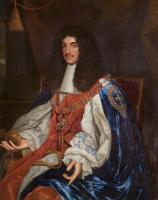
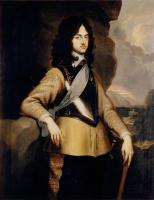
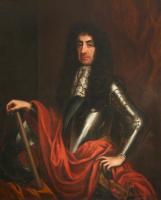
In 1663 John Aubrey [aged 36] visited Avebury with King Charles II [aged 32].


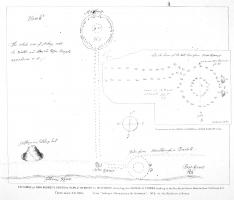
1663. John Aubrey [aged 36]. Ground Plan of Avebury with the West Kennet Avenue, The Sanctuary [Map] and Silbury Hill [Map] from Monumenta Brittannica.
Wiltshire Archaeological Magazine 1857 V4 Pages 307-363. "1663. King Charles II [aged 32] discoursing one morning with my Lord Brownker [aged 43] and Dr. Charleton1 concerning Stoneheng, they told his Majestie, what they had heard me say, concerning Aubury, se. that it did as much exceed Stoneheng as a Cathedral does a Parish Church. His Majesty admired that none of our Chorographers had taken notice of it: and commanded Dr. Charlton to bring me to him the next morning. I brought with me a draught of it donne by memorie only: but well enough resembling it, with which his Majesty was pleased: gave me his hand to kisse and commanded me to waite on him at Marleborough when he went to Bath with the Queen (which was about a fortnight after) which I did: and the next day, when the court were on their journie, his Majesty left the Queen and diverted to Aubury, where I shewed him that stupendious Antiquity, with the view whereof, He and his Royal Highness, the Duke of Yorke, were very well pleased. His Majesty commanded me to write a Description of it, and present it to him: and the Duke of Yorke commanded me to give an account of the old Camps, and Barrows on the Plaines.
"As his Majesty departed from Aubury to overtake the Queen, he cast his eie on Silsbury-hill [Map] about a mile off: which they had the curiosity to see, and walkt up to the top of it, with the Duke of Yorke, Dr. Charlton and I attending them. They went to Lacock2 to dinner: and that evening to Bath; all the Gentry and Commonaltie of those parts waiting on them, with great acclamations of joy, &c.
"There have been several books writt by learned men concerning Stoneheng, much differing from one another, some affirming one thing, some another. Now I come in the rear of all by comparative arguments to give a clear evidence that these monuments were pagan temples, which was not made out before; and have also (with humble submission to better judgments) offered a probability, that they were temples of the Druids.
"When a traveller rides along by the ruines of a Monastery, he knows by the manner of building, sc. Chapell, Cloysters, &c., that it was a Convent, but of what order (sc. Benedictine, Dominican, &e.,) it was, he cannot tell by the bare view. So it is cleer that all the monuments, which I have here recounted were Temples. Now my presumption is, That the Druids being the most eminent Priests [or Order of Priests] among the Britaines, 'tis odds, but that these ancient monuments [sc. Aubury, Stonehenge, Kerrig y Druidd &c.] were Temples of the Priests of the most eminent Order, viz., Druids, and it is strongly to be presumed, that Aubury, Stoneheng, &c., are as ancient as these times.
"This inquiry, I must confess, is a gropeing in the dark: but although I have not brought it into a cleer light, yet I can affirm that I have brought it from an utter darkness to a thin mist, and have gonne farther in this essay than any one before me.
"These antiquities are so exceedingly old that no bookes doe reach them, se. that there is no way to retrive them but by comparative antiquitie, which I have writt upon the spott from the monuments themselves,— 'Historia quoque modo scripta, bona est;'3 and though this be writt, as I rode a gallop, yet the novelty of it, and the faithfulness of the delivery, may make some amends for the uncorrectness of the style.
"The first draught was worn out with time and handling, and now, methinks, after many years lying dormant, I come abroad, like the ghost of one of those Druids.
"I beg the reader's pardon for running this preface into a storie, and wish him as much pleasure in reading them, as I met in seeing them. Vale.
John Aubrey [aged 36].
Note 1. William Visc. Brouncker of Earlstoke, was the first President of the Royal Scciety. Dr. Walter Charleton was the King's Physician, and author of a treatise advocating the Danish origin of Stonehenge.
Note 2. Sir John Talbot's.
Note 3. History is also just written, it is good.

July 1663. John Aubrey [aged 37]. Ground Plan of Avebury.
In 1664 John Aubrey [aged 37] visited Stanton Drew Great Circle.
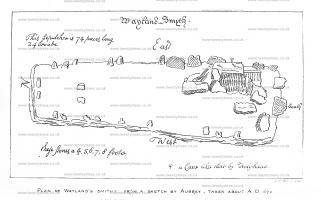
1670. John Aubrey [aged 43]. Plan of Wayland's Smithy Long Barrow [Map].

1687. Drawing of the The Devil's Arrow's [Map] by John Aubrey [aged 60].
On 7th June 1697 John Aubrey [aged 71] died.
The History and Antiquities of Surrey by John Aubrey. First published 1718-1719.
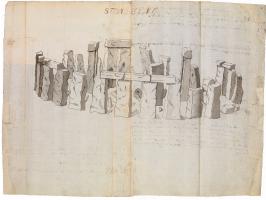
Around 1840. John Aubrey, "Monumenta Britannica". Stonehenge.
The Natural History Of Wiltshire by John Aubrey. The Natural History Of Wiltshire by John Aubrey.