

Newark on Trent, Nottinghamshire is in Nottinghamshire.
See: Carlton Hall, Newark on Trent, Elston Newark on Trent, Nottinghamshire, Flint's Dockyard, Newark, Newark Castle, Nottinghamshire [Map], Newark-on-Trent Cemetery, White Hart Inn, Newark [Map].
Fosse Way 5f Leicester to Lincoln. Leaving Ratae Corieltavorum [Map] aka Leicester the Fosse way continues north-west through Thurmaston, Leicestershire [Map], past Syston [Map], where it makes a slight change in direction, through Six Hills, Leicestershire [Map] where Roman road (RM58) forks off north east to Grantham [Map]. Then passing Vernementum [Map] aka Willoughby-on-the-Wolds the Fosse Way make another minor change in alignment at Cotgrave [Map] before continuing through Margidunum, Nottinghamshire [Map], Ad Pontem [Map] aka East Stoke. Ad Pontem refers to it being close to the River Trent. The road continues through Newark on Trent, Nottinghamshire [Map] then Crococalana Roman Settlement [Map] near present day Brough. At Bracebridge [Map] the Fosse Way meets Ermine Street 2 before continuing into Lindum Colonia [Map] aka Lincoln.
In December 1542 Laurence Oliphant 3rd Lord Oliphant reached at Newark on Trent, Nottinghamshire [Map].
Around 1563 Jane Sacheverell was born to Henry Sacheverell [aged 16] and Jane Ireton [aged 23] at Newark on Trent, Nottinghamshire [Map]. Adjusted frmm 1554 to 1563 to be consistent with father's birth in 1547. She married Thomas Hutchinson and had issue.
On 2nd July 1643 Charles Cavendish [aged 23] received the Queen and escorted her to Oxford taking Burton-on-Trent on the way at Newark on Trent, Nottinghamshire [Map].
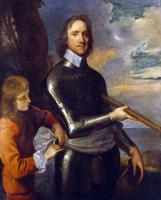
On 28th July 1643 the Parliamentary arms commanded by Oliver Cromwell [aged 44] and the Royalist army commanded by Charles Cavendish [aged 23] fought at the Battle of Gainsborough at North Scarle.
Charles Cavendish was killed by James Berry. He was buried at Newark on Trent, Nottinghamshire [Map].
On 4th August 1643 the Royalist Newdigate Poyntz [aged 34] died probably from wounds received at the battle.
John Evelyn's Diary. 14th August 1654. Went by Newark-on-Trent [Map], a brave town and garrison. Next, by Wharton House, belonging to the Lord Chaworth, a handsome seat; then by Home, a noble place belonging to the Marquis of Dorchester [aged 48], and passed the famous River Trent, which divides the South from the North of England; and so lay that night at Nottingham [Map].
Samuel Pepys' Diary. 4th February 1665. He told us another odd passage: how the King [aged 34] having newly put out Prince Rupert [aged 45] of his generallshipp, upon some miscarriage at Bristoll, and Sir Richard Willis1 of his governorship of Newarke [Map], at the entreaty of the gentry of the County, and put in my Lord Bellasses [aged 50], the great officers of the King's army mutinyed, and come in that manner with swords drawn, into the market-place of the towne where the King was; which the King hearing, says, "I must to horse". And there himself personally, when every body expected they should have been opposed, the King come, and cried to the head of the mutineers, which was Prince Rupert, "Nephew, I command you to be gone". So the Prince, in all his fury and discontent, withdrew, and his company scattered, which they say was the greatest piece of mutiny in the world.
Note 1. Sir Richard Willis, the betrayer of the Royalists, was one of the "Sealed Knot". When the Restoration had become a certainty, he wrote to Clarendon imploring him to intercede for him with the King (see Lister's "Life of Clarendon", vol. iii., p. 87).


Samuel Pepys' Diary. 4th February 1665. At noon being invited, I to the Sun behind the 'Change [Map], to dinner to my Lord Bellasses [aged 50], where a great deal of discourse with him, and some good, among others at table he told us a very handsome passage of the King's sending him his message about holding out the town of Newarke [Map], of which he was then governor for the King [aged 34]. This message he sent in a sluggbullet, being writ in cypher, and wrapped up in lead and swallowed. So the messenger come to my Lord and told him he had a message from the King, but it was yet in his belly; so they did give him some physique, and out it come. This was a month before the King's flying to the Scotts; and therein he told him that at such a day, being the 3d or 6th of May, he should hear of his being come to the Scotts, being assured by the King of France [aged 26] that in coming to them he should be used with all the liberty, honour, and safety, that could be desired. And at the just day he did come to the Scotts.
In 1679 Robert Leke 3rd Earl Scarsdale [aged 24] was elected MP Newark.

In 1841 John Manners [aged 22] was elected MP Newark which seat he held until 1847.

The True Chronicles of Jean le Bel Volume 2 Chapters 61-109 1342-1361
The Chronicle of Jean le Bel, Volume 2 continues one of the most important fourteenth-century accounts of the early Hundred Years’ War. Written by the Liège chronicler Jean le Bel, this vivid narrative follows the fortunes of Edward III, Jean II of France, the Black Prince, the great nobles of France and England, and the soldiers, captains and companies who shaped the conflict. This volume covers some of the most dramatic events of the period, including the battles of Crécy and Poitiers, the siege and capture of Calais, the captivity of King John, the rise of the Jacquerie, the turmoil in Paris under Étienne Marcel and Charles of Navarre, the devastation caused by the free companies, Edward III’s great campaign of 1359–1360, and the negotiations leading to the Treaty of Brétigny. Jean le Bel’s chronicle is especially valuable for its lively detail, its interest in chivalry, warfare, politics and reputation, and its influence on later chroniclers, most famously Froissart. This English translation presents the text in clear, readable British English while preserving the force and character of the original narrative. The translation includes extensive notes to help the reader better understand Jean le Bel's text. Volume 2 also includes translated appendices drawn from royal and administrative records, many from the English Record Office, which illuminate Edward III’s campaigns in Brittany, the siege and occupation of Calais, naval preparations, military finance, appointments, safe conducts and related affairs.
Available at Amazon in eBook and Paperback format.
In 1857 Henry Pelham Alexander Pelham-Clinton 6th Duke Newcastle-under-Lyne [aged 22] was elected MP Newark.
The River Trent rises on Biddulph Moor, Staffordshire [Map] and flows, in a great horseshoe through, or near, Stoke-on-Trent, Staffordshire [Map], Stone, Staffordshire [Map], Essex Bridge [Map], Bishton Hall, Staffordshire [Map], Colwich, Staffordshire [Map] passing St Michael and All Angels Church, Colwich [Map], Rugeley, Staffordshire [Map], Kings Bromley, Staffordshire [Map], Alrewas, Staffordshire [Map], Burton-upon-Trent, Staffordshire [Map], Newton Solney, Derbyshire [Map], Repton, Derbyshire [Map], under Swarkestone Bridge, Derbyshire [Map], Sawley, Derbyshire [Map], Nottingham, Nottinghamshire [Map], Holme Pierrepoint, Nottinghamshire [Map], Stoke Ferry, Shelford [Map], under Gunthorpe Bridge, Nottinghamshire [Map], past Gunthorpe Lock [Map], Hoveringham, Nottingham [Map], Newark on Trent, Nottinghamshire [Map], Knaith [Map], Dunham Bridge [Map], Sutton on Trent, Nottinghamshire [Map], the Isle of Axholme [Map] and Gainsborough [Map] before joining the Humber Estuary at Trent Falls [Map].
On 12th May 1816 Edmund Beckett 1st Baron Grimthorpe was born to Edmund Beckett aka Denison 4th Baronet [aged 29] and Maria Beverley Lady Beckett [aged 21] at Carlton Hall, Newark on Trent. He married 7th October 1845 Fanny Catherine Lonsdale Baroness Beckett, daughter of Bishop John Lonsdale and Sophia Bolland.
In 1724 Robert Waring Darwin was born to Robert Darwin of Elston [aged 41] and Elizabeth Hill [aged 22] in Elston Hall, Newark on Trent.

On 12th December 1731 Erasmus Darwin was born to Robert Darwin of Elston [aged 49] and Elizabeth Hill [aged 29] in Elston Hall, Newark on Trent. He married 1757 Mary aka Polly Howard and had issue.

Around 1850. William Harold Cubley [aged 33]. "Flint's Dockyard, Newark".
On 10th August 1896 William Harold Cubley [aged 79] died at Bryndu, Llanberis [Map] whilst on a painting trip in Wales. He was buried at Newark-on-Trent Cemetery.
White Hart Inn, Newark [Map]. Dated by dendrochronology as follows: rear (south) wing around 1312. The main front dates from the late 15th century; a crown post roof of the south range.

Collectanea by John Leland [1502-1552]. The Xth Day of the fayd Monneth [10th July 1503], the sayd Quene [aged 13] departed from Grauntham, hyr Company in fayr Order, and the sayd Alderman, and wyth hym the Bourgeses and Habitants, conveyed hyr by the Space of 3 Mylles, and then tooke ther Lycence.
A Mille from Grauntham was semled the Compagny of Sheryf of the Countie of Lincoln, well drest, all on Horsebak to the Nomber of xxx Horsys, the wich wer presented by the fayd Sir Robert Dymock to the sayd Quene, for to do hyr Service, and conveyde hyr to Newerke.
To the wich Place, sche was receyved att thre Mylles from the Towne by the Bally, his Company ther abydynge togeder; also by Mr. William Perpoynt, Scheriff of Nothynhamshyre, having in his Fellowschip Sir John Marcant, Sir John Duneham, Sir William Beron, Knights, and other Gentylmen and Squyers, accompayned of ther Folks well honnestly drest of ther Liverays, and horsed, to the Nomber of two hundreth Horsys, the wych convayd hyr tyll she was owt of the sayd Countiee. And owt of the sayd Towne cam before hyr the College, arayde rychly in Processyon.
Thys don, she entered within the said Towne in fayre Aray, so that yt was a fayr Thyng for to se the People togeder in the Stretts and Windowes of the Housys; and she was lodged at the Hert [Map].