

 Cappuck Roman Fort
 Jedburgh Castle
 Kelso Abbey
 Melrose Abbey
 Trimontium aka Melrose Roman Fort
 Mounthooly, Roxburghshire
 Pennymuir Roman Fort
 St Boswells, Roxburghshire
 Tow Ford, Roxburghshire
 Whitton Edge, Roxburghshire
Roxburghshire is in Scotland.
In 1267 John Grey [aged 42] died at Broxmouth.
From Chew Green Roman Camps [Map] Dere Street crosses the Kale Water at Tow Ford, Roxburghshire [Map] where there is Roman Camp, Pennymuir Roman Fort [Map], Whitton Edge, Roxburghshire [Map], Cappuck Roman Fort [Map], Mounthooly, Roxburghshire [Map] where it crosses the River Teviot. After crossing the River Teviot it reaches St Boswells, Roxburghshire [Map] then Trimontium aka Melrose Roman Fort [Map] where it meets the River Tweed.
On 14th October 1879 Thomas John Clapperton was born to John William Clapperton at Galashiels, Roxburghshire.
On 11th June 1634 Walter Scott 1st Earl Buccleuch was buried at Hawick.
Anglo-Saxon Chronicle. 952. This year the Northumbrians expelled King Anlaf [aged 25], and received Eric the son of Harold. This year also King Edred ordered Archbishop Wulfstan to be brought into prison at Jedburgh; because he was oft bewrayed before the king: and the same year the king ordered a great slaughter to be made in the town of Thetford, Norfolk [Map], in revenge of the abbot, whom they had formerly slain.
On 23rd April 1141 King Malcolm IV of Scotland was born to Henry Dunkeld 3rd Earl Huntingdon 1st Earl of Northumbria [aged 27] and Ada Warenne Countess Huntingdon and Northumbria [aged 21] at Jedburgh.
On 21st January 1264 Alexander Dunkeld Prince Scotland was born to King Alexander III of Scotland [aged 22] and Margaret Queen of Scotland [aged 23] at Jedburgh. He a grandson of King Henry III of England. He married 14th November 1282 his half third cousin once removed Margaret Dampierre Countess Guelders, daughter of Guy Dampierre Count Flanders and Isabelle Luxembourg Countess Flanders.
On 27th February 1545 a Scottish army defeated an English army at the Battle of Ancrum Moor at Jedburgh. The Scots Archibald Douglas 6th Earl Angus [aged 56], John Lindsay 5th Lord Lindsay of the Byres [aged 63] and James Hamilton 2nd Earl Arran [aged 29] fought.
Brian Leyton and Ralph Eure were killed.

1798 to 1799. Thomas Girtin [aged 22]. Jedburgh Abbey.

Before 1802. Thomas Girtin [aged 26]. Jedburgh Abbey.

Anne Boleyn. Her Life as told by Lancelot de Carle's 1536 Letter.
In 1536, two weeks after the execution of Anne Boleyn, her brother George and four others, Lancelot du Carle, wrote an extraordinary letter that described Anne's life, and her trial and execution, to which he was a witness. This book presents a new translation of that letter, with additional material from other contemporary sources such as Letters, Hall's and Wriothesley's Chronicles, the pamphlets of Wynkyn the Worde, the Memorial of George Constantyne, the Portuguese Letter and the Baga de Secrets, all of which are provided in Appendices.
Available at Amazon in eBook and Paperback format.
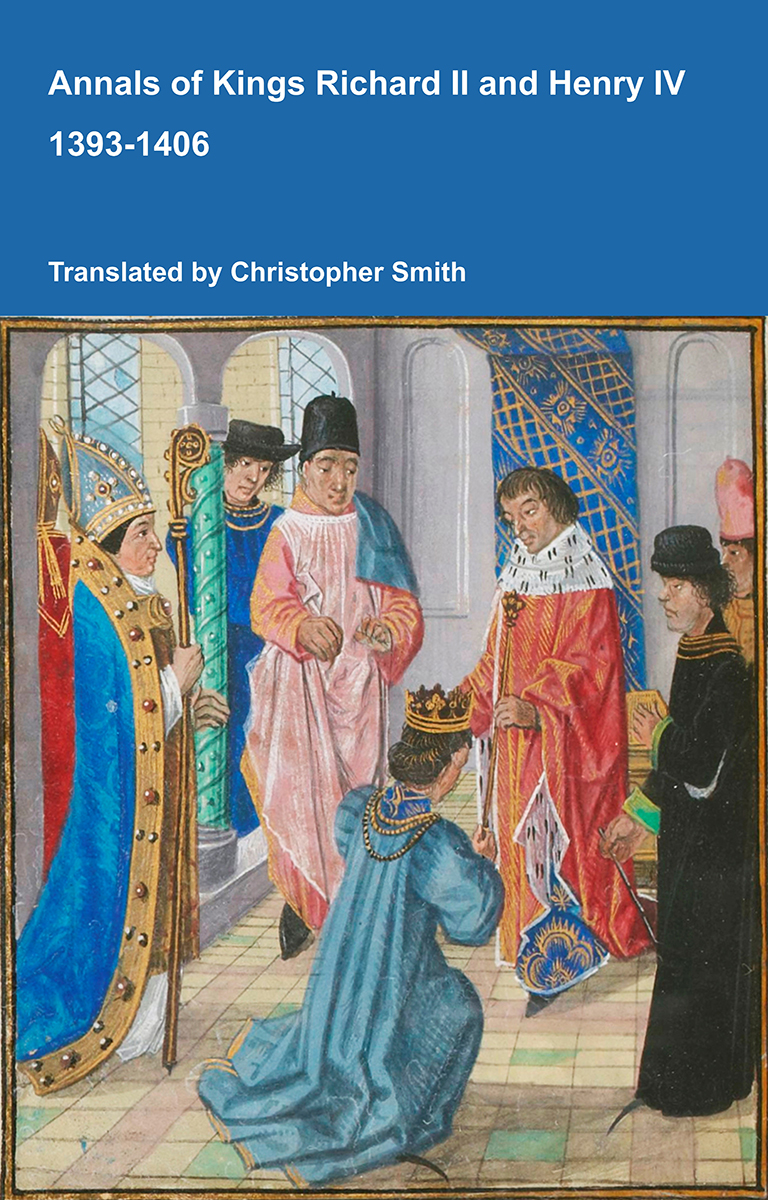 Annals of Kings Richard II and Henry IV. At that time, an excellent knight, Sir Thomas Strother, keeper of the castle of Jedburgh [Map], was deceived by a certain Scottish knight called William English. He had sworn to the said Thomas that, while the truce lasted, he would contrive no harm against him, his men, or his castle. But the treacherous Scot, having found an opportunity one night, when Thomas’s servants were in the town, secretly entered the castle by ladders with a band of one hundred Scots. When Thomas became aware of his arrival, though he had scarcely eight servants with him, he manfully defended the tower in which he and his wife were, and kept the Scots from entering until the servants who had been in the town came and forced the Scots to take flight in shame. Afterwards the said Thomas appealed the said traitor of perjury and falsehood, offering to fight in the aforesaid cause. The Scot, although he greatly feared meeting Thomas, was nevertheless encouraged to fight by his own men. When the appointed day came, the duel was fought, and Thomas, who upheld a just cause, was defeated by the hidden judgement of God, to the delight of the Scots and to the confusion and manifest shame of the English.
Eo tempore, miles egregius, Dominus Thomas Strohir, eustos Castri de Gedworthe, cireumventus est per quemdam militem Scotiæ, dictum "Willelmum Englysch," qui juraverat dicto Thomæ, quod nihil mali machinaretur sibi nec suis, vel suo castello, durante treuga. Sed Scotus perfidus, nocte quadam captata opportunitate, dum famuli Thomæ fuerunt in villa, furtive castellum per scalas ingressus est, cum turba centum Scotorum. Cujus adventu percepto, Thomas, qui vix octo servientes secum habuit, turrim, in qua ipse et uxor sua fuere, defendit viriliter, et Scotos ab ingressu arcuit, donec venirent famuli qui in villa fuerant, eb Scotos fugçam capere cogerent, cum pudore. Posten dictus Thomas appellavit dictum perfidum de perjurio et falsitate, offerens se pugnaturum in causa præmissa. Scotus vero, licet multum formidaret congressum Thomæ, per suos tamen fuit animatus ad pugnam. Adveniente die dato, duello pugnatum est, et Thomas, qui justam fovit causam, victus, occulto Dei judicio, Scotorum tripudio, Anglorum confusioni et opprobrio manifesto.
In 1828 James Forsyth was born to Adam Forsyth and Agnes m Forsyth in Kelso. He married 1. 28th April 1860 Eliza Hastie and had issue 2. 7th November 1868 Annie Hardie and had issue.
In 1839 Annie Hardie was born at Kelso.
On 18th January 1650 Robert Ker 1st Earl Roxburghe [aged 80] died at Floors Castle. His grandson William [aged 27] succeeded 2nd Earl Roxburghe.

1875. William Richardson [aged 60]. "Kelso Abbey [Map]".
1861. Census. Annie Hardie [aged 22]. Daughter. 22. Milliner. 3 Union Street.
Around 1300 William "Flower of Chivalry and Knight Liddesdale" Douglas 1st Earl Atholl was born to James Douglas of Hermiston and Lothian and Joan at Liddlesdale. He married before 1340 Elizabeth Maxwell Countess Atholl and had issue.
Around 1340 Mary Douglas Countess Mar was born to William "Flower of Chivalry and Knight Liddesdale" Douglas 1st Earl Atholl [aged 40] and Elizabeth Maxwell Countess Atholl [aged 5] at Liddlesdale. She married before 1366 Thomas Erskine 13th Earl of Mar.
Bede. 696. How one in the province of the Northumbrians rose from the dead and related many things which he had seen some to be greatly dreaded and some to be desired
At this time a memorable miracle, and like to those of former days, was wrought in Britain; for, to the end that the living might be roused from the death of the soul, a certain man, who had been some time dead, rose again to the life of the body, and related many memorable things that he had seen; some of which I have thought fit here briefly to describe. There was a certain householder in that district of the Northumbrians which is called Incuneningum [Map], who led a godly life, with all his house. This man fell sick, and his sickness daily increasing, he was brought to extremity, and died in the beginning of the night; but at dawn he came to life again, and suddenly sat up, whereat all those that sat about the body weeping fled away in great terror, only his wife, who loved him better, though trembling and greatly afraid, remained with him. And he comforting her, said, "Fear not, for I am now in very deed risen from death whereof I was holden, and permitted again to live among men; nevertheless, hereafter I must not live as I was wont, but after a very different manner." Then rising immediately, he went to the oratory of the little town, and continuing in prayer till day, forthwith divided all his substance into three parts; one whereof he gave to his wife, another to his children, and the third, which he kept himself, he straightway distributed among the poor. Not long after, being set free from the cares of this world, he came to the monastery of Mailros [Map], which is almost enclosed by the winding of the river Tweed, and having received the tonsure, went apart into a place of abode which the abbot had provided, and there he continued till the day of his death, in so great contrition of mind and mortifying of the body, that even if his tongue had been silent, his life would have declared that he had seen many things either to be dreaded or coveted, which were hidden from other men.
Thus he related what he had seen. He that led me had a countenance full of light, and shining raiment, and we went in silence, as it seemed to me, towards the rising of the summer sun. And as we walked we came to a broad and deep valley of infinite length; it lay on our left, and one side of it was exceeding terrible with raging flames, the other no less intolerable for violent hail and cold snows drifting and sweeping through all the place. Both sides were full of the souls of men which seemed to be tossed from one side to the other as it were by a violent storm; for when they could no longer endure the fervent heat, the hapless souls leaped into the midst of the deadly cold; and finding no rest there, they leaped back again to be burnt in the midst of the unquenchable flames. Now whereas an innumerable multitude of misshapen spirits were thus tormented far and near with this interchange of misery, as far as I could see, without any interval of rest, I began to think that peradventure this might be Hell, of whose intolerable torments I had often heard men talk. My guide, who went before me, answered to my thought, saying, 'Think not so, for this is not the Hell you believe it to be.'.
On 28th March 1424 King James I of Scotland [aged 29] signed his release agreement, in which he promised to pay a ransom of 60,000 marks, at Durham, County Durham [Map]. He and his wife Joan Beaufort Queen Consort Scotland [aged 20], married for seven weeks, travelled to Melrose Abbey [Map] arriving on 5th April 1424
80AD. Trimontium aka Melrose Roman Fort [Map] was built in 80 AD and garrisoned for around 100 years. At its largest, the fort was 60,700 square metres and the garrison comprised 1,000 infantry and 500 cavalry. In all, the fort extended to 81,000 square metres of fortified areas and enclosures, grouped around a parade ground. A large settlement developed to support the garrison, and this featured shrines as well as a military amphitheatre. The water supply for the fort and town came from over 200 wells dug around the site.
From Chew Green Roman Camps [Map] Dere Street crosses the Kale Water at Tow Ford, Roxburghshire [Map] where there is Roman Camp, Pennymuir Roman Fort [Map], Whitton Edge, Roxburghshire [Map], Cappuck Roman Fort [Map], Mounthooly, Roxburghshire [Map] where it crosses the River Teviot. After crossing the River Teviot it reaches St Boswells, Roxburghshire [Map] then Trimontium aka Melrose Roman Fort [Map] where it meets the River Tweed.

Adam Murimuth's Continuation and Robert of Avesbury’s 'The Wonderful Deeds of King Edward III'
This volume brings together two of the most important contemporary chronicles for the reign of Edward III and the opening phases of the Hundred Years’ War. Written in Latin by English clerical observers, these texts provide a vivid and authoritative window into the political, diplomatic, and military history of fourteenth-century England and its continental ambitions. Adam Murimuth Continuatio's Chronicarum continues an earlier chronicle into the mid-fourteenth century, offering concise but valuable notices on royal policy, foreign relations, and ecclesiastical affairs. Its annalistic structure makes it especially useful for establishing chronology and tracing the development of events year by year. Complementing it, Robert of Avesbury’s De gestis mirabilibus regis Edwardi tertii is a rich documentary chronicle preserving letters, treaties, and official records alongside narrative passages. It is an indispensable source for understanding Edward III’s claim to the French crown, the conduct of war, and the mechanisms of medieval diplomacy. Together, these works offer scholars, students, and enthusiasts a reliable and unembellished account of a transformative period in English and European history. Essential for anyone interested in medieval chronicles, the Hundred Years’ War, or the reign of Edward III.
Available at Amazon in eBook and Paperback format.
From Chew Green Roman Camps [Map] Dere Street crosses the Kale Water at Tow Ford, Roxburghshire [Map] where there is Roman Camp, Pennymuir Roman Fort [Map], Whitton Edge, Roxburghshire [Map], Cappuck Roman Fort [Map], Mounthooly, Roxburghshire [Map] where it crosses the River Teviot. After crossing the River Teviot it reaches St Boswells, Roxburghshire [Map] then Trimontium aka Melrose Roman Fort [Map] where it meets the River Tweed.
From Chew Green Roman Camps [Map] Dere Street crosses the Kale Water at Tow Ford, Roxburghshire [Map] where there is Roman Camp, Pennymuir Roman Fort [Map], Whitton Edge, Roxburghshire [Map], Cappuck Roman Fort [Map], Mounthooly, Roxburghshire [Map] where it crosses the River Teviot. After crossing the River Teviot it reaches St Boswells, Roxburghshire [Map] then Trimontium aka Melrose Roman Fort [Map] where it meets the River Tweed.
From Chew Green Roman Camps [Map] Dere Street crosses the Kale Water at Tow Ford, Roxburghshire [Map] where there is Roman Camp, Pennymuir Roman Fort [Map], Whitton Edge, Roxburghshire [Map], Cappuck Roman Fort [Map], Mounthooly, Roxburghshire [Map] where it crosses the River Teviot. After crossing the River Teviot it reaches St Boswells, Roxburghshire [Map] then Trimontium aka Melrose Roman Fort [Map] where it meets the River Tweed.
Before 10th November 1818 Catherine Margaret Pringle was born at Stitchel, Roxbughshire.
From Chew Green Roman Camps [Map] Dere Street crosses the Kale Water at Tow Ford, Roxburghshire [Map] where there is Roman Camp, Pennymuir Roman Fort [Map], Whitton Edge, Roxburghshire [Map], Cappuck Roman Fort [Map], Mounthooly, Roxburghshire [Map] where it crosses the River Teviot. After crossing the River Teviot it reaches St Boswells, Roxburghshire [Map] then Trimontium aka Melrose Roman Fort [Map] where it meets the River Tweed.
From Chew Green Roman Camps [Map] Dere Street crosses the Kale Water at Tow Ford, Roxburghshire [Map] where there is Roman Camp, Pennymuir Roman Fort [Map], Whitton Edge, Roxburghshire [Map], Cappuck Roman Fort [Map], Mounthooly, Roxburghshire [Map] where it crosses the River Teviot. After crossing the River Teviot it reaches St Boswells, Roxburghshire [Map] then Trimontium aka Melrose Roman Fort [Map] where it meets the River Tweed.