All About History Books on Amazon

Chronicle of a Bourgeois of Valenciennes

Récits d’un bourgeois de Valenciennes aka The Chronicle of a Bourgeois of Valenciennes is a vivid 14th-century vernacular chronicle written by an anonymous urban chronicler from Valenciennes in the County of Hainaut. It survives in a manuscript that describes local and regional history from about 1253 to 1366, blending chronology, narrative episodes, and eyewitness-style accounts of political, military, and social events in medieval France, Flanders, and the Low Countries. The work begins with a chronological framework of events affecting Valenciennes and its region under rulers such as King Philip VI of France and the shifting allegiances of local nobility. It includes accounts of conflicts, sieges, diplomatic manoeuvres, and the impact of broader struggles like the Hundred Years’ War on urban life in Hainaut. Written from the perspective of a burgher (bourgeois) rather than a monastery or royal court, the chronicle offers a rare lay viewpoint on high politics and warfare, reflecting how merchants, townspeople, and civic institutions experienced the turbulence of the 13th and 14th centuries. Its narrative style combines straightforward reporting of events with moral and civic observations, making it a valuable source for readers interested in medieval urban society, regional politics, and the lived experience of war and governance in pre-modern Europe.

Available at Amazon in eBook and Paperback format.

Calton Barrows, Chatsworth Calver Low Barrows Hob Hurst's House Barrow Rowsley Barrow Cavendish Club, Edensor St Peter's Church, Edensor

Chatsworth, Derbyshire, Derbyshire Dales, North-Central England, British Isles [Map]

Chatsworth, Derbyshire is in Derbyshire Dales.

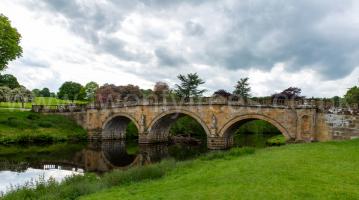
Chatsworth Bridge, Derbyshire Dales, North-Central England, British Isles [Map]

1759. Chatsworth Bridge [Map] spans the River Derwent. 1759-74 by James Paine, substantially completed by 1761. Sandstone ashlar and rock-faced sandstone. Three broad segmental arches with step moulding and moulded hoodmould.

Edensor, Chatsworth, Derbyshire, Derbyshire Dales, North-Central England, British Isles

Around 1785 Edensor, Chatsworth, Derbyshire William Cavendish 6th Duke Devonshire, working with Joseph Paxton relocated Edensor, Chatsworth, Derbyshire, possibly so that it could no longer be seen from Chatsworth House, Derbyshire [Map]. One the east of the original village one house was left in situ being occupied by an elderly retainer Anthony Holmes. It was walled around to protect it against deer and cattle. Six houses were left in-situ although they were modified to include ornamental chimneys. The new village was provided with allotments, a small prison and a mortuary.

Cavendish Club, Edensor, Chatsworth, Derbyshire Dales, North-Central England, British Isles [Map]

1775. The Cavendish Club, Edensor [Map] was originally built as a Coaching Inn in, unusually for the area, red brick, although it was, originally, rendered in cement. It was called the Grape Inn - a bunch of grapes continues to hang in the portico. There were two ranges of coaching stables and accommodation at the rear. The Inn was used by travellers between Buxton, Dovedale and Sheffield.

After 1918 the Cavendish Club, Edensor [Map] was converted into a Village Club for estate staff including a dance hall, stage, dressing rooms, film projector, and two billiard rooms, a library, a games room and a bar for men only. In the buildings at the rear there was a surgery for the Chatsworth District Nurse.