

In October 1855 [his father] Arthur Hughes [aged 23] and [his mother] Tryphena Foord [aged 26] were married. His brother [his uncle] Edward Hughes [aged 27] was married to her older sister [his aunt] Harriet Foord [aged 29]. An example of Marriage of Two Sets of Siblings. They had five children including painter Arthur Foord Hughes.

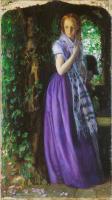
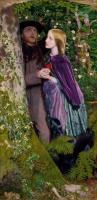
In 1856 Arthur Foord Hughes was born to Arthur Hughes [aged 23] and Tryphena Foord [aged 27] in Pimlico.

1873. Arthur Foord Hughes [aged 17]. "Farmyard Doves".
In 1891 Arthur Foord Hughes [aged 35] and Elizabeth Jones [aged 27] were married. He the son of Arthur Hughes [aged 58] and Tryphena Foord [aged 62].

1899. Arthur Foord Hughes [aged 43]. "The finding of Leander".
In 1901 Arthur Foord Hughes [aged 45] and [his wife] Elizabeth Jones [aged 37] are living at 7 Albert Mansions, Albert Bridge Road, Battersea.

1914. Arthur Foord Hughes [aged 58]. "A lady reading while playing the spinet".
On 22nd December 1915 [his father] Arthur Hughes [aged 83] died in Kew Green, London. He was buried in Richmond Cemetery.
In March 1921 [his mother] Tryphena Foord [aged 92] died.

Before 1934. Arthur Foord Hughes [aged 77]. "A Summer's Day".

Chronicle of a Bourgeois of Valenciennes
Récits d’un bourgeois de Valenciennes aka The Chronicle of a Bourgeois of Valenciennes is a vivid 14th-century vernacular chronicle written by an anonymous urban chronicler from Valenciennes in the County of Hainaut. It survives in a manuscript that describes local and regional history from about 1253 to 1366, blending chronology, narrative episodes, and eyewitness-style accounts of political, military, and social events in medieval France, Flanders, and the Low Countries. The work begins with a chronological framework of events affecting Valenciennes and its region under rulers such as King Philip VI of France and the shifting allegiances of local nobility. It includes accounts of conflicts, sieges, diplomatic manoeuvres, and the impact of broader struggles like the Hundred Years’ War on urban life in Hainaut. Written from the perspective of a burgher (bourgeois) rather than a monastery or royal court, the chronicle offers a rare lay viewpoint on high politics and warfare, reflecting how merchants, townspeople, and civic institutions experienced the turbulence of the 13th and 14th centuries. Its narrative style combines straightforward reporting of events with moral and civic observations, making it a valuable source for readers interested in medieval urban society, regional politics, and the lived experience of war and governance in pre-modern Europe.
Available at Amazon in eBook and Paperback format.

Before 1934. Arthur Foord Hughes [aged 77]. "Below Stairs".

Before 1934. Arthur Foord Hughes [aged 77]. "A farmer in his barn".
On 20th July 1934 Arthur Foord Hughes [aged 78] died.
28th July 1934. Hastings and St Leonards Observer.
Sussex Artist. Death of Mr A Foord Hughes [deceased]
STUDENT OF WINDMILLS. Sussex art circles have suffered a severe loss by the death of Mr. Arthur Foord Hughes, which occurred in a Hastings nursing home last Friday, at the age of 77. He had been in failing health for some time. Mr. Hughes's delicate watercolours were well known locally. He painted practically everv windmill in Sussex, and it was one of his sorrows that these picturesque landmarks were fast disappearing from the face of the countryside. Within few weeks of his birth in London October 9th. 1856. he sat as an unconscious model for Dante Gabriel Rossetti, though his career almost came to an untimely end soon afterwards when Ruskin prepared to seat himself on the couch where the infant lay! His father was the painter of important works to seen in the Tate Gallery and collections at Birmingham, Bournemouth and Oxford, and was also the original illustrator of "Tom Brown's School Days," for which young Hughes sat, rather reluctantly it is said, as the model of the boy hero.
ACADEMY DISTINCTION. But although he probably resented these temporary curtailments of liberty, the boy made up his mind at an early age to concentrate art as a career. After leaving King's College School, he pursued his artistic education at Heatherleys, the Slade and finally the Royal Academy, where in he gained the silver medal for the best drawing.
His love of Sussex was deeply rooted and for some years he lived in a delightful cottage at Pett, touring the whole county in search of scenes worthy of his brush. Later on he moved with his wife to home of the late Harry Furniss at High Wickham, overlooking Old Hastings. He published a book on Sussex windmills, containing a wealth of interesting information and copiously illustrated with his charming water-colours. Two of his best pictures were The Finding of Leander,' sold at the New Gallery, and "The Gleaner," hung at the Academy.
Grandfather: Edward Hughes
father: Arthur Hughes
Grandfather: Robert Foord
mother: Tryphena Foord