

See Painters.
On 30th November 1770 John Buckler was born at Calbourne, Isle of Wight.

1798. John Buckler [aged 27]. To the Reverend Samuel Partridge, M.A. Vicar of Boston, Lincolnshire

1801. John Buckler [aged 30]. Winchester Cathedral [Map].
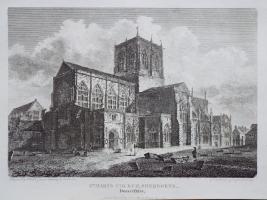
1803. John Buckler [aged 32]. St. Mary's Church [Map], Sherborn, Dorsetshire.

1803. John Buckler [aged 32]. St Augustine's Hospital, Sherborn.

1805. John Buckler [aged 34]. South East View of the Cathedral [Map] and Metropolitan Church of St. Peter, York.

1808. John Buckler [aged 37]. South East View of the Cathedral Church of Winchester [Map].

1809. John Buckler [aged 38]. Fountains Abbey, North Yorkshire [Map].

1809. John Buckler [aged 38]. Burton-upon-Trent Bridge.

Around 1814. John Buckler [aged 43]. Eton College [Map].

1821. John Buckler [aged 50]. Wells Cathedral [Map].

1825. John Buckler [aged 54]. Abbots Kitchen, Glastonbury Abbey.

1850. John Buckler [aged 79]. Ely Cathedral [Map].

Before 1851. John Buckler [aged 80]. Font in St Werburgh's Church, Hanbury [Map] showing a round bowl resting on a cluster of stunted pillars, upon round steps.
On 6th December 1851 John Buckler [aged 81] died
Archaeologia Volume 29 Section III. The task of completing Mr. Stothard's design has been recently adopted by Mr. George Hollis (the son-in-law of Mr. John Buckler, F.S.A.), and his son Mr. Thomas Hollis: and among the objects of their earliest attention have been the royal effigies just named. In the course of making his drawings from the monument of Richard the Second, Mr. Thomas Hollis discovered that the robes of the effigies, and the platform or bed upon which they are placed, are ornamented with various patterns, punctured upon the metal, which had become so entirely concealed by the accumulated dirt of centuries that they were at length forgotten and unknown.